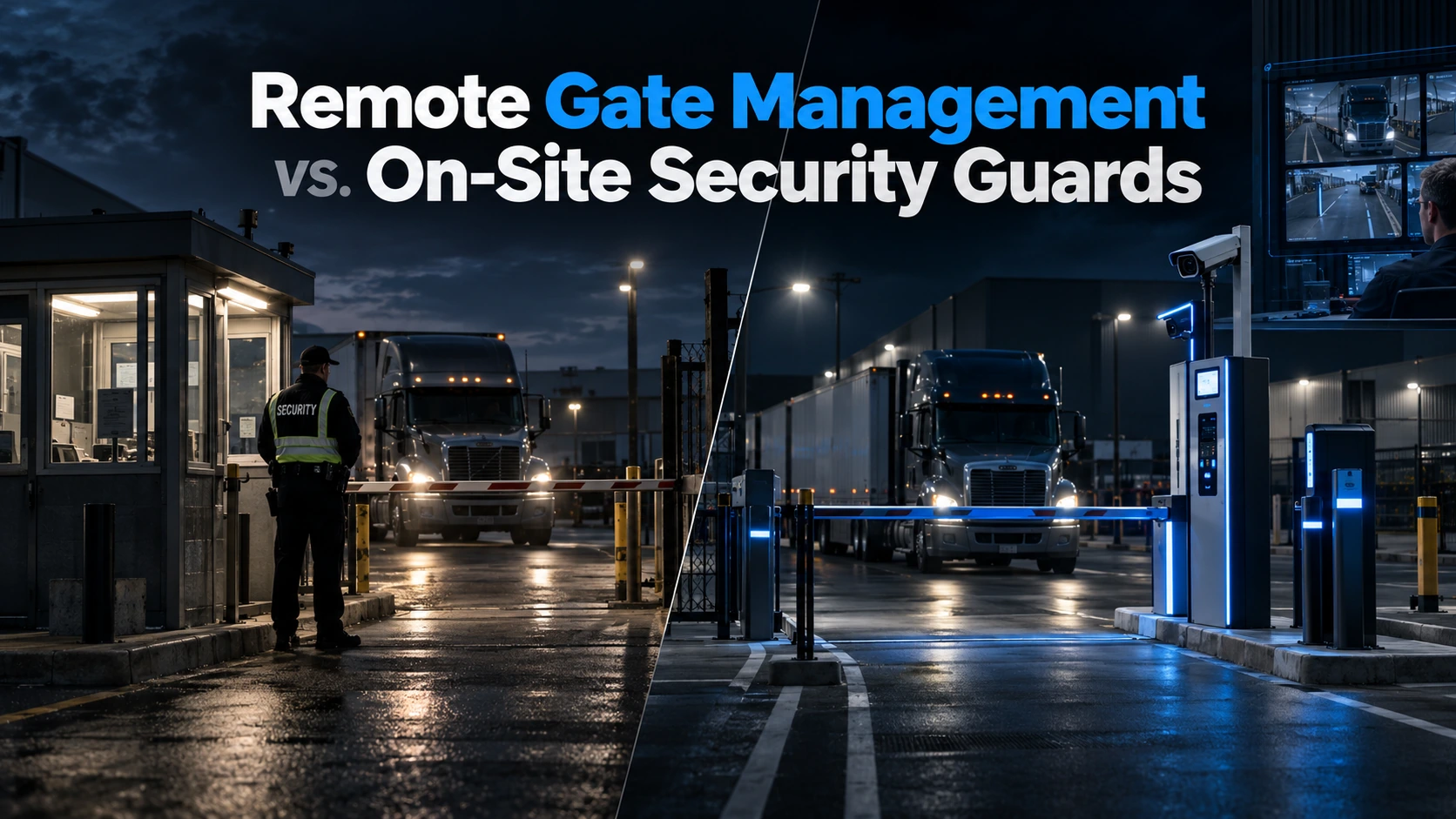
Many industrial facilities still rely on a security guard sitting at the gate to verify drivers, open barriers, answer questions, document arrivals, and handle exceptions.
That model works — but it can also become expensive, inconsistent, and difficult to scale.
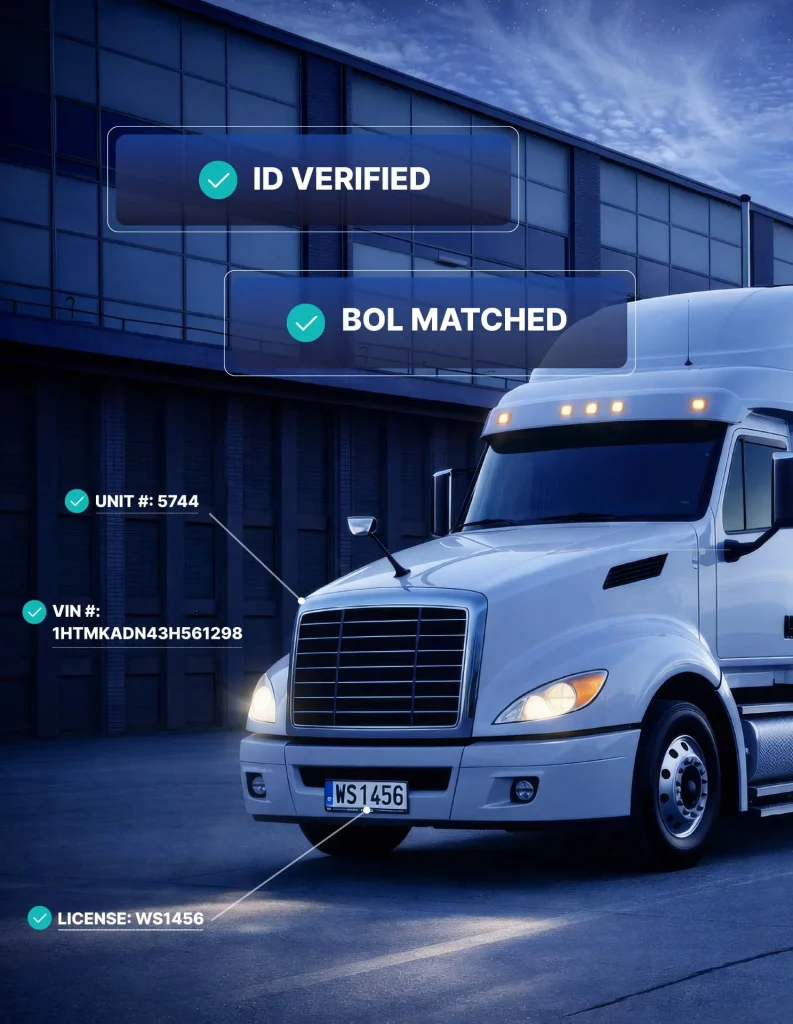
Remote gate management combines automation, cameras, communication tools, digital verification, and trained remote agents so routine transactions can move automatically while people step in when judgment is required.
Quick Answer: Is Remote Gate Management Better Than an On-Site Guard?
For facilities with repeatable truck traffic and clearly defined access procedures, remote gate management can reduce dependence on guard-heavy operations while improving documentation and consistency.
On-site guards may still make sense when a facility requires constant physical presence, hands-on inspections, or tasks that cannot be performed remotely.
The strongest model depends on what actually happens at the gate.
| Area | On-Site Security Guard | Remote Gate Management |
|---|---|---|
| Routine verification | Manual | Can be automated |
| Driver interaction | In person | Remote communication |
| Gate documentation | Often manual | Digital and structured |
| Multiple gates | Usually requires more staff | Can be managed centrally |
| Exceptions | Guard judgment | Escalated to trained remote agent |
| 24/7 coverage | Requires staffing shifts | Centralized remote coverage |
| Reporting | Depends on guard process | Searchable transaction records |
What Does an On-Site Gate Guard Actually Do?
A guard at an industrial gate may perform many different tasks during a single shift.
These can include checking credentials, controlling access, monitoring surveillance systems, communicating with drivers, documenting activity, and responding to unusual situations.
The U.S. Bureau of Labor Statistics describes security guard duties as including access control, monitoring alarms and video surveillance, enforcing site rules, conducting security checks, responding to emergencies, and writing reports.
You can review the Bureau of Labor Statistics overview of security guard duties.
The challenge is that many of these tasks do not necessarily require someone to be physically present at the gate for every transaction.
Where Traditional Guarding Creates Friction
A busy gate can force one person to handle several things at once. A driver needs instructions. Another truck is waiting for verification. A trailer number does not match. The phone rings. A visitor arrives. A manager needs to approve an exception. Meanwhile, another truck is waiting behind the barrier.
The problem is not necessarily the guard. The problem is asking one person to act as the access control system, documentation system, communication system, and exception-management system at the same time.
What Is Remote Gate Management?
Remote gate management separates routine gate processing from the physical guard booth.
Depending on the facility, the system can support:
- Driver verification
- Truck and trailer identification
- License plate capture
- BOL documentation
- Seal checks
- Gate opening and closing
- Remote driver communication
- Exception escalation
- Digital transaction records
Routine activity can move through a defined workflow.
When something does not match, a remote agent can review the event and determine what happens next.
Remote Gate Management Does Not Mean Removing Human Judgment
This distinction is important. Real logistics facilities do not operate perfectly every day.
A substitute driver arrives. A BOL is difficult to read. A trailer changes. A seal number does not match. A truck arrives outside the expected appointment window. A customer requires approval.
A gate system should not blindly approve an unusual transaction simply because the normal workflow failed.
Instead, the exception should be escalated to a trained person who can review the situation, communicate with the driver, follow the facility protocol, and involve site personnel when necessary.
That is where remote gate management becomes different from simple unattended gate automation.
Which Model Costs More?
The answer depends on the facility, but comparing only the hourly cost of a guard with the price of technology can be misleading.
A complete comparison should include:
- Guard wages
- Overtime
- Shift coverage
- Turnover
- Recruitment and training
- Supervision
- Gate delays
- Manual reporting
- Technology costs
- Maintenance
- Remote operator coverage
The better question is not “What does the technology cost?” It is “What does the current gate operation cost us to run?”
Remote Gate Management Can Improve Consistency
One of the largest operational advantages is process consistency.
If the workflow requires a driver check, trailer verification, BOL capture, and seal confirmation, those steps can become part of the gate process instead of relying entirely on individual memory.
This becomes especially valuable across multiple shifts or facilities.
A standardized process reduces the chance that one guard performs a detailed check while another performs only part of it.
Digital Records Change the Investigation Process
Traditional gate operations often leave information across paper logs, spreadsheets, email, camera systems, and handwritten notes.
Remote gate management can create a structured record that connects:
- Driver
- Carrier
- Truck
- Trailer
- Entry and exit time
- Documents
- Seal status
- Access decision
- Exceptions
- Relevant video
That makes it easier to investigate a cargo dispute or access question later.
Read more in our guide to digital gate transaction records.
When Does an On-Site Guard Still Make Sense?
Remote gate management is not automatically the right solution for every location.
An on-site guard may still be appropriate when the position requires frequent physical inspection, direct handling of materials, extensive pedestrian interaction, or another task that cannot be performed remotely.
Some facilities may also use a hybrid approach.
The goal should be to identify which responsibilities truly require physical presence and which can be automated or handled remotely.
How Birdseye Approaches Remote Gate Management
GATECORE helps automate routine driver, truck, trailer, document, seal, and access workflows.
When a transaction falls outside the expected process, trained Birdseye agents can step in and resolve the exception according to facility protocols.
The result is automation where it works and human judgment where it matters.
Which Gate Model Is Right for Your Facility?
Ask these questions:
- How many transactions does the gate process every day?
- How much of the workflow is repetitive?
- How often do exceptions occur?
- How much are we spending on guard coverage?
- Are gate procedures consistent across shifts?
- Can we quickly find transaction records?
- Do unusual situations require human judgment?
If most gate work is repetitive but your facility still needs human backup for complex situations, remote gate management may be worth evaluating.
Frequently Asked Questions
Can remote gate management replace a security guard?
In many truck gate environments, routine access control, verification, communication, and documentation can be handled remotely or automatically. Whether a guard can be fully replaced depends on the physical tasks and protocols required at the site.
What happens when an automated gate cannot verify a driver?
A strong remote gate system should escalate the exception to a trained person rather than automatically approving or permanently blocking the transaction.
Is remote gate management available 24/7?
Remote gate operations can be designed around continuous coverage, depending on the service and facility requirements.
Does remote gate management create digital records?
Yes. Modern systems can create structured records connecting drivers, vehicles, trailers, documents, access decisions, and timestamps.