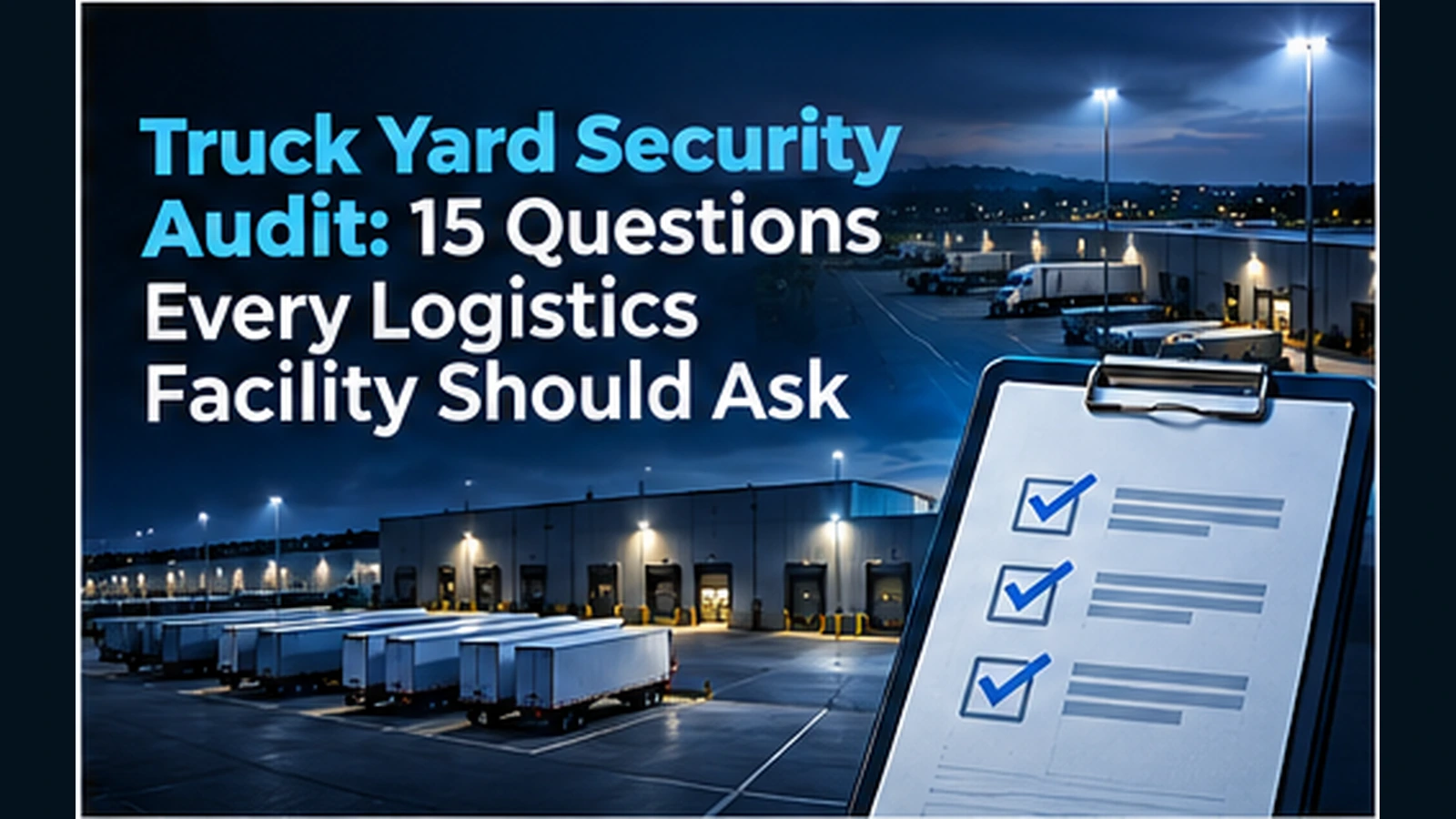
A truck yard security audit should answer more than whether the cameras are online and the fence is standing.
A facility can have cameras, lights, gates, guards, and access control and still have major security gaps.
The real question is whether those controls work together during actual operations.
A strong truck yard security audit tests visibility, verification, access, trailer protection, documentation, after-hours coverage, and response.
This checklist is designed for warehouses, distribution centers, 3PLs, LTL terminals, manufacturing facilities, transportation yards, and other industrial properties with regular truck and trailer traffic.
Quick Answer: What Should a Truck Yard Security Audit Cover?
| Area | Audit Objective |
|---|---|
| Lighting | Identify dark areas and weak nighttime visibility |
| Cameras | Confirm important areas are actually visible |
| Perimeter | Find weak fence lines, blind spots, and secondary access |
| Gate | Verify drivers, trucks, trailers, and authorization |
| Outbound control | Confirm the correct freight is leaving with the correct party |
| Trailer yard | Detect unusual movement and protect staged freight |
| Records | Make events searchable and reconstructable |
| Response | Know who acts when a real threat is detected |
Why Conduct a Truck Yard Security Audit?
Security conditions change.
Vegetation grows.
Trailer parking expands.
A new customer requires a different protocol.
Gate traffic increases.
A camera gets moved.
A new building blocks an old sightline.
A process that worked two years ago may no longer fit the operation.
CISA guidance recommends security assessments to identify threats and vulnerabilities and emphasizes defining perimeters, access-controlled areas, surveillance, and lighting. See CISA physical security guidance.
The audit should therefore test what the site looks like today.
1. Can You Clearly See the Entire Yard After Dark?
Do not answer this question from a daytime walkthrough.
Visit the property at night.
Look at:
- Back corners
- Trailer rows
- Fence lines
- Employee parking
- Secondary gates
- Dock approaches
- Areas between buildings
CISA notes that security lighting can support monitoring and detection and that inadequate lighting can make perimeter breaches harder to detect. Review CISA security lighting guidance.
If a person can stand in an area without being clearly visible, that area deserves attention.
2. Do Your Cameras See What You Think They See?
Open the actual camera views.
Do not rely on a camera map.
Check:
- Night image quality
- Headlight glare
- Trailer obstruction
- Vegetation
- Weather effects
- Camera angle
- Coverage between trailer rows
A camera can be technically online while providing poor security value.
3. Are There Blind Spots Along the Perimeter?
Walk the entire fence line.
Look for:
- Overgrowth
- Damaged fencing
- Objects that can be climbed
- Areas hidden by parked trailers
- Unmonitored secondary gates
- Drainage or utility openings
- Dark corners
Also consider whether someone outside the fence can access or tamper with trailers parked too close to the boundary.
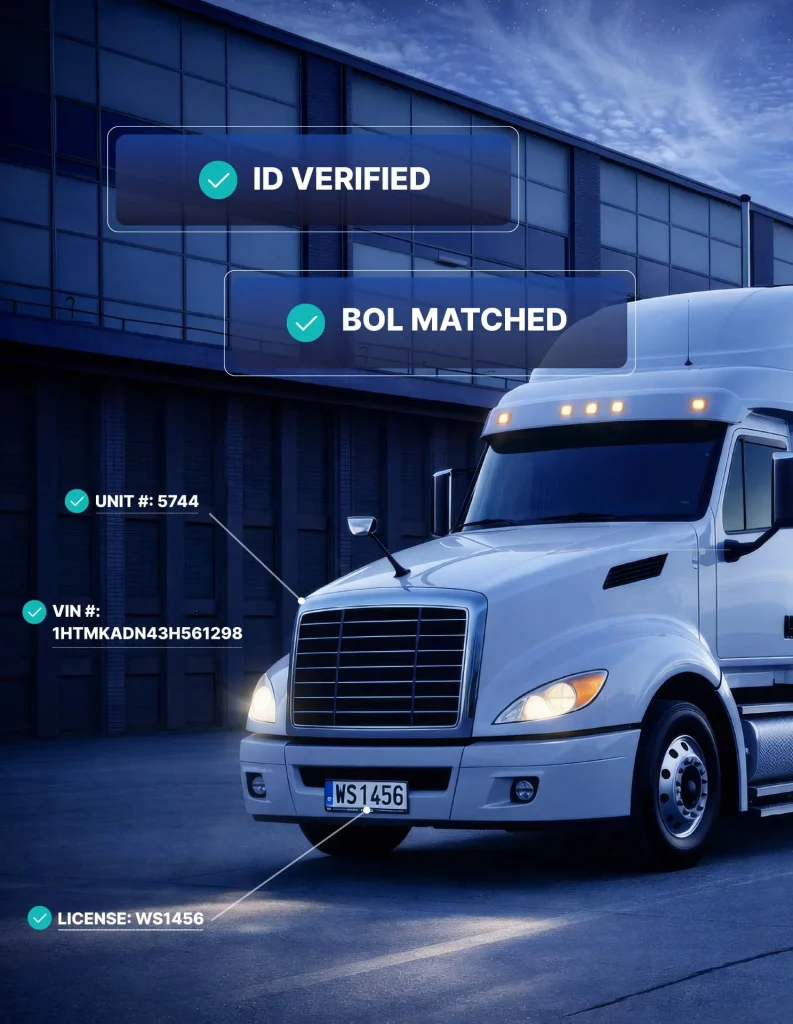
4. Does Every Truck Entry Require Real Verification?
A gate barrier does not automatically create secure access control. Ask what actually happens when a driver arrives.
Does the process verify:
- Driver
- Carrier
- Tractor
- Trailer
- Appointment
- Pickup or delivery reference
The FBI recommends independently verifying shipment requests, carrier information, and pickup details through trusted channels as cargo theft schemes become more sophisticated. Read the FBI 2026 warning.
5. What Happens When the Information Does Not Match?
This may be the most important gate question.
Normal transactions are easy.
Security is tested when:
- The driver changes
- The trailer is different
- The BOL is unclear
- The appointment cannot be found
- The seal is wrong
- The carrier calls with new instructions
Does the facility have a defined exception procedure?
Or does someone improvise?
6. Is Outbound Traffic Verified as Carefully as Inbound Traffic?
Many sites focus heavily on entry while treating exit as routine.
But outbound release is where cargo leaves the facility.
The audit should ask whether the site verifies:
- Outbound driver
- Tractor
- Trailer
- Shipment reference
- Documents
- Seal
- Authorization
The outbound gate may be the final opportunity to stop a fraudulent pickup.
7. Can You Identify Every Loaded Trailer in the Yard?
Ask operations for a list.
Then compare it with what is physically present.
Can the site identify:
- Loaded vs. empty equipment
- High-value loads
- Long-dwell trailers
- Overnight staging
- Expected departure time
Unknown trailers create unknown risk.
8. Can You Detect Unexpected Trailer Movement?
Trailer movement is normal.
Unexpected movement is not.
The site should be able to recognize when a trailer:
- Moves at an unusual time
- Leaves an unexpected zone
- Approaches the gate without a matching transaction
- Is moved by unauthorized equipment
This is especially important in large LTL, 3PL, and distribution yards where movement is constant.
9. Are Long-Dwell and High-Value Trailers Staged Intentionally?
Do not let staging happen only based on available space.
Consider whether higher-risk freight should be placed where it has:
- Better lighting
- More camera coverage
- Greater distance from perimeter access
- Stronger gate control
- More active overnight supervision
CargoNet recommends reducing dwell for loaded equipment where possible and using monitored parking or staging for extended stops. See CargoNet’s security recommendations.
10. Are Shift Changes Creating a Supervision Gap?
Security risk can increase during handoff periods.
Ask:
- Who owns unresolved gate exceptions at shift change?
- Who reviews unusual overnight activity?
- Are important incidents handed off verbally or digitally?
- Can the next shift see what happened before they arrived?
A good security system should not lose context because the people changed.
11. Can You Search Gate Transactions Without Reading Paper Logs?
Pick a random date from two months ago.
Ask the team to find every transaction involving one trailer number.
How long does it take?
If the answer requires searching binders, spreadsheets, and separate video archives, the record system is creating investigation friction.
12. Can Video Be Connected to the Event?
A facility may retain weeks of footage but still struggle to find the relevant minute.
The audit should test whether a gate or yard event can be matched with corresponding footage quickly.
This is especially useful for:
- Cargo disputes
- Damage claims
- Unauthorized access
- Trailer mismatches
- After-hours activity
13. Who Responds When AI or Cameras Detect Something?
Detection is only useful if it leads to a decision.
Ask:
- Who receives the alert?
- Who verifies it?
- Can they communicate with the person on site?
- Can they escalate?
- What is the response time?
- What happens after hours?
The audit should test the response chain, not just the detection technology.
14. Are Security Procedures Consistent Across Shifts and Sites?
If three guards describe three different driver-verification procedures, the facility has a process problem.
Standardization matters because organized theft groups exploit inconsistency.
Multi-site operators should compare:
- Required fields
- Exception types
- Approval rules
- Outbound verification
- Record retention
- Escalation contacts
15. Can Leadership Measure Whether Security Is Improving?
The final question is whether the security program produces usable metrics.
Examples include:
- Gate processing time
- Exception rate
- Denied access
- Trailer mismatches
- Seal exceptions
- After-hours activity
- Manual overrides
- Perimeter alerts
- Verified threats
- Response time
If leadership cannot measure the process, it is difficult to know whether risk is improving.
How to Score Your Truck Yard Security Audit
Use a simple three-level score for each question:
- Green: control exists, is consistent, and is documented.
- Yellow: control exists but depends on people, manual work, or inconsistent execution.
- Red: no reliable control or no clear owner.
Do not focus only on the number of red items.
Some questions carry more risk than others.
A red score for outbound verification or after-hours response may deserve more urgency than a minor camera-angle issue.
Turn the Audit Into an Action Plan
After scoring, organize improvements into:
- Immediate fixes: lighting failures, open gates, broken cameras, missing access procedures.
- Process fixes: verification rules, exception handling, outbound checks, shift handoffs.
- Technology fixes: cameras, automation, digital records, alerting, integrations.
- Management fixes: KPIs, ownership, multi-site standards, periodic review.
A useful audit should end with owners and deadlines, not a PDF that nobody opens again.
Use this audit together with our guides to truck yard security gaps, after-hours truck yard security, and the Complete Guide to Truck Yard Gate Automation.
How Birdseye Supports Truck Yard Security Audits
Birdseye evaluates security across the full facility environment.
GATECORE strengthens gate verification and transaction records.
YARDCORE adds visibility across trailer movement and yard activity.
SAFECORE supports AI-assisted perimeter monitoring with trained human verification and intervention.
The Portal centralizes important events and records for review.
What Evidence Should You Collect During the Audit?
A good audit should produce evidence, not only opinions.
Collect examples such as:
- Nighttime camera screenshots
- Photos of dark or obstructed areas
- Gate transaction samples
- Exception records
- Trailer-location reports
- Response timestamps
- Shift handoff records
- Outbound release records
This gives management something concrete to review and makes it easier to confirm later that the problem was fixed.
Who Should Participate in a Truck Yard Security Audit?
The audit should not belong to security alone.
Include representatives from:
- Security
- Operations
- Transportation
- Yard management
- Facilities
- IT or systems
- Risk or loss prevention
- Site leadership
Each group sees different failure points. Operations may know where trucks queue. Facilities may know which lights fail repeatedly. Security may know where camera coverage is weak. IT may know which systems cannot exchange data.
The strongest audit looks at the site as one operating system rather than a collection of separate departments.
How to Re-Test After Improvements
After corrective action, repeat the specific scenario that exposed the weakness.
If the problem was a dark trailer row, inspect it at night again. If the issue was an outbound trailer mismatch, test the workflow with a controlled mismatch. If the problem was slow alert response, measure the response time again.
Security improvements should be verified in the environment where the original weakness existed.
Executive Questions After the Audit
- Which three risks could create the largest operational or financial loss?
- Which gaps can be fixed immediately?
- Which weaknesses require process change rather than new hardware?
- Which controls depend too heavily on individual memory?
- What should be measured monthly?
- When will the site be re-audited?
Implementation Tip: Audit the Facility in More Than One Operating Condition
A single walkthrough can miss important weaknesses.
If possible, inspect the site during a busy daytime window, after dark, and during a lower-staffed period such as a weekend or shift change.
The same gate, camera, or trailer row may behave very differently under those conditions. Daytime traffic may block camera views. Nighttime headlights may create glare. Weekend staffing may reveal unclear exception ownership.
A truck yard should be audited when it is busy, when it is dark, and when fewer people are present.
One final principle: an audit is not complete when the walkthrough ends. The facility should assign owners, prioritize risk, document corrective actions, and confirm the fix under real operating conditions. Otherwise, the audit becomes a list of observations instead of a security improvement program.
Repeat the review whenever site conditions or operating patterns materially change.
Frequently Asked Questions About Truck Yard Security Audits
How often should a truck yard security audit be performed?
Facilities should review security periodically and after major operational changes, site expansion, incidents, new customer requirements, or changes in yard layout and traffic.
Should a truck yard security audit be performed at night?
At least part of the audit should occur after dark because lighting, glare, camera performance, staffing, and sightlines can be very different from daytime conditions.
What is the biggest truck yard security risk?
There is no single universal risk. Common gaps include weak gate verification, poor outbound controls, trailer blind spots, perimeter weaknesses, incomplete records, and unclear response procedures.
Are cameras enough for a secure truck yard?
No. Cameras should be combined with access control, verification, lighting, perimeter protection, digital records, and a clear response process.
What should happen after a security audit?
Findings should be prioritized by risk, assigned to owners, given deadlines, and reviewed after corrective action to confirm that the issue was actually resolved.
Do Not Wait for an Incident to Discover the Weak Part of Your Yard
A security audit is most valuable when it finds the problem before a criminal, customer, insurer, or investigator does.
Walk the yard. Test the process. Review the records. Challenge the exceptions. Then fix what does not hold up.