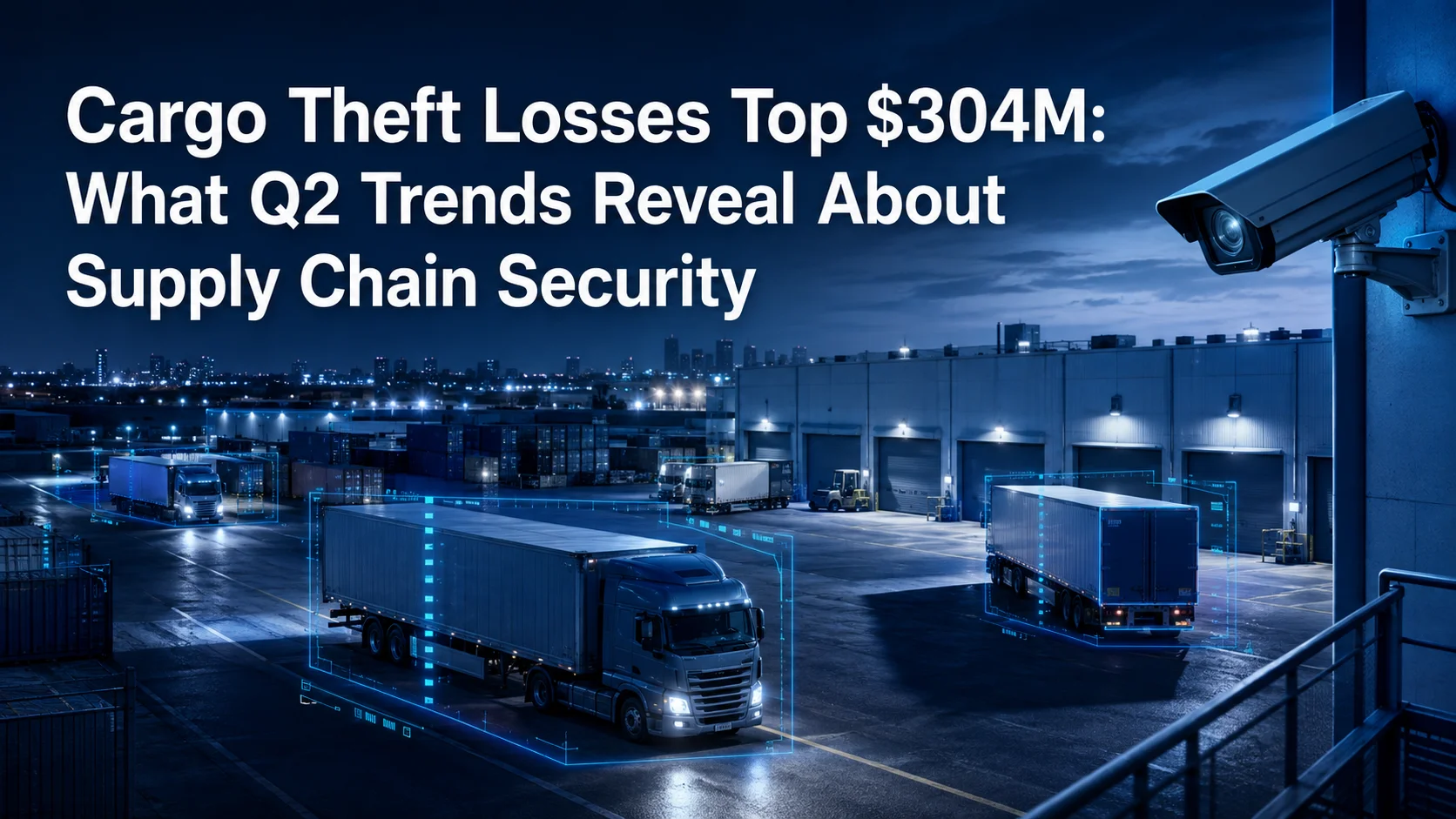
Direct Answer: What Does the Q2 Cargo Theft Report Show?
Cargo theft incidents may have declined in Q2 2026, but the financial risk became much more serious.
According to industry reporting based on CargoNet data, cargo theft incidents across the United States and Canada fell during the quarter, while estimated losses climbed above $304 million. That means fewer incidents still produced far greater financial damage.
For logistics companies, warehouses, manufacturers, distributors, transportation operations, and industrial facilities, the message is clear: Lower theft volume does not always mean lower risk.
Modern cargo theft is becoming more selective, more organized, and more focused on high-value freight. Criminal groups are not only trying to steal more loads. They are trying to identify the right loads, exploit weak verification processes, and take advantage of gaps in facility visibility.
That is why supply chain security needs to go beyond passive cameras, guard logs, and after-the-fact investigations. Facilities need stronger gate verification, yard visibility, perimeter protection, human-verified monitoring, and centralized records.
Quick Summary: What Logistics Leaders Should Know
| Q2 cargo theft trend | Why it matters |
|---|---|
| Fewer incidents overall | Incident count alone does not show the full risk |
| Higher total losses | Organized theft groups are targeting higher-value freight |
| Metals remained heavily targeted | Copper and specialized industrial metals continue to attract theft |
| Enterprise technology remained a major target | High-value tech freight can move like ordinary dry freight |
| Cyber-enabled tactics continued | Cargo theft increasingly overlaps with fraud, identity misuse, and shipment misdirection |
| Documentation and verification matter more | Gate, yard, and shipment records can make or break incident response |
Why Fewer Thefts Can Still Mean Higher Risk
It is easy to assume that fewer thefts means the supply chain is becoming safer. That is not always true.
If theft groups become more selective and target higher-value freight, total losses can rise even when incident volume falls. One stolen load of enterprise technology, specialized metals, or high-value freight can cause more damage than many smaller thefts.
For facility operators, this changes how risk should be evaluated. The question is not only, “How many incidents have we had?”
The better questions are:
- Can we identify high-risk shipments before they move through the facility?
- Can we verify drivers and carriers at the gate?
- Can we document trailers, seals, and Bills of Lading?
- Can we see what happens after a vehicle enters the yard?
- Can we detect suspicious perimeter activity in real time?
- Can we quickly review what happened if a load is questioned?
If the answer is no, then the facility may be exposed even if recent theft volume looks low.
What Types of Cargo Are Being Targeted?
The Q2 report highlighted a shift toward higher-value freight, including metals and enterprise technology. That matters because these categories can create a security mismatch.
A shipment of computer networking equipment, cryptocurrency mining machines, copper, aluminum, nickel, or other industrial metals may be worth a significant amount of money. But in day-to-day operations, those loads may still move through the supply chain like ordinary freight. That creates opportunity for organized cargo theft groups.
If a high-value shipment is treated like a routine load, the facility may not apply the level of verification, visibility, or documentation that the shipment deserves. For logistics teams, this means security procedures should match the value and risk profile of the freight, not just the trailer type.
Cargo Theft Is Becoming More Strategic
Traditional cargo theft often involved physically stealing unattended trailers or loads. That still happens, but modern cargo theft is broader.
Today’s theft schemes may involve false carrier identity, compromised communications, shipment misdirection, fraudulent pickups, altered delivery instructions, and coordinated resale networks.
This is why cargo theft should not be treated as a simple physical security issue.
- It is also a verification problem.
- It is a documentation problem.
- It is a facility visibility problem.
- It is an operational control problem.
A company may have strong transportation tracking but still be vulnerable if the physical facility cannot verify what happens at the gate, in the yard, or around the perimeter.
Why Gate Verification Is Critical
The gate is one of the most important control points in supply chain security.
Every truck that enters or exits creates a security decision. Every driver interaction creates a verification moment. Every trailer movement creates a record that may matter later.
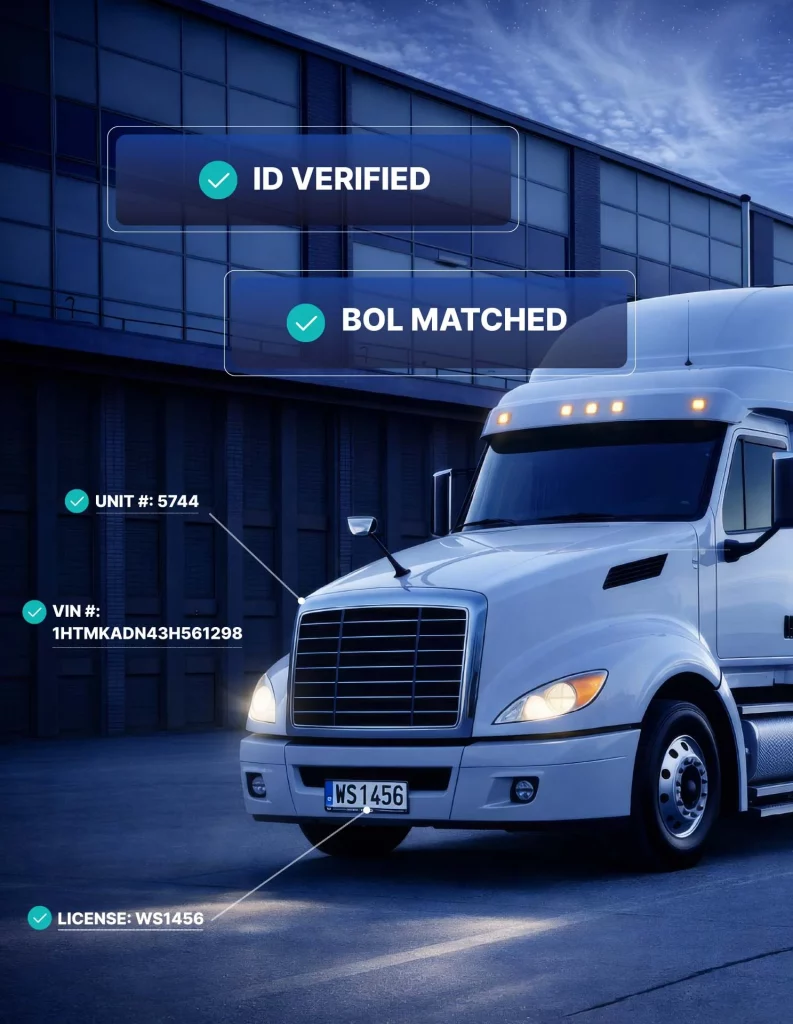
A weak gate process can create several risks. A driver may be cleared without enough verification. A carrier may not be validated properly. A trailer may be logged incorrectly. A seal may not be checked consistently. A Bill of Lading may not be captured in a useful way.
When an incident happens, those small gaps become major problems.
GATECORE helps facilities strengthen gate operations by supporting driver verification, vehicle and trailer logging, license plate capture, Bill of Lading documentation, seal checks, access workflows, and gate transaction records. The goal is not just to open or close a gate. The goal is to create a verified access event that the facility can trust later.
Why Yard Visibility Matters After Access Is Granted
Access control does not end when a truck passes through the gate.
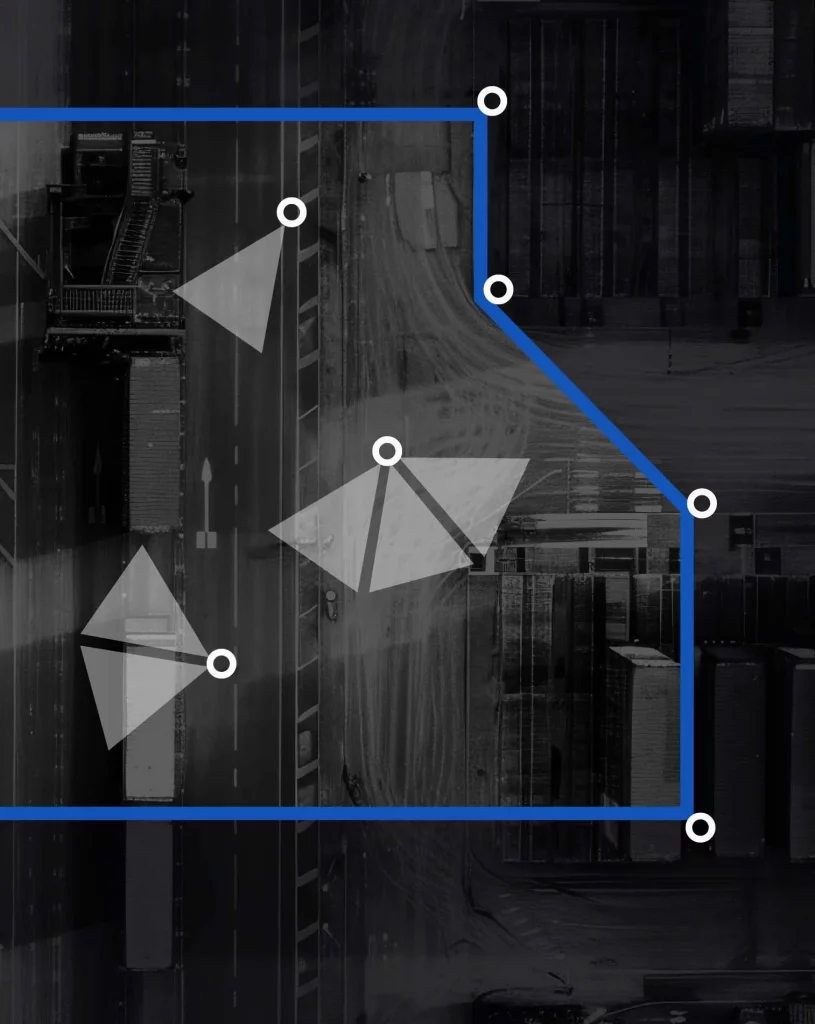
Many cargo theft risks exist inside the yard. Trailers are dropped. Vehicles move between docks. Drivers wait. Equipment is staged. Outdoor storage areas may be exposed. High-value freight may sit unattended for hours or overnight.
If the yard is not visible in real time, a facility may only discover a problem after the load is missing.
YARDCORE helps facilities improve visibility across yard activity. It supports monitoring of movement, activity, exceptions, restricted areas, and incidents across large industrial environments. For supply chain operators, yard visibility is essential because freight risk often continues after the gate event. A verified entry is useful. Verified visibility after entry is stronger.
Why Perimeter Protection Still Matters
Cargo theft is becoming more strategic and cyber-enabled, but physical access still matters.
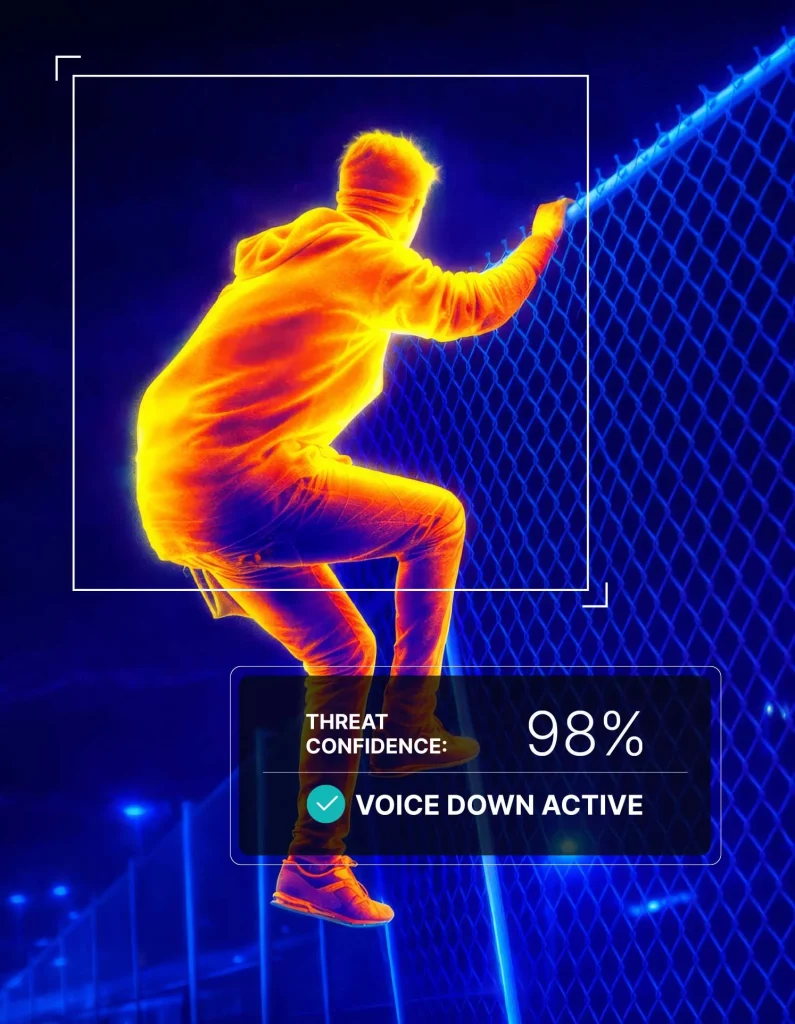
Fence lines, side gates, trailer rows, outdoor storage areas, dock areas, and restricted zones can all create exposure. If suspicious activity happens after hours or away from the main gate, the facility needs to know while the event is still active.
A passive camera may capture the activity. But if no one verifies or responds in real time, the footage may only help after the damage is done.
SAFECORE helps facilities protect perimeters and vulnerable areas with AI-powered detection, human verification, live intervention, escalation procedures, and incident documentation. The strongest perimeter strategy is not just recording suspicious activity. It is detecting it, verifying it, and responding before it becomes a loss.
Why AI and Human Verification Work Better Together
AI can help monitor large facilities by detecting people, vehicles, motion, unusual behavior, and perimeter events faster than manual review alone.
But AI alone is not enough.
Industrial facilities are complex. A truck arriving early may be harmless or suspicious. A person near a fence may be an employee, driver, vendor, or intruder. A trailer movement may be routine or unauthorized.
Human verification adds context.
The best model combines AI-powered detection with trained human review. AI helps identify the signal. Human operators verify what the signal means. Then the facility can respond according to the correct procedure. This is especially important when cargo theft schemes involve both physical activity and operational deception.
Documentation Is Part of Cargo Theft Prevention
Cargo theft prevention is not only about stopping theft in the moment. It is also about proving what happened when questions come up later.
If a shipment is missing, delayed, misdirected, or disputed, teams need clear records.
- Who entered the gate?
- What truck and trailer were involved?
- Was the driver verified?
- Was the Bill of Lading captured?
- Was the seal checked?
- When did the vehicle exit?
- What happened in the yard?
- Was there any perimeter activity?
If the answer requires searching through paper logs, disconnected cameras, emails, phone calls, and memory, the investigation becomes slower and weaker.
The Portal helps centralize gate transactions, yard events, perimeter alerts, incident records, and operational activity. That gives teams a clearer way to review what happened and improve procedures.
What Facilities Should Review After This Report
The Q2 cargo theft numbers should push facility leaders to review their own security and operations process.
The most important questions are:
- Can we verify drivers and carriers before access is granted?
- Can we document vehicles, trailers, BOLs, and seals consistently?
- Can we identify high-risk shipments that need additional controls?
- Can we see yard activity after a truck enters?
- Can we detect suspicious perimeter activity in real time?
- Can we review gate, yard, and perimeter events from one place?
- Can we respond before a situation becomes a loss?
If the answer is no, the facility may have a visibility gap.
How Birdseye Helps Reduce Facility-Level Risk
Birdseye helps industrial and logistics facilities improve visibility where supply chain security becomes physical: gates, yards, and perimeters.
- At the gate, GATECORE helps strengthen verification and documentation.
- In the yard, YARDCORE helps improve visibility into vehicle movement, activity, and exceptions.
- Around the perimeter, SAFECORE helps detect and respond to suspicious activity earlier.
- Through The Portal, teams can review important facility events in one centralized view.
This is not about adding complexity. It is about helping facilities see, verify, respond, and document what matters.
Final Takeaway: Cargo Theft Risk Is Becoming More Targeted
The Q2 cargo theft trend shows that incident counts do not tell the whole story.
Even when fewer thefts are reported, losses can rise when organized groups target higher-value freight. That means supply chain security needs to focus on risk quality, not only risk quantity.
For warehouses, logistics yards, manufacturers, distributors, and transportation operations, the priority should be clear:
- Strengthen the gate.
- Watch the yard.
- Protect the perimeter.
- Verify the event.
- Document what happened.
- Centralize the record.
Cargo theft prevention starts before the load disappears.
FAQs About Cargo Theft and Supply Chain Security
Why did cargo theft losses rise despite fewer incidents?
Losses can rise when theft groups target higher-value freight. Fewer incidents can still produce greater financial damage if the stolen cargo includes metals, enterprise technology, or other high-value shipments.
What cargo is most at risk?
High-value and easily resold freight is often at greater risk. Recent trends point to metals, enterprise computer equipment, networking equipment, technology shipments, and selected food or beverage categories.
Why is gate verification important for cargo theft prevention?
Gate verification helps confirm who is entering, what vehicle and trailer are involved, what documentation was captured, and whether the access event was handled properly. Weak gate verification can make theft, fraud, or shipment disputes harder to detect and investigate.
Are cameras enough to prevent cargo theft?
Cameras are useful, but passive cameras are not enough. Cargo theft prevention requires real-time visibility, human verification, response procedures, and clear documentation across gates, yards, and perimeters.
How does Birdseye support cargo theft prevention?
Birdseye supports cargo theft prevention through GATECORE for gate verification, YARDCORE for yard visibility, SAFECORE for perimeter protection, and The Portal for centralized event review and reporting.