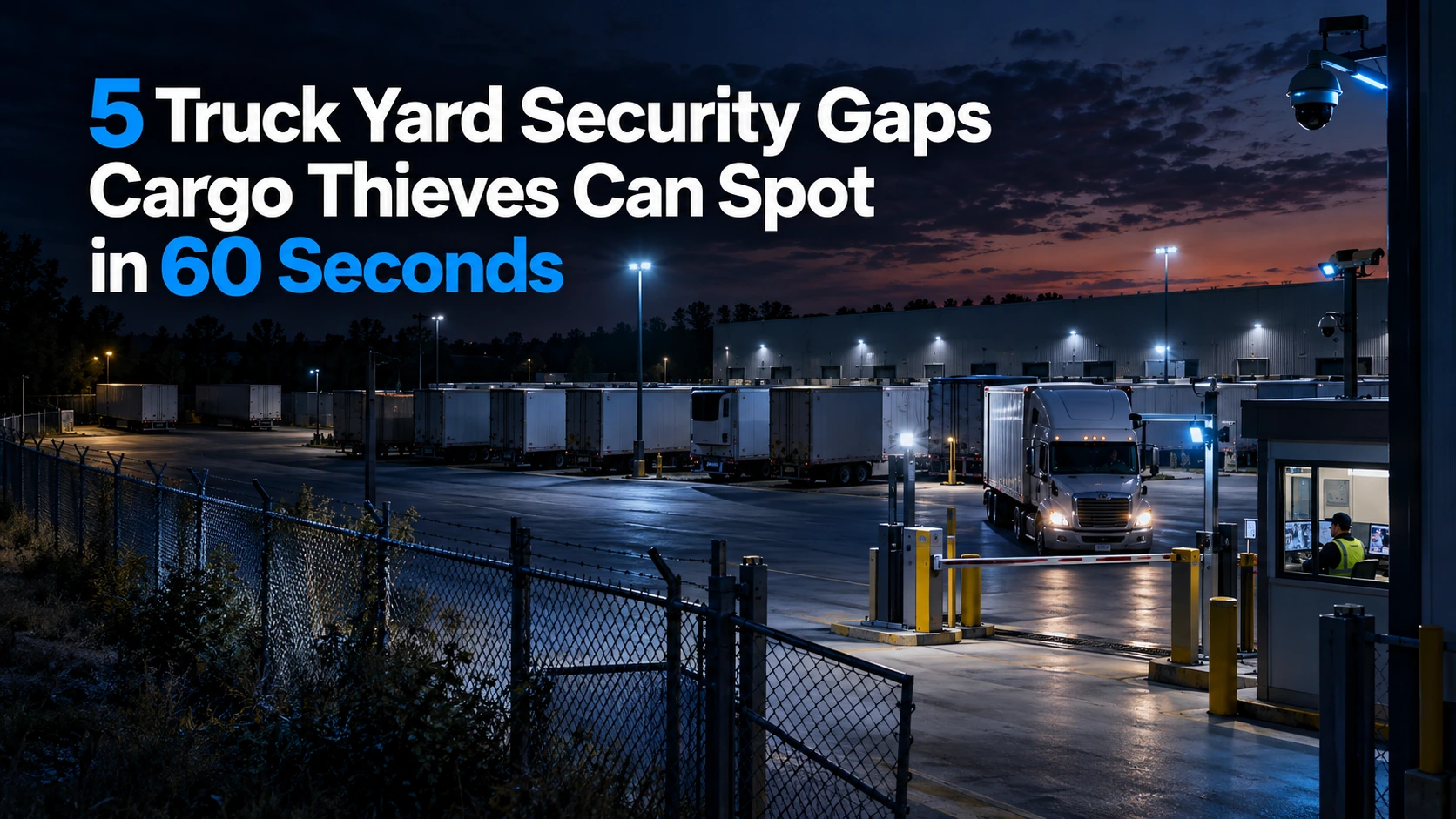
A truck yard does not need an obvious security failure to become vulnerable.
Sometimes the weaknesses are visible almost immediately.
A dark corner. A camera blind spot. An overgrown fence line. A gate operating without proper verification. No reliable record of who entered the property.
Those small gaps can tell someone a lot about how seriously a facility controls its perimeter, gate, and yard.
For warehouses, distribution centers, 3PL facilities, LTL terminals, manufacturing plants, and transportation yards, a good security walkthrough should look at the property the same way an intruder might.
Here are five truck yard security gaps to look for.
Quick Answer: What Are the Most Common Truck Yard Security Gaps?
| Security Gap | What to Check | Why It Matters |
|---|---|---|
| 1. Poor lighting | Back corners, trailer rows, fence lines and loading areas | Dark areas make monitoring and detection harder |
| 2. Weak camera coverage | Gates, perimeter, trailer rows and restricted areas | Blind spots reduce visibility and evidence |
| 3. Blocked sightlines | Vegetation, parked equipment and fence lines | Obstructions can hide activity from cameras and personnel |
| 4. Gates left on manual | Driver, vehicle and shipment verification | Physical access without verification creates unnecessary risk |
| 5. Incomplete entry records | Drivers, trucks, trailers, visitors and access decisions | Poor records make investigations and accountability harder |
1. Dead Lighting in the Back Corners
One of the easiest security problems to identify is poor lighting.
The front entrance may be brightly illuminated while the back of the property, trailer rows, fence lines, unused loading areas, and employee parking areas receive far less attention.
That creates uneven visibility across the facility.
If your security team cannot clearly see an area after dark, cameras and remote monitoring systems may also have a harder time evaluating what is happening there.
CISA physical security guidance notes that security lighting can support perimeter monitoring and detection and may also help deter attempts to breach a facility perimeter.
Facilities can review CISA physical security and resiliency resources for additional guidance.
What Should You Check?
Do not evaluate lighting only during the daytime.
Walk the property after dark.
Look specifically at:
- Back corners of the yard
- Trailer parking rows
- Fence lines
- Loading docks
- Pedestrian access points
- Gate approaches
- Areas between buildings
- Equipment storage zones
Also check whether a light technically works but still leaves a large shadow or blind area.
The goal is not simply to have lights installed.
The goal is to create useful visibility.
2. Camera Coverage Nobody Can See — or Security Teams Cannot Use
A facility may have dozens of security cameras and still have weak coverage.
The important question is not:
How many cameras do we have?
It is:
What can those cameras actually see?
Camera placement should make important areas difficult to approach without being observed.
That includes gates, truck approaches, fence lines, trailer rows, loading docks, restricted zones, and other high-risk areas.
Visible security infrastructure can also communicate that the property is being actively monitored.
Look for Camera Blind Spots
Common problems include:
- Cameras mounted too high or at ineffective angles
- Trailer rows blocking other trailers
- Gate cameras that capture vehicles but not useful identifying details
- Vegetation blocking camera views
- Large areas covered by a single camera
- Nighttime image quality that is significantly worse than daytime footage
- Cameras that record but are not actively monitored
Recording an incident and preventing an incident are not the same thing.
A stronger security model combines cameras with active detection, verification, and response.
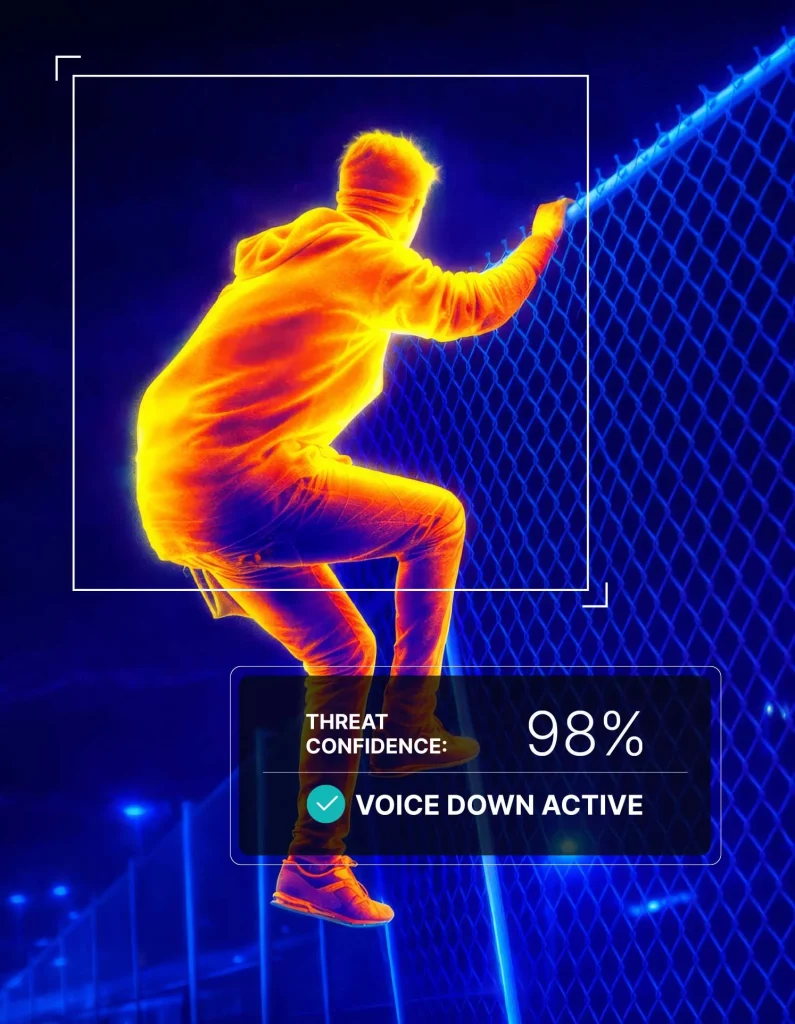
3. Sightlines Lost to Overgrowth
Security cameras cannot monitor what they cannot see.
Neither can guards, remote agents, employees, or patrol teams.
Trees, bushes, weeds, landscaping, storage containers, unused equipment, and other objects can gradually obstruct important lines of sight.
This often happens slowly. When a camera is first installed, the view may be clear. Six months later, vegetation may cover part of the fence line. A year later, the same camera may have a substantial blind spot.
Security coverage needs maintenance just like the physical equipment itself.
Keep the Fence Line Visible
Facilities should periodically review vegetation around:
- Perimeter fencing
- Security cameras
- Gate entrances
- Trailer staging areas
- Emergency exits
- Restricted zones
The exact maintenance schedule will depend on climate and landscaping, but the principle is simple:
Do not allow landscaping to become security cover.
During every security walkthrough, compare what cameras are supposed to see with what they actually see today.
4. A Gate Left on Manual
A gate arm is not access control by itself.
If anyone can approach the property and have the gate opened without proper verification, the physical barrier provides limited protection.
This is especially important at truck facilities.
A driver may know:
- The customer name.
- The carrier name.
- The shipment number.
- The destination.
But that does not automatically mean the driver should be given access.
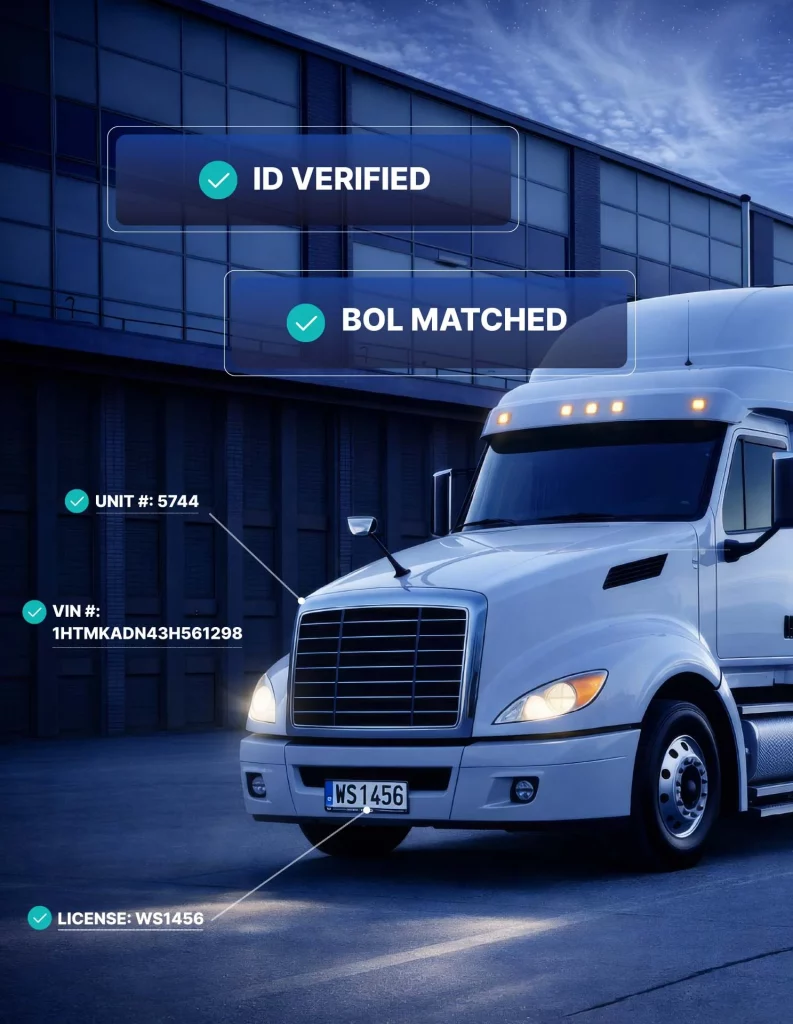
Every gate transaction should connect physical entry with a verification process.
Verify Before the Gate Opens
Depending on the facility, that may mean confirming:
- Driver identity
- Carrier information
- Truck number
- Trailer number
- License plate
- Appointment
- Pickup authorization
- Bill of Lading
- Seal number and condition
The FBI’s cargo theft guidance recommends confirming the identity of drivers at pickup, including driver, truck, and trailer information.
This has become increasingly important as cargo theft extends beyond traditional physical theft.
The FBI identifies strategic cargo theft methods such as fictitious pickups, identity theft, fraudulent carriers, account takeovers, and double brokering.
A truck can therefore arrive at the correct gate with convincing information and still represent the wrong transaction.
Verify the transaction before the barrier lifts.
5. No Reliable Record of Who Came In
The final weakness may not be visible until something goes wrong.
A facility may allow hundreds of drivers, contractors, trucks, trailers, visitors, and vendors onto the property every week.
But when an incident occurs, can the security team quickly answer:
- Who entered?
- When?
- Which truck?
- Which trailer?
- Which driver?
- Why were they there?
- Who approved the entry?
- When did they leave?
- Was there an exception?
- Is there video connected to the event?
If that information requires searching paper logs, spreadsheets, emails, camera archives, and employee memories, the facility does not really have a complete transaction record.
Log Every Entry, Every Time
A digital gate transaction record can connect:
- Driver information
- Carrier
- Truck
- Trailer
- License plate
- Entry timestamp
- Exit timestamp
- Shipment documentation
- Seal checks
- Access decisions
- Exceptions
- Relevant video
The objective is not simply to know that someone entered. It is to understand the complete transaction.
That can significantly improve investigations, customer disputes, cargo theft reviews, claims, and operational accountability.
Why These Five Security Gaps Matter for Cargo Theft Prevention
Cargo theft does not always begin with a sophisticated attack.
Sometimes criminals are looking for the facility that appears easiest to exploit. Poor lighting suggests low nighttime visibility. Weak camera coverage suggests blind spots. Overgrowth creates concealment. A poorly controlled gate creates an access opportunity. Incomplete records reduce accountability after entry.
Together, those weaknesses create something more dangerous than any one problem:
a facility where abnormal activity can blend into normal operations.
The FBI warns that cargo theft can occur at warehouses, freight distribution facilities, trailers, storage locations, truck stops, drop lots, rail yards, and other points throughout the supply chain.
That means effective cargo theft prevention cannot rely on one camera, one gate, or one guard.
Security has to work across the entire property.
A Better Truck Yard Security Walkthrough
The next time you walk your facility, do not only ask whether your equipment is working.
Ask whether your security operation would recognize a problem quickly enough to do something about it.
Check:
- Where the property becomes dark
- Where camera coverage disappears
- Where vegetation or equipment blocks visibility
- Whether every gate entry requires verification
- Whether every transaction creates a usable record
Then ask one additional question:
If something happened here right now, who would know — and what would they do?
That is the difference between passive surveillance and active facility supervision.
How Birdseye Strengthens the Entire Yard
Birdseye connects security across the gate, yard, and perimeter.
GATECORE supports automated driver, truck, trailer, document, seal, and access verification.
YARDCORE improves visibility across trailer yards and operational areas.
SAFECORE combines AI-powered monitoring with trained human verification and live intervention.
The Portal centralizes important events and transaction records for easier review.
AI handles routine detection and verification. Trained Birdseye agents step in when the situation requires judgment.
Truck Yard Security Should Make Weaknesses Hard to Find
A security program should not depend on an intruder overlooking the weak part of your facility.
- The dark corner matters.
- The blocked camera matters.
- The overgrown fence line matters.
- The manual gate matters.
- The missing entry record matters.
- Each one may seem small on its own.
Together, they can determine whether suspicious activity is detected early or discovered after the loss.
Frequently Asked Questions About Truck Yard Security
What are the most important areas to secure in a truck yard?
Facilities should prioritize gates, trailer staging areas, loading docks, perimeter fencing, restricted zones, parking areas, and locations where high-value freight may remain unattended.
How can warehouses reduce truck yard blind spots?
Facilities can improve lighting, review camera placement, trim vegetation, keep fence lines clear, remove visual obstructions, and regularly test camera coverage during both daytime and nighttime conditions.
Why is gate verification important for cargo theft prevention?
Gate verification helps confirm that the driver, carrier, truck, trailer, and shipment information match the expected transaction before physical access is granted.
Are security cameras enough for truck yard security?
No. Cameras provide visibility, but stronger truck yard security combines cameras with access control, AI-assisted detection, human verification, transaction records, and real-time intervention.
Why should facilities keep digital gate records?
Digital gate records make it easier to identify who entered the property, when they entered, which vehicle and trailer were involved, what documentation was presented, and what access decision was made.