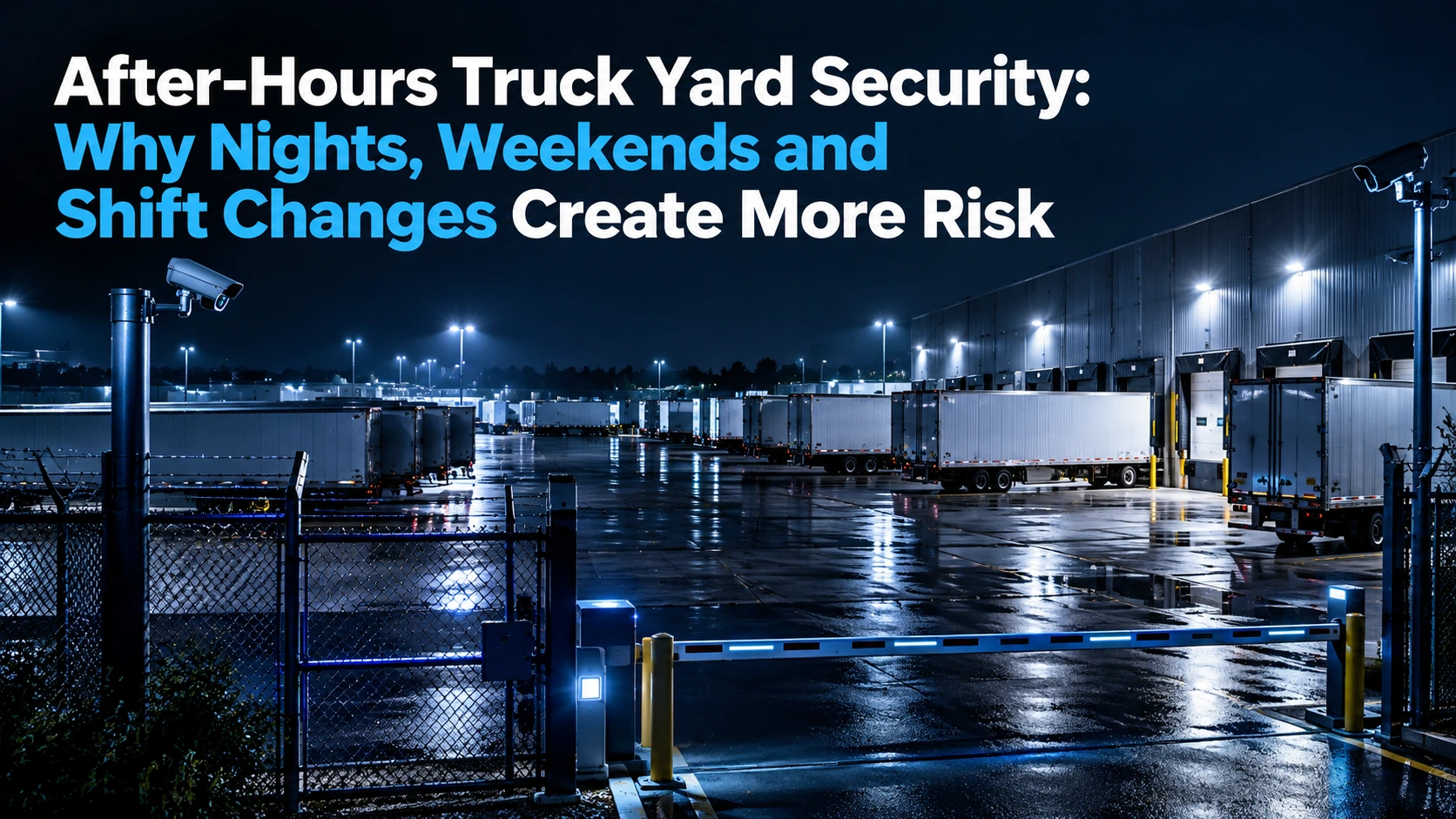
A truck yard does not become less valuable after the day shift goes home.
Loaded trailers still contain freight. Gates still open. Drivers still arrive. Yard tractors still move equipment. Perimeter fences still need to be monitored.
What changes after hours is the amount of normal supervision around those assets.
After-hours truck yard security is about maintaining visibility, verification, and response during nights, weekends, shift changes, holidays, and other periods when fewer people are present.
Those windows matter because abnormal activity can be harder to distinguish and slower to resolve when the facility is operating with reduced staffing.
Quick Answer: Why Are Truck Yards More Vulnerable After Hours?
| After-Hours Condition | Security Impact |
|---|---|
| Fewer employees onsite | Less natural observation and slower escalation |
| Loaded trailers remain staged | High-value assets may sit unattended longer |
| Lower traffic volume | Unauthorized activity may stand out less if nobody is watching |
| Shift changes | Responsibility and context can be lost during handoff |
| After-hours pickups | Verification can be weaker if normal approvers are unavailable |
| Lighting limitations | Blind spots and poor image quality may increase |
After-Hours Risk Is Not Only About Intrusion
It is easy to think of nighttime security only as a perimeter problem.
Someone cuts a fence. Someone enters the yard. Someone attempts to steal a trailer.
Those risks are real, but after-hours exposure can also involve operational decisions.
An unexpected driver arrives.
A trailer moves to an unusual location.
A gate is opened manually.
A pickup is approved by someone who does not normally handle that customer.
A security alert occurs during a shift handoff.
After-hours security has to cover the entire operational chain from perimeter to gate to yard to exit.
Nights Reduce Natural Surveillance
During a busy daytime shift, a large facility may have dozens or hundreds of people moving through it.
Drivers, warehouse employees, supervisors, yard jockeys, maintenance personnel, contractors, and office staff all create a form of natural observation.
At 2:00 AM, that environment can look very different.
There may be fewer people available to notice that a vehicle is in the wrong place or that someone is walking between trailers. This is why active monitoring matters more when normal human presence drops.
Lighting Becomes a Security Control After Dark
Security lighting affects what cameras, remote operators, guards, and employees can see.
CISA physical security guidance notes that appropriate lighting can support perimeter monitoring and detection and may help deter attempts to breach a facility.
After-hours walkthroughs should specifically inspect:
- Back corners of the property
- Fence lines
- Trailer rows
- Dock approaches
- Employee parking
- Secondary gates
- Areas between buildings
- High-value staging locations
A light fixture being installed does not mean the area is effectively illuminated.
Check actual nighttime visibility, shadows, glare, and camera image quality.
Weekends Can Increase Freight Dwell Time
Some facilities move less freight on weekends.
That may mean loaded trailers remain on the property longer.
CargoNet holiday analyses have repeatedly identified reduced staffing and unattended loaded equipment as important risk conditions.
The same principle applies to ordinary weekends.
When freight sits longer, the security plan should account for:
- Where loaded trailers are staged
- Whether the area is monitored
- Whether trailer movement is expected
- Who can authorize a pickup
- How perimeter alerts are verified
- Who responds when something is wrong
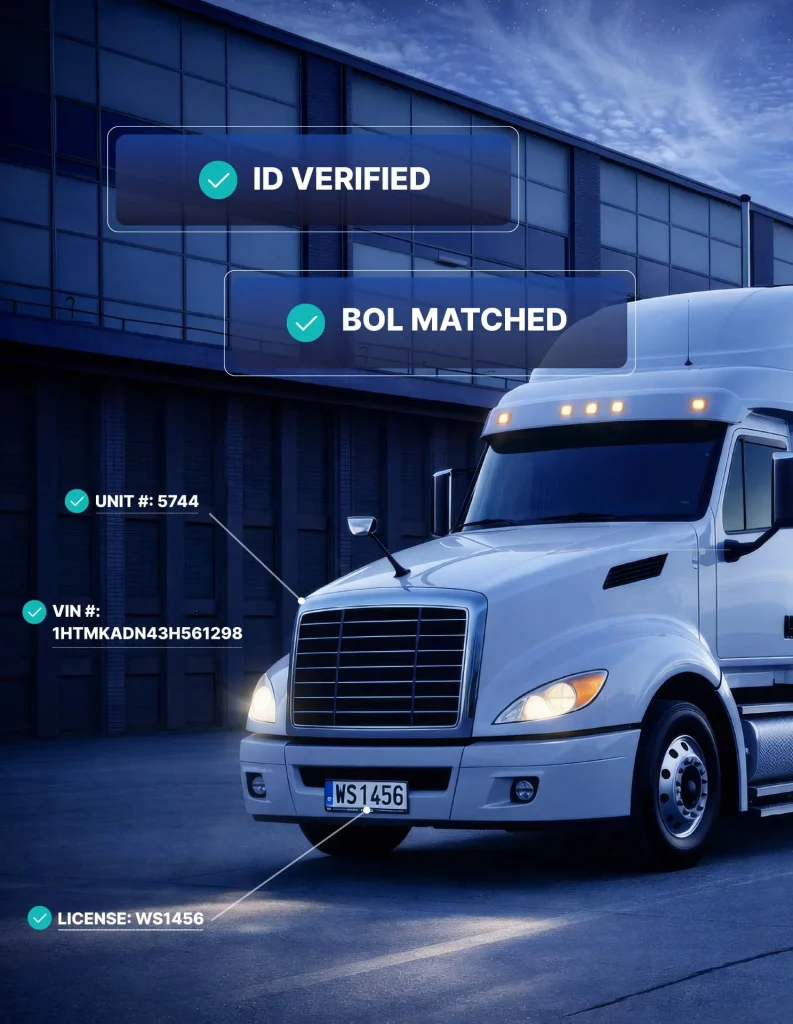
Shift Changes Create a Handoff Problem
Shift change is a unique security window because responsibility moves from one person or team to another.
Important context can disappear during that handoff.
For example:
- A suspicious vehicle was seen earlier
- A trailer is waiting for secondary approval
- A driver is expected to return
- A perimeter camera is temporarily blocked
- A gate is operating under a temporary procedure
If those details exist only in conversation, the incoming team may not know what matters.
Digital event records reduce dependence on memory during shift changes.
After-Hours Pickups Need Strong Verification
An after-hours pickup can be legitimate.
It can also create an opportunity for fraud if normal customer contacts or supervisors are unavailable.
Facilities should decide in advance:
- Which customers allow after-hours pickup
- Which carriers are expected
- What credentials are required
- Who can approve a substitution
- What happens if the appointment is missing
- Whether high-value loads require additional review
Do not let an unusual time become a reason to reduce verification.
The Outbound Gate Is Critical at Night
A stolen trailer leaving through a legitimate gate can look like normal traffic if the transaction is not verified.
Outbound security should connect:
- Driver
- Carrier
- Tractor
- Trailer
- Shipment
- Authorization
- Timestamp
- Exception status
This is especially important when the yard is quiet and fewer people can independently observe the departure.
AI Can Watch More, but Someone Still Needs to Decide
AI-powered monitoring can help identify people, vehicles, motion, loitering, restricted-zone activity, and other events across a large facility.
That scale is useful after hours.
But detection is not the same as resolution.
A person near a fence may be an intruder or a maintenance contractor.
A trailer moving at midnight may be suspicious or scheduled.
A vehicle parked near a dock may be unauthorized or waiting for an assignment.
Human verification provides the context needed to decide whether an AI-detected event should trigger intervention.
Read Why Human Verification Matters in AI Security.
Remote Intervention Can Reduce Response Time
When suspicious activity is verified, speed matters.
Depending on the facility and event, response may include:
- Voice-Down™ communication
- Contacting an onsite employee
- Escalating to management
- Holding a gate transaction
- Contacting law enforcement
- Preserving relevant video and event records
A security system that only records the event may provide evidence later.
An active security operation tries to change what happens while the event is still occurring.
After-Hours Security Requires Better Camera Placement
Cameras should be evaluated based on how the yard operates after dark.
Important views may include:
- Perimeter fence lines
- Trailer rows
- Gate approaches
- Gate exits
- Dock approaches
- High-value zones
- Secondary access points
Also review whether parked trailers or vegetation create blind spots.
A camera that had a clear view when installed can become ineffective as the operating environment changes.
Searchable Records Matter More When Fewer Witnesses Exist
If something happens at 3:00 AM, there may be fewer people who can later explain what occurred.
Digital records can provide that context.
A useful event record may connect:
- Gate transaction
- Driver
- Truck
- Trailer
- Access decision
- Exception
- Video
- Perimeter event
- Operator action
That makes after-hours investigations faster and less dependent on individual memory.
Build an After-Hours Operating Profile
One of the most effective ways to improve overnight security is to define what “normal” actually looks like after hours.
Which gates should be active? Which carriers normally arrive? How many trailers typically move? Which loading docks remain open? Are contractors expected? Which areas should be completely empty?
Without that baseline, a security team can see activity but may not know whether it is unusual.
An after-hours operating profile can include:
- Expected traffic by hour
- Approved after-hours carriers
- Active gates and docks
- Authorized employee areas
- Expected yard tractor routes
- Restricted trailer rows
- Normal contractor windows
The more clearly normal activity is defined, the easier it becomes to identify exceptions.
Measure Response, Not Just Detection
Many security programs measure whether a camera or sensor generated an alert. That is only the first step.
After-hours performance should also measure what happened next.
Useful metrics include:
- Time from detection to verification
- Time from verification to intervention
- Number of false or non-threat events
- Number of after-hours gate exceptions
- Number of denied or held transactions
- Number of unresolved events at shift change
A system that detects an intruder in five seconds but takes twenty minutes to get a human response may not be delivering the protection leadership assumes.
Detection speed matters. Decision speed matters more.
Review the Yard From the Outside In
Security teams usually understand the facility from inside the property. A useful after-hours exercise is to walk or drive the perimeter from the perspective of someone approaching from outside.
Look for dark sections, damaged fencing, places where trailers block camera views, landscaping that creates concealment, and secondary roads that provide easy access to the property boundary.
This simple change in perspective can reveal vulnerabilities that are difficult to notice during normal daytime operations.
After-Hours Security Should Support Operations, Not Fight Them
An overnight security process that constantly blocks legitimate drivers or generates excessive false alarms will eventually be bypassed by the people who need to keep freight moving.
The better approach is to design security around actual nighttime workflows. If certain carriers routinely arrive after midnight, build them into the expected process. If yard tractors operate in specific zones, define those patterns. If maintenance crews use a secondary gate, register that activity.
Good after-hours security creates less friction for normal activity and more friction for activity that does not belong.
This balance is especially important in high-volume operations where delays can create queues, detention, missed dock appointments, and pressure on employees to override controls.
Use Near Misses as Security Data
Not every security weakness results in a theft. A gate opened manually without full verification, a trailer moved without a clear record, or an alert that was noticed late can all be useful near-miss events.
Review these events regularly. They show where procedures, staffing, cameras, lighting, or escalation rules need improvement before a serious incident occurs.
One final test is simple: review the facility at the exact hours when leadership is least likely to be present. Security weaknesses that are invisible during a busy weekday often become obvious after midnight or early on Sunday morning. Use those reviews to update camera placement, lighting, escalation rules, and gate procedures before the next exception tests the system for you.
How Birdseye Supports After-Hours Truck Yard Security
Birdseye helps facilities maintain supervision across gates, yards, and perimeters when local activity slows.
SAFECORE supports AI-powered perimeter monitoring with trained human verification and intervention.
YARDCORE improves visibility across trailer yards and operational areas.
GATECORE supports structured gate verification and digital transactions.
The Portal helps centralize important events for review.
After-Hours Truck Yard Security Checklist
- Walk the yard after dark
- Check lighting and shadows
- Review camera blind spots
- Confirm perimeter coverage
- Identify loaded trailers staying overnight
- Define after-hours pickup rules
- Verify outbound transactions
- Create a shift-handoff process
- Make sure verified threats can trigger intervention
- Document exceptions and operator actions
Frequently Asked Questions
Why are truck yards more vulnerable at night?
Nighttime often brings lower staffing, reduced natural surveillance, longer trailer dwell times, and greater dependence on lighting, cameras, and formal monitoring procedures.
What should be monitored after hours?
Facilities should prioritize gates, perimeter fencing, trailer rows, loading docks, high-value staging areas, secondary access points, and unexpected vehicle or pedestrian activity.
Are weekends higher risk for cargo theft?
Weekends can increase exposure when loaded freight sits longer and fewer employees are present. Risk depends on facility operations, freight value, local conditions, and security controls.
How can AI improve overnight security?
AI can monitor large areas continuously and surface events that match defined criteria. Human verification can then determine whether the event requires intervention.
Why are shift changes a security risk?
Context can be lost when responsibility moves between teams. Structured digital records and clear handoff procedures help preserve information about unresolved events and exceptions.
Your Facility Should Not Become Less Supervised Because the Team Went Home
Nights, weekends, and shift changes are normal operating conditions.
Security should be designed for them.
The goal is continuous visibility and consistent decision-making even when the number of people onsite changes.