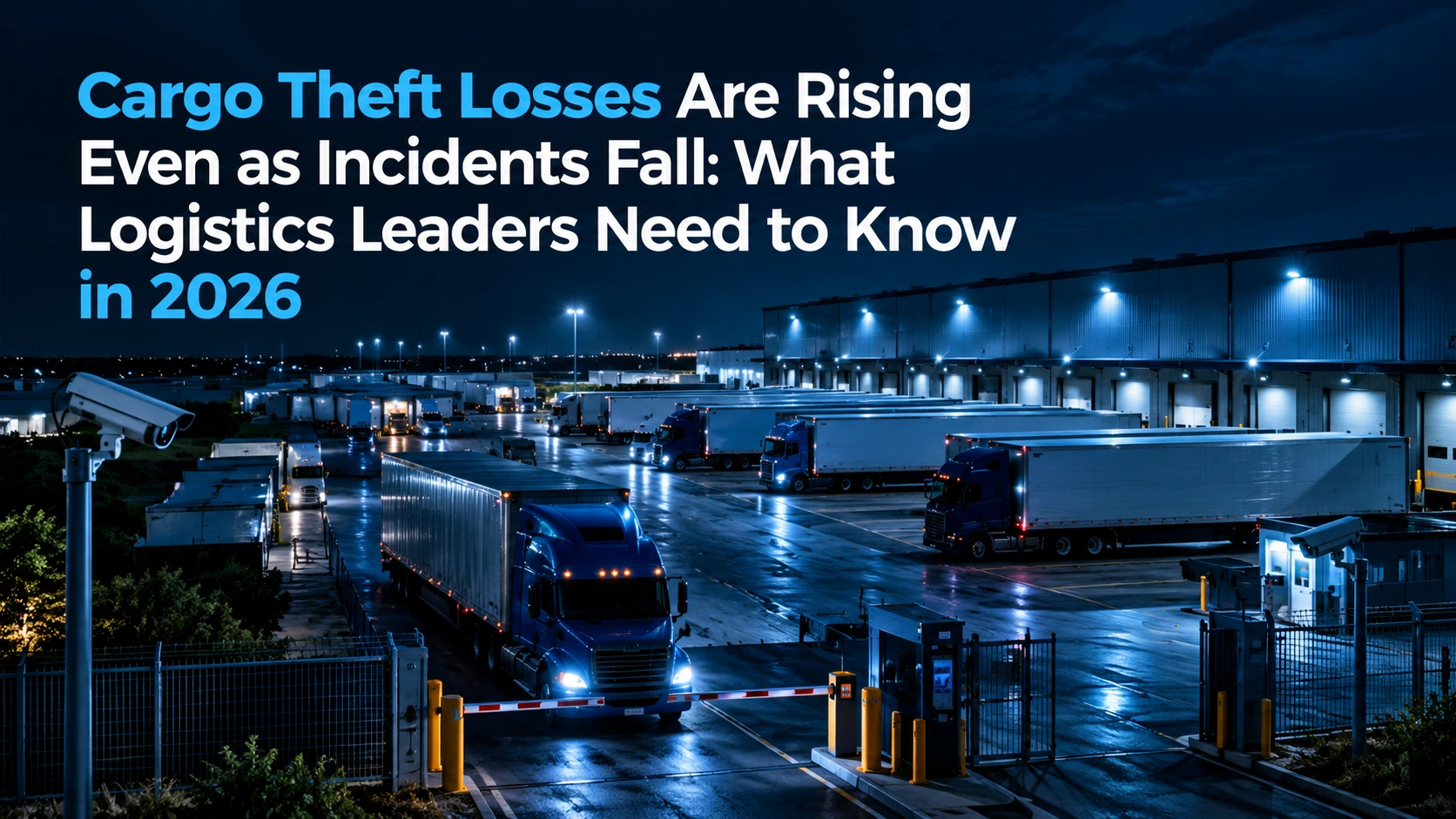
Cargo theft risk cannot be measured by incident count alone.
That is one of the clearest lessons from 2026 cargo theft data. Verisk CargoNet reported 677 incidents in the second quarter of 2026, down 26% from Q2 2025. At the same time, estimated losses rose to $304.6 million, more than double the $135.7 million estimated for the same quarter a year earlier.
For logistics leaders, fewer reported thefts do not necessarily mean a safer operating environment. A smaller number of highly targeted, high-value incidents can create more financial damage than a larger number of lower-value thefts.
That changes how warehouses, distribution centers, 3PLs, LTL terminals, manufacturers, carriers, and industrial yards should think about cargo security in 2026.
Instead of asking only, “How many incidents did we have?” leadership should also ask:
- What is the value of freight exposed at each facility?
- Which loads would create the largest business interruption if stolen?
- How strong is driver and carrier verification?
- How quickly can the facility detect unusual activity?
- What happens when automation reaches an exception?
- Can the team reconstruct a gate or yard event without searching five different systems?
Read the original CargoNet Q2 2026 cargo theft analysis.
Quick Answer: Why Are Cargo Theft Losses Rising When Incidents Are Falling?
The most likely explanation is not that cargo theft is disappearing. It is that criminal groups are becoming more selective, more sophisticated, and more focused on high-value opportunities.
| 2026 Trend | What It Means for Logistics Operations |
|---|---|
| Incident volume declined | Raw incident counts may suggest improvement, but they do not describe financial severity. |
| Estimated losses increased sharply | Individual successful thefts can create much larger losses. |
| High-value goods are targeted | Security controls may need to vary based on cargo value and commodity risk. |
| Identity-based theft remains active | Carrier approval alone is not enough; pickup and gate verification matter. |
| Cyber and physical theft are converging | Digital compromise can lead to physical loss at the gate, yard, dock, or delivery point. |
Incident Count Is Becoming a Weak Security KPI
Many organizations naturally measure security by the number of incidents reported during a month, quarter, or year.
That metric is still useful, but by itself it can create false confidence.
Imagine two facilities.
Facility A experiences six low-value theft attempts totaling $30,000 in losses.
Facility B experiences one successful fraudulent pickup involving a load valued at $800,000.
Facility B has fewer incidents but a dramatically worse financial outcome.
Security performance should therefore be measured by exposure, severity, verification quality, response time, and recoverability—not just event count.
CargoNet’s Q2 data illustrates this directly. Reported events fell, but estimated losses more than doubled because several multimillion-dollar thefts changed the financial picture.
Why High-Value Freight Changes the Security Equation
High-value freight creates an asymmetric risk problem.
One failed verification event can be more expensive than months of security labor.
One trailer carrying enterprise technology components, specialty metals, electronics, or other high-value goods can represent a substantial concentration of risk.
This is why security controls should not always be identical for every transaction.
A facility may choose to apply additional verification to:
- High-value commodities
- Loads above a defined financial threshold
- New or unfamiliar carriers
- After-hours pickups
- Last-minute driver substitutions
- Changed delivery instructions
- Loads with unusual routing changes
- Transactions with documentation mismatches
Risk-based security means applying more scrutiny where the financial and operational consequences are higher.
Strategic Cargo Theft Makes Verification More Important
The FBI distinguishes between straight cargo theft and strategic cargo theft.
Straight cargo theft usually involves physically stealing freight from a truck, trailer, container, yard, parking location, or other storage point.
Strategic cargo theft uses deception. The FBI identifies tactics such as fictitious pickups, identity theft, account takeovers, double brokering, and fraudulent carriers.
You can review the FBI cargo theft guidance.
These schemes matter because a criminal may not need to break through a fence.
They may attempt to arrive looking legitimate.
The carrier name may be correct. The shipment reference may be real. The paperwork may appear convincing. The contact information may have been compromised earlier in the process.
The physical gate can become the last point where a fraudulent transaction can still be stopped before freight leaves the facility.
Cyber Compromise Can Become Physical Cargo Loss
The transportation sector increasingly faces a blended threat.
The FBI warned in 2026 that cyber-enabled cargo theft schemes are using phishing, spoofed websites, compromised business accounts, fraudulent load postings, and impersonation of legitimate brokers and carriers to redirect or steal shipments.
NMFTA’s 2026 Transportation Cybersecurity Trends work makes a similar point: digital compromise is increasingly connected to physical freight theft, with identity fraud, account hijacking, and carrier impersonation becoming practical tools for organized cargo crime.
See NMFTA’s 2026 transportation cybersecurity trends overview.
This creates a critical operational question:
If a fraudulent actor has access to legitimate-looking digital information, what independent checks exist at the physical facility?
The Gate Should Verify More Than a Name
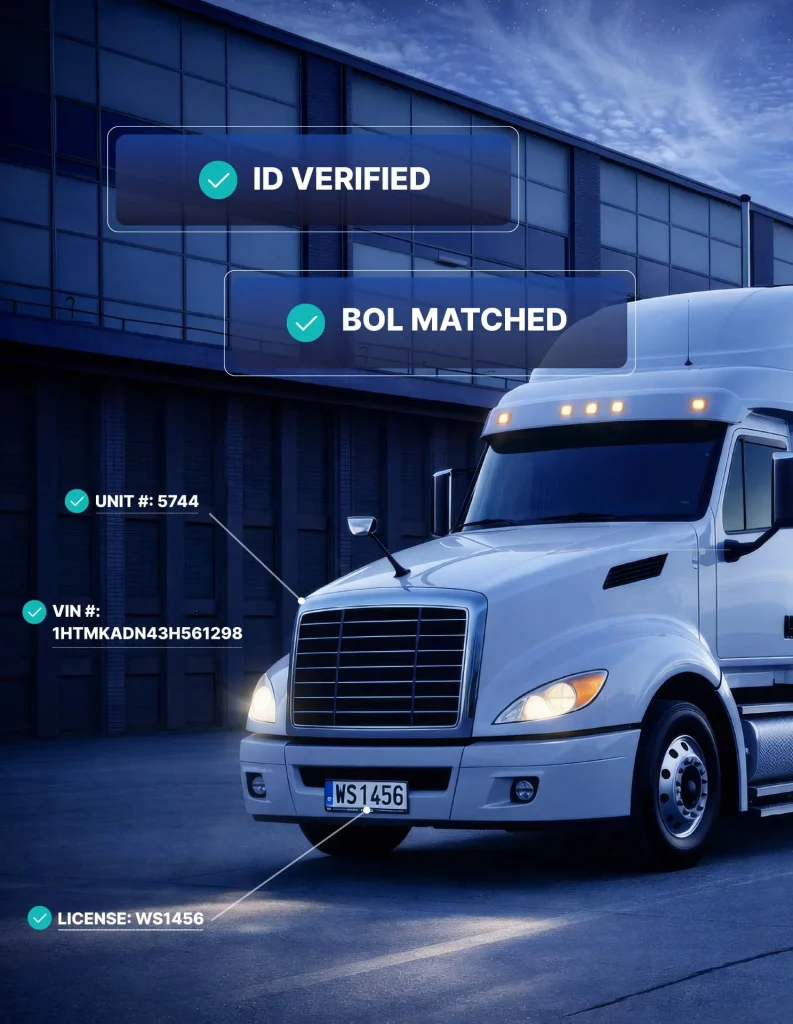
A gate transaction should not rely on a single data point.
Depending on the facility and cargo, verification may include:
- Driver identity
- Carrier identity
- Truck number
- Trailer number
- License plate
- Appointment or pickup reference
- Bill of Lading information
- Seal number and condition
- Customer authorization
- Expected arrival time
- Outbound authorization
When those elements are connected, the transaction becomes harder to fake than when the facility checks only a name or pickup number.
For more detail, see our guide to driver verification at warehouse gates.
High-Value Risk Continues After the Truck Enters
Gate verification is only the first layer.
Once a trailer enters the property, the risk moves into the yard.
High-value freight may remain staged for hours. A trailer can be repositioned. A driver may wait for a dock. Yard tractors may move equipment. Employees, contractors, and visitors may share the same operating environment.
This is why yard security should answer questions such as:
- Where is high-value freight staged?
- Who should be near it?
- Is the area visible after dark?
- Can unusual movement be detected?
- Can the security team intervene in real time?
- Is the outbound transaction verified as carefully as the inbound transaction?
High-value freight should remain visible from arrival to departure, not only while it is crossing the gate.
Why Outbound Verification Deserves More Attention
Facilities often focus heavily on who enters the property.
But from a cargo theft perspective, the outbound gate may be the final control point before the loss becomes irreversible.
Before a loaded trailer leaves, the facility should be able to confirm that:
- The correct driver is present
- The correct tractor is attached
- The correct trailer is leaving
- The shipment is authorized for release
- Required documentation is present
- Any seal requirement has been satisfied
- The transaction does not contain unresolved exceptions
This becomes even more important when high-value goods are involved.
Security Teams Need Better Measures Than “No Incidents”
A facility can go months without a reported cargo theft and still have significant unresolved exposure.
More useful operational security metrics include:
- Driver verification completion rate
- Trailer verification completion rate
- Percentage of outbound loads with complete digital records
- Number of gate exceptions
- Average exception resolution time
- After-hours transaction count
- Unauthorized or denied access events
- Perimeter alert verification rate
- Time from detection to intervention
- High-value freight staging duration
The absence of a theft does not prove the absence of a vulnerability.
What Should Logistics Leaders Do Differently in 2026?
The first step is to stop treating every cargo movement as if it carries the same risk.
Security leadership should work with operations, transportation, and finance to identify the scenarios that create the largest potential loss.
That may include specific commodities, customers, facilities, lanes, pickup windows, or carrier situations.
Then build controls around those situations.
For example:
- Require enhanced verification for loads above a defined value
- Require secondary approval for last-minute carrier or driver changes
- Increase monitoring around high-value trailer staging areas
- Use stronger outbound verification for targeted commodities
- Review after-hours and holiday pickup procedures
- Create digital transaction records that connect gate activity with relevant video
What This Means for CFOs and Operations Leaders
Cargo theft is often discussed as a security-team problem, but the 2026 loss pattern makes it a financial and operational problem too.
A severe theft can create direct inventory loss, emergency transportation costs, customer penalties, insurance deductibles, claims administration, production delays, and lost employee time. For a 3PL, the impact can also include customer-retention risk. For a manufacturer, one missing component can interrupt production. For a retailer, a stolen high-demand load can become a revenue problem during a critical selling period.
That means the business case for stronger cargo security should not be built only around preventing “security incidents.” It should be built around reducing loss severity and business interruption.
Leadership should understand which facilities hold the greatest concentration of value, which customers or commodities create the greatest exposure, and which security controls are currently dependent on manual judgment. Those questions help connect security investment to measurable business risk instead of treating cameras, guards, gates, and monitoring as isolated line items.
The executive question is not simply “How many thefts did we have?” It is “What is the largest preventable loss our current process could allow?”
How Birdseye Supports a Risk-Based Security Model
Birdseye connects gate, yard, and perimeter security instead of treating each area as a separate system.
GATECORE supports driver, truck, trailer, document, seal, and access verification.
YARDCORE improves visibility after vehicles enter the property.
SAFECORE combines AI-powered detection with trained human verification and live intervention.
The Portal helps centralize important facility events and transaction records.
The goal is simple: automate routine activity, escalate exceptions, and maintain a stronger record of what happened.
Executive Checklist: Are You Measuring the Right Cargo Theft Risk?
- Do we know the highest-value freight moving through each facility?
- Do high-value loads receive stronger verification?
- Can we verify driver, truck, trailer, and shipment information at pickup?
- Do we have a process for carrier or driver substitutions?
- Can we identify unusual activity around high-value trailers?
- Do we verify outbound transactions as carefully as inbound transactions?
- Can we reconstruct a gate event quickly?
- Do our KPIs measure financial exposure and severity, not only incident count?
- Can a trained person step in when automation cannot resolve an exception?
Frequently Asked Questions
Why can cargo theft losses rise when incidents fall?
A smaller number of thefts can still create greater losses if criminal groups target higher-value freight or carry out more financially severe schemes. CargoNet’s Q2 2026 data showed exactly that pattern.
What is strategic cargo theft?
Strategic cargo theft uses deception to obtain freight. The FBI lists fictitious pickups, identity theft, account takeovers, double brokering, and fraudulent carriers among current strategic cargo theft methods.
What freight is most at risk?
Risk changes over time, but high-value, easily resold, or operationally critical goods can attract organized theft groups. Facilities should use current intelligence and their own shipment data to identify the highest-risk commodities.
How can warehouses reduce cargo theft risk?
Warehouses can strengthen driver and carrier verification, maintain trailer visibility, improve perimeter monitoring, create digital gate records, verify outbound loads, and ensure suspicious activity can trigger real-time intervention.
Are cameras enough to stop cargo theft?
No. Cameras provide visibility and evidence, but effective cargo theft prevention also requires verification, access control, exception handling, documentation, and response.
Fewer Incidents Should Not Create False Confidence
The 2026 cargo theft environment shows why security leaders need to look beyond incident counts.
The more important question is what one successful failure could cost.
If a single fraudulent pickup, trailer theft, or high-value loss can create a seven-figure problem, verification and response deserve to be treated as business controls—not simply security expenses.