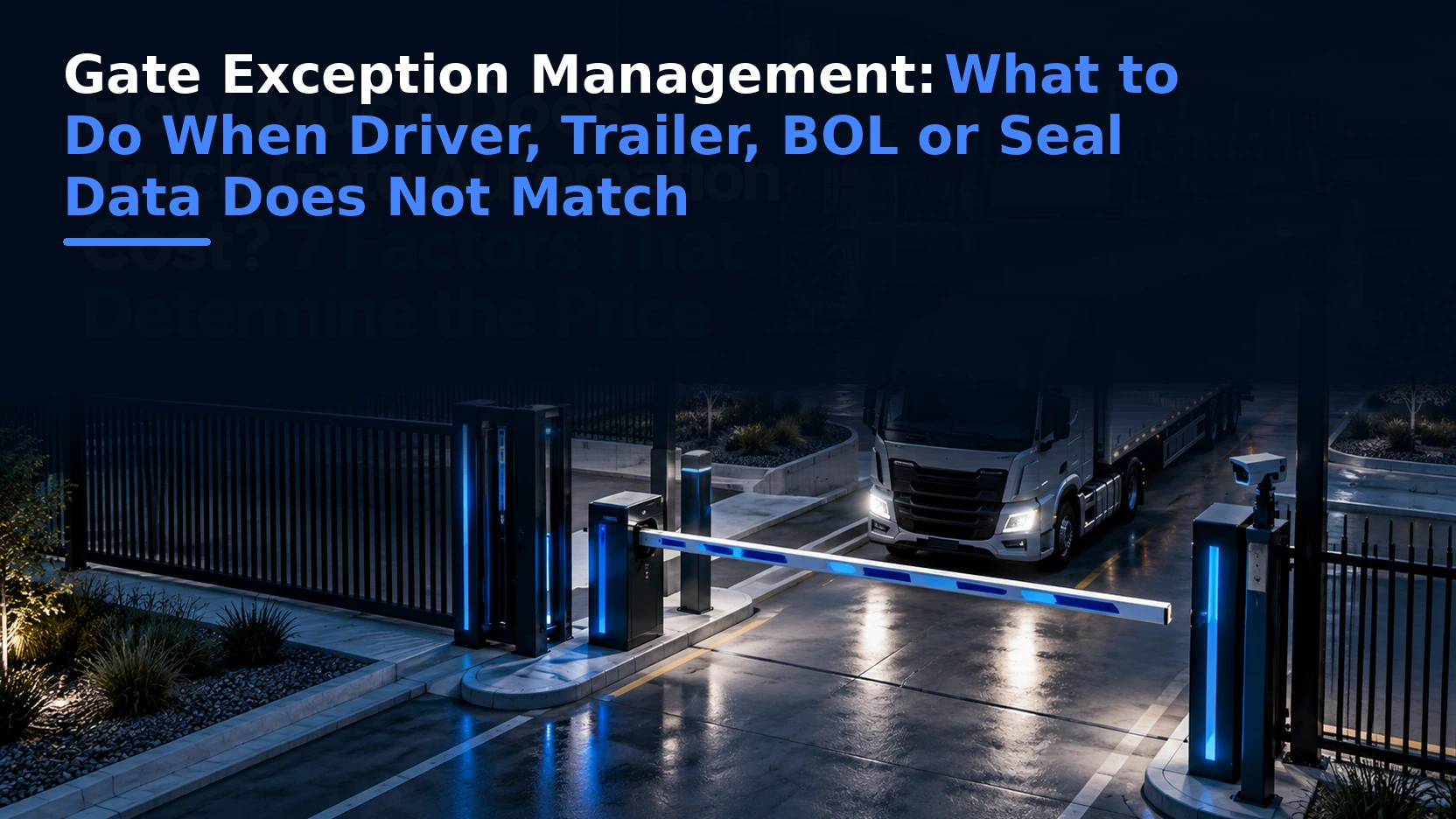
Truck gates are easy to automate when every transaction looks exactly as expected. Real facilities rarely work that way. A driver arrives early. A trailer number changes. A BOL is incomplete. A seal does not match. A carrier substitutes equipment. A pickup number cannot be found. A customer calls with a last-minute approval.
Gate exception management is the process of identifying, holding, reviewing, resolving, and documenting transactions that fall outside the facility’s normal gate workflow.
It is one of the most important parts of gate automation because the security value of the system is determined not only by how fast it processes routine trucks, but by how safely it handles the transactions that do not fit the rules.
Quick Answer: What Should Happen When Gate Data Does Not Match?
The gate should not blindly approve the transaction and it should not necessarily reject it permanently.
A stronger process is:
- Detect the mismatch.
- Pause the transaction.
- Classify the exception.
- Verify the relevant information.
- Escalate to the correct person when needed.
- Approve, deny, redirect, or continue holding.
- Document the decision and supporting evidence.
| Exception | Immediate Action | Typical Verification |
|---|---|---|
| Driver mismatch | Hold transaction | Confirm identity and authorization |
| Trailer mismatch | Do not release or admit automatically | Confirm equipment substitution |
| BOL discrepancy | Request clarification | Match shipment details and approval |
| Seal mismatch | Escalate | Confirm seal number, condition, and exception reason |
| Missing appointment | Hold or route to exception workflow | Confirm shipper/receiver authorization |
| After-hours change | Apply stricter review | Use approved escalation contacts |
Why Exceptions Matter More Than Routine Transactions
Routine gate activity is predictable. The expected driver arrives with the expected trailer and the correct shipment details. The transaction is easy to verify and can move quickly. Exceptions are where risk concentrates. A mismatch may be harmless.
It may also indicate:
- a dispatch error;
- a carrier substitution;
- incorrect paperwork;
- a customer communication problem;
- an unauthorized pickup attempt;
- a fraudulent carrier;
- shipment misdirection;
- or a broader cyber-enabled theft scheme.
The FBI identifies fictitious pickups, identity theft, fraudulent carriers, double brokering, account takeovers, and cyber-enabled deception among current cargo theft methods. That makes mismatches at the gate operationally important, not merely inconvenient.
Review the FBI’s cargo theft guidance.
The Goal Is Not to Eliminate Exceptions
No realistic logistics operation can eliminate every exception. Drivers change. Equipment breaks. Appointments are updated. Paperwork is corrected. Customers make legitimate last-minute requests.
The goal is to make exceptions visible, controlled, and auditable.
A secure process should let routine trucks move quickly while making unusual transactions harder to exploit.
1. Driver Mismatch
A driver mismatch occurs when the person at the gate does not match the expected driver information. This can happen for legitimate reasons, such as a carrier reassigning a driver. But the replacement driver should not gain access simply because they know the load number or customer name.
Facilities should verify:
- driver identity;
- carrier affiliation;
- pickup or appointment reference;
- authorization for the substitution;
- truck and trailer information;
- and any secure pickup credential required by the customer.
Read our driver verification at warehouse gates guide.
2. Trailer Mismatch
A trailer mismatch can be operationally normal or a serious security concern. The question is whether the substitution is authorized. The gate should not simply overwrite the old trailer number and continue.
Instead, the system should preserve the original expected data and record the revised equipment information along with the reason for the change.
This creates a stronger chain of custody and makes later investigation easier.
3. BOL Discrepancy
A Bill of Lading can contain information that does not match the gate transaction, appointment, trailer, or load record.
Examples include:
- wrong shipment number;
- incorrect customer or destination;
- missing reference;
- unexpected commodity;
- different trailer information;
- or incomplete documentation.
The response depends on the facility protocol, but the discrepancy should be documented and resolved before the transaction is treated as routine.
See BOL Capture and Seal Checks: Why Gate Documentation Matters.
4. Seal Mismatch or Damage
A seal exception deserves clear rules because the seal may be an important indicator of shipment integrity.
The gate or receiving workflow may need to record:
- expected seal number;
- observed seal number;
- whether the seal is intact;
- whether it is missing;
- whether it appears damaged;
- who authorized the exception;
- and what happened next.
“Seal checked” is less useful than a structured record of what was actually observed.
5. Missing Appointment or Pickup Reference
A missing appointment should not automatically mean the driver is fraudulent. But it should move the transaction into an exception path. The facility may need to confirm:
- whether the shipment exists;
- whether the driver is expected;
- whether the carrier is approved;
- whether the driver is early or late;
- and who has authority to admit or release the vehicle.
The important part is that the exception is resolved through a defined workflow instead of an informal decision made under pressure.
6. Carrier or Contact Change
A changed carrier or new contact method can be legitimate, but it also overlaps with strategic cargo theft techniques.
NMFTA’s 2026 transportation cybersecurity research highlights identity fraud and compromised business systems as growing risks. CargoNet has also warned about criminals using legitimate-looking carrier accounts and business phone systems.
Read NMFTA’s 2026 cybersecurity trends overview.
If carrier identity or contact information changes, verify the update through a trusted source rather than the new contact method alone.
7. After-Hours Exceptions
After-hours transactions deserve special attention because staffing and management availability may be reduced.
A secure operating protocol should define:
- which exceptions can be resolved by the gate team;
- which require management approval;
- which contacts are authorized after hours;
- what happens when no approver can be reached;
- and where the truck should wait while the issue is resolved.
Without those rules, employees may feel pressure to improvise simply to keep traffic moving.
Exception Management vs. Manual Gatekeeping
Some facilities assume that keeping a human guard at the gate automatically solves the exception problem. It does not.
A guard can still make inconsistent decisions if the protocol is unclear, the required information is scattered across systems, or the correct approver is difficult to reach.
The advantage of a structured exception workflow is consistency, not the absence of human judgment.
Automation can detect that something does not match. A trained person can then apply context and follow the facility’s approved decision path.
This is the model described in our article on human verification in AI security.
What a Good Exception Record Should Include
A useful record should capture enough information to explain why the normal workflow stopped and how the transaction was resolved.
Depending on the event, that may include:
- exception type;
- original expected information;
- observed or revised information;
- driver and carrier;
- truck and trailer;
- BOL information;
- seal status;
- timestamp;
- photos or video where appropriate;
- person contacted;
- approval decision;
- operator actions;
- and final gate outcome.
Read our guide to digital gate transaction records.
How to Prioritize Gate Exceptions
Not every mismatch needs the same level of escalation. A useful model is to group exceptions by risk.
Low-Risk Exceptions
Examples may include an early arrival, a known driver with a minor appointment timing issue, or a formatting difference in a reference number.
These can often be resolved quickly through a standard confirmation step.
Medium-Risk Exceptions
Examples may include a trailer substitution, missing document, changed appointment, or new driver from an expected carrier.
These usually require additional verification and documented authorization.
High-Risk Exceptions
Examples may include multiple mismatches, an unexpected carrier, a changed destination, seal discrepancy, unknown driver, suspicious after-hours request, or pressure to bypass normal controls.
These should trigger a stronger hold and escalation path.
Gate Exception KPIs
Exception data can improve both security and operations.
Useful metrics include:
- exceptions per 100 gate transactions;
- driver mismatch rate;
- trailer mismatch rate;
- BOL exception rate;
- seal exception rate;
- missing appointment rate;
- after-hours exception rate;
- percentage of exceptions resolved remotely;
- percentage escalated to site management;
- average exception resolution time;
- denied access rate;
- and repeat exceptions by carrier or customer.
These metrics can reveal where upstream processes are creating friction. A high trailer mismatch rate may indicate dispatch data problems. Frequent missing appointments may point to scheduling integration issues. Repeated document errors may indicate a carrier training problem.
Exception data should improve the process, not only document problems.
How to Design an Exception Playbook
A good playbook should be specific enough that operators know what to do without calling a manager for every small mismatch.
For each exception type, define:
- what triggers the exception;
- what information must be checked;
- who can approve it;
- when escalation is mandatory;
- how long the vehicle can remain in the lane;
- where the driver should wait if review takes longer;
- and what evidence must be stored.
The playbook should be reviewed whenever customer requirements, carrier workflows, or facility procedures change.
How Birdseye Supports Gate Exception Management
GATECORE helps automate routine verification while identifying transactions that fall outside approved protocols.
When a situation requires context, trained Birdseye agents can step in, communicate with the driver, follow the customer’s escalation path, and document the final decision.
The Portal helps centralize transaction and exception records for review.
The objective is simple: routine activity moves quickly, while exceptions receive the attention they actually require.
Gate Exception Management Checklist
- Define every common exception type.
- Set a risk level for each exception.
- Identify who can approve each type.
- Create after-hours escalation rules.
- Preserve original expected data.
- Record revised information rather than overwriting history.
- Document the reason for every override.
- Store relevant photos, documents, or video where appropriate.
- Measure exception frequency and resolution time.
- Review repeat exceptions by carrier, customer, and shift.
How to Keep Exceptions From Blocking the Gate
A secure exception process should not turn one problem truck into a queue of ten trucks.
Facilities should decide in advance how a lane is cleared when a review will take more than a minute or two. That may mean directing the vehicle to a designated holding area, moving the conversation to a remote agent, or using a secondary lane for detailed review.
The operational objective is to separate transaction review time from lane occupancy time.
If every complex exception remains physically parked at the primary gate lane, security decisions can quickly become an operational bottleneck. The same control that protects the facility can then create pressure on staff to rush the decision simply to restore traffic flow.
Designing a physical and procedural holding process removes that pressure and makes secure decisions easier.
Review Exceptions as a Monthly Operating Dataset
Exception logs should not disappear into an archive after the truck leaves.
At least monthly, security and operations leaders should review the most common exception types, the carriers that generate repeated mismatches, the shifts with the longest resolution times, and any overrides that occurred outside normal approval paths.
This can reveal recurring causes such as incomplete appointment data, weak dispatch integrations, customer-specific procedures that are unclear to drivers, or carriers that repeatedly substitute equipment without updating the facility.
A mature gate program uses exception data to remove avoidable friction while preserving strict controls around the exceptions that actually create risk.
Frequently Asked Questions
What is a gate exception?
A gate exception is a transaction that does not match the facility’s expected access or shipment workflow, such as a driver, trailer, BOL, seal, appointment, or carrier mismatch.
Should every gate exception be denied?
No. Many exceptions are legitimate operational changes. The transaction should be paused and verified according to a defined process before it is approved, denied, or redirected.
Can gate automation handle exceptions?
Automation can identify mismatches and route them into an exception workflow. Complex situations still benefit from trained human review when the correct decision requires context.
What is the most important information to record?
Record what was expected, what did not match, who verified the change, who approved the decision, and the final gate outcome.
How can exception data improve operations?
Patterns in trailer mismatches, missing appointments, document errors, or long resolution times can reveal upstream process problems and help teams reduce future friction.
Final Takeaway
A gate automation system is only as strong as its exception process. Routine transactions prove that the workflow is fast. Exceptions prove whether it is secure.
Detect the mismatch, pause the transaction, verify the change, apply the right level of human judgment, and preserve the decision record.