When a logistics company evaluates security guard cost, the calculation often starts with an hourly rate.
That is understandable.
It is also incomplete.
The true cost of guard-heavy security includes wages, overtime, coverage gaps, turnover, supervision, vendor markup, training, manual administration, gate delays, and the operational cost of asking people to perform repetitive tasks that technology can handle more consistently.
For CFOs and operations leaders, the important question is not “What does a guard cost per hour?”
The better question is:
“What does this security operating model cost the business?”
Quick Answer: What Costs Should Be Included in a Security Guard ROI Analysis?
| Cost Category | What to Measure |
|---|---|
| Direct labor | Wages or contracted hourly rate |
| Overtime | Extra coverage, holidays, call-outs, double shifts |
| Coverage | Breaks, absences, vacancies, scheduling redundancy |
| Turnover | Recruiting, onboarding, training, performance variability |
| Supervision | Management and vendor oversight |
| Manual administration | Paper logs, reporting, calls, data entry |
| Gate delay | Truck wait time, detention, congestion, dock impact |
| Investigation effort | Time spent reconstructing incidents and records |
| Technology opportunity cost | Tasks that could be automated or handled remotely |
Start With the Labor Baseline
The U.S. Bureau of Labor Statistics reports a median annual wage of $38,020 for security guards in May 2025. It also notes that night shifts are common and that guards frequently control access, monitor alarms and video systems, patrol property, conduct security checks, respond to emergencies, and write reports. See the BLS security guard profile.
That wage figure is useful as a labor benchmark, but it is not the same as the fully loaded cost of a security post.
Facilities may use direct employees or contracted guard services. Contracted rates can include employer taxes, insurance, scheduling, recruiting, management, and vendor margin. Direct employees create those costs internally.
A 24/7 post also requires far more than one employee.
1. A 24/7 Guard Post Is a Coverage Model, Not One Salary
One week contains 168 hours.
Even before vacations, sick days, holidays, training, and turnover, a continuously staffed post requires multiple people.
This is one reason CFOs should calculate cost by post, not by individual employee.
Questions to ask:
- What is the annual spend per gate post?
- How many posts operate 24/7?
- How much overtime supports those posts?
- How much relief coverage is required?
- How often does a supervisor fill a gap?
- What is the holiday premium?
That gives leadership a much more realistic baseline.
2. Overtime Can Distort the Economics Quickly
Security operations are sensitive to staffing gaps.
A warehouse cannot simply leave a required gate post empty because someone called out.
The company may need overtime, a replacement from the vendor, supervisor coverage, or temporary reassignment.
Those solutions keep the site operating, but they can increase cost and reduce consistency.
A useful CFO analysis should isolate:
- Regular hours
- Overtime hours
- Holiday hours
- Emergency replacement hours
- Temporary coverage
3. Turnover Has a Cost Even When the Hourly Rate Does Not Change
A new guard must learn the site.
That may include:
- Customer-specific access procedures
- Carrier rules
- Driver check-in
- Trailer numbering conventions
- BOL procedures
- Seal checks
- Emergency contacts
- Escalation rules
- Yard layout
BLS data shows on-the-job training is required for the vast majority of security guard positions. Review BLS occupational requirements data.
When turnover is high, the facility repeatedly pays the operational cost of bringing a new person up to site-specific competence.
That cost may show up as supervisor time, mistakes, longer transactions, or more escalations rather than a separate invoice.
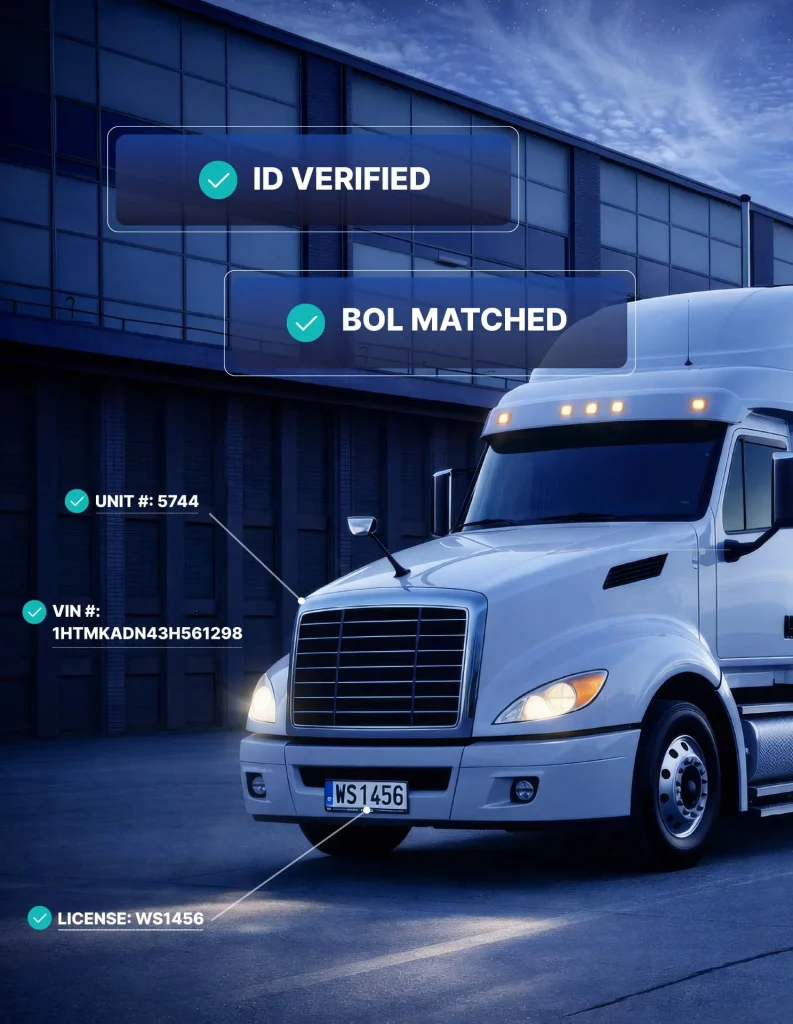
4. Manual Gate Processing Has an Operations Cost
At logistics facilities, a guard may do much more than security.
The guard may:
- Check IDs
- Record tractor and trailer numbers
- Call dispatch
- Review paperwork
- Check appointments
- Open the gate
- Give yard directions
- Write logs
- Handle exceptions
If a truck transaction takes several minutes longer because the process is fully manual, the cost is not limited to security payroll.
It can contribute to:
- Truck queues
- Driver detention
- Yard congestion
- Late dock arrivals
- Administrative calls
- Frustrated carriers
This is why gate automation should be evaluated as both a security and operations investment.
5. Paper Logs Create Hidden Administrative Cost
Paper is inexpensive.
Using paper as an operational database is not.
When a customer asks about a trailer from three weeks ago, employees may need to find:
- The correct binder
- The correct day
- The correct shift
- The camera footage
- The BOL image
- The relevant phone call or email
That investigation can involve several employees across security, operations, claims, and management.
Digital gate records reduce the effort required to reconstruct an event.
6. Management and Vendor Oversight Belong in the Calculation
Security posts do not manage themselves.
Internal teams may spend time on:
- Scheduling
- Performance issues
- Incident review
- Vendor meetings
- Training
- Post orders
- Invoice review
- Coverage disputes
For a multi-site company, these tasks can become a meaningful management burden.
If automation standardizes routine procedures, part of the value may come from reducing supervision complexity.
7. Guard Cost Should Be Compared Against the Work Being Performed
This is where the analysis becomes strategic.
Some guard tasks absolutely require human judgment.
Others are repetitive.
Examples of tasks that may be automated or remotely handled include:
- Capturing license plates
- Recording truck and trailer numbers
- Checking expected appointment data
- Creating transaction timestamps
- Opening a barrier after verification
- Monitoring camera analytics
- Maintaining searchable records
Examples that may benefit from a trained person include:
- Unusual driver substitutions
- Document ambiguity
- Conflicting shipment instructions
- Suspicious perimeter events
- Emergency response
- Complex facility-specific exceptions
The financial goal should not be “remove all people.” It should be “stop paying people to manually do what software can do reliably.”
8. Calculate Cost Per Transaction, Not Only Cost Per Hour
A useful CFO metric is security cost per gate transaction.
For example:
Annual gate security spend ÷ annual truck transactions = security labor cost per transaction.
This can be refined by including:
- Guard labor
- Vendor management
- Gate technology
- Manual administration
- Exception handling
This helps compare facilities with different traffic volumes and can reveal where a low hourly rate still produces an expensive operating model.
9. Measure the Cost of Coverage Redundancy
Traditional security requires staffing redundancy because the facility cannot rely on one individual being available every hour.
Technology creates a different type of redundancy.
Routine workflows can continue automatically while remote agents cover exceptions across multiple locations.
This can change the economics of scale for companies operating several gates or facilities.
10. Include Risk and Documentation Quality in ROI
Security ROI cannot be reduced to payroll savings.
The model should also consider whether the future state creates stronger documentation and fewer gaps.
Useful questions include:
- Can we verify who entered and exited?
- Can we search transactions quickly?
- Are exceptions recorded?
- Are outbound releases controlled?
- Can we link video to the event?
- Can we standardize protocol across sites?
If lower cost produces weaker control, the project is not successful.
What Should a CFO Ask Before Approving Security Automation?
- What is our current annual cost per post?
- What is our overtime percentage?
- What is our annual turnover or replacement burden?
- How many gate tasks are repetitive?
- How many transactions occur per year?
- What is average truck processing time?
- How often are managers called to resolve routine exceptions?
- How long does it take to investigate an old gate event?
- Which tasks truly require physical presence?
- What human backup exists when automation cannot resolve an event?
For related financial and operational comparisons, see Remote Gate Management vs. On-Site Security Guards, Alternatives to Security Guards at Truck Gates, and How Much Does Truck Gate Automation Cost?.
How Birdseye Changes the Security Cost Model
GATECORE automates repeatable gate workflows while trained Birdseye agents handle complex exceptions.
SAFECORE uses AI-assisted monitoring backed by trained human verification and intervention.
YARDCORE expands visibility across operational areas without requiring a person to manually watch every camera feed.
The Portal creates centralized event and transaction records.
The objective is to reduce repetitive labor while preserving human judgment where it creates real value.
A Simple Security Cost Framework
CFOs can evaluate the current state using five categories:
- Labor: wages, contracted rates, overtime, holiday coverage.
- Management: scheduling, supervision, vendor oversight, training.
- Operations: gate delays, administrative calls, manual processing.
- Investigation: time required to locate records and reconstruct events.
- Risk: control gaps, inconsistent processes, undocumented exceptions.
Then compare those categories with the proposed automated or hybrid model.
11. Compare Current-State Cost With Future-State Cost Over Several Years
A one-year comparison can understate or overstate the economics.
Technology may require implementation cost in year one while labor costs continue every year. A useful CFO model should therefore compare several years of expected cost.
The model can include:
- Current annual guard spend
- Expected wage or vendor-rate increases
- Overtime trend
- Technology implementation
- Recurring software and monitoring
- Maintenance
- Remote human support
- Expected labor reduction
This gives leadership a clearer view of payback period and total cost of ownership.
12. Separate Savings From Value Creation
Some benefits reduce expense directly.
Others create operational value.
Direct savings may include fewer guard hours, less overtime, or lower administrative effort.
Operational value may include faster truck processing, better transaction records, fewer manual errors, more consistent protocols, and faster investigation.
Keeping these categories separate makes the business case more credible.
13. Do Not Ignore the Cost of Inconsistent Execution
Two guards can follow the same post order differently.
One may document every trailer number carefully. Another may abbreviate. One may escalate every mismatch. Another may wave through a familiar carrier.
Those differences are hard to price, but they matter.
Standardized automated workflows can reduce variability in routine tasks while preserving human review for exceptions.
Questions CFOs Should Ask Vendors
- Which current guard tasks disappear?
- Which human tasks remain?
- What happens during technology failure?
- What is included in recurring fees?
- What are implementation and maintenance costs?
- How is exception coverage staffed?
- What evidence will show that throughput or documentation improved?
Implementation Tip: Build a 30-Day Baseline Before Changing the Model
Before replacing or reducing guard coverage, collect a short period of current-state data.
Track guard hours, overtime, truck transactions, average processing time, exceptions, manager interventions, after-hours calls, and investigation requests.
This baseline gives finance a realistic comparison point and prevents the project from being judged only by assumptions.
After automation or remote coverage is introduced, measure the same metrics again.
The strongest ROI case is not a theoretical savings percentage. It is a before-and-after operating record from the facility itself.
One final principle: cost reduction should not be evaluated separately from control quality. A cheaper security model that creates weaker verification or slower response is not a successful optimization. The target is lower repetitive labor cost with equal or better security performance, documentation, and operational throughput.
That same framework also makes multi-site comparisons much easier for finance teams.
Frequently Asked Questions About Security Guard Cost
How much does a security guard cost a logistics facility?
The total cost depends on wage or vendor rate, hours of coverage, overtime, holidays, supervision, turnover, and the number of posts required. The hourly rate alone does not represent the full operating cost.
How many guards are needed for a 24/7 post?
A 24/7 post requires 168 coverage hours per week, so multiple employees plus relief coverage are typically necessary.
Can gate automation reduce guard costs?
Yes. Repetitive verification, documentation, and access-control tasks can often be automated, while trained personnel remain available for exceptions and complex situations.
Should CFOs include truck delays in security ROI?
Yes. If manual security processing creates queues or delays, that operational impact should be considered alongside direct security labor.
Is remote security the same as removing human oversight?
No. A hybrid model can use automation for routine tasks while trained remote agents verify and resolve events that require judgment.
Stop Measuring Security Only by the Hour
The hourly guard rate is easy to see because it appears on an invoice.
The larger costs are often scattered across operations, overtime, management, investigations, and waiting time.
The best security cost analysis measures the full operating model — and asks which work actually requires a person to be physically present.