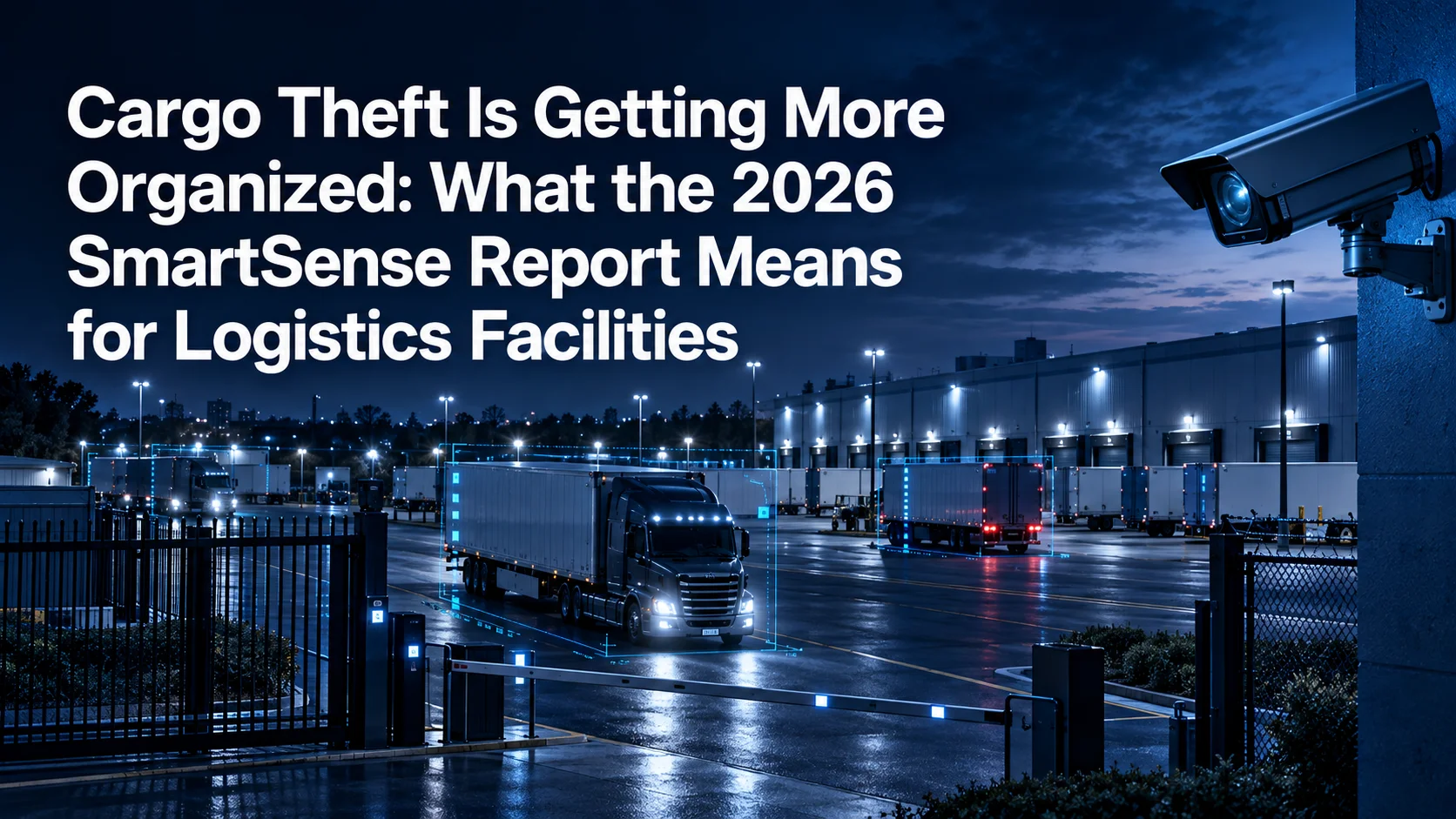
Cargo theft is no longer just a matter of someone breaking into a trailer.
A new 2026 SmartSense survey of 150 U.S.-based loss prevention and organized retail crime leaders found that 79% are more concerned about cargo theft today than ever before, while 81% believe cargo theft has become more organized in recent years.
For warehouses, distribution centers, transportation yards, and manufacturing facilities, the message is clear:
Cargo theft prevention now requires better verification, better facility visibility, and faster intervention — not simply more cameras.
What Did the 2026 SmartSense Cargo Theft Report Find?
SmartSense surveyed loss prevention, supply chain security, risk management, logistics, and organized retail crime leaders in August 2026.
The results show how quickly the threat is changing.
| Finding | Survey Result |
|---|---|
| More concerned about cargo theft than ever | 79% |
| Say cargo theft is becoming more organized | 81% |
| Say cargo theft incidents increased from last year | 63% |
| Say cargo theft caused lost sales | 80% |
| Report at least $1 million in annual cargo theft losses | 40% |
| Report more than $2 million in annual losses | 28% |
The report also identified several of the tactics security leaders are most concerned about:
Fraudulent pickups and carrier impersonation — 78%
GPS jamming and spoofing — 71%
Trailer theft — 66%
Double brokering — 64%
These are not random smash-and-grab incidents.
They point toward a much more coordinated form of cargo crime.
Read the original SmartSense cargo theft report.
Cargo Theft Is Becoming a Verification Problem
One of the most important findings is the concern around fraudulent pickups and carrier impersonation.
That matters because the theft may begin before anyone realizes a physical security incident has occurred.
A driver can arrive at a facility appearing to have legitimate information. The carrier name may look correct. The shipment may be expected. The truck may look ordinary.
But if the driver, carrier, trailer, shipment, or pickup authorization does not match the expected transaction, the facility may release valuable freight to the wrong person.
The FBI distinguishes between traditional cargo theft and strategic cargo theft, where criminals use deceptive tactics rather than simply stealing unattended freight.
Facilities can review the FBI’s cargo theft guidance for more information.
That makes the gate one of the most important verification points in the supply chain.
Facilities need to know more than whether a truck arrived. They need to verify driver identity, carrier information, truck and trailer details, shipment documentation, seal condition, pickup authorization, and the final access decision.
GPS Tracking Alone Cannot Protect the Facility
Another major concern in the SmartSense survey was GPS jamming and spoofing.
Real-time shipment tracking is valuable, but location visibility should not be confused with complete security.
Tracking can tell you where an asset appears to be.
It does not necessarily tell you who entered the facility, whether the correct trailer was released, whether the driver matched the shipment, whether the seal was intact, or whether suspicious activity occurred inside the yard.
Cargo visibility and facility security solve different parts of the problem.
The strongest approach connects them.
Trailer Theft Makes Yard Visibility More Important
Sixty-six percent of respondents identified trailer theft as a major concern.
Once a truck gets through the gate, security cannot stop.
Large logistics yards may contain dozens or hundreds of trailers, drivers, tractors, contractors, and employees moving at the same time.
A recorded camera system may provide evidence afterward. But prevention requires understanding activity while it is happening.
Facilities should be able to detect unusual movement, activity around restricted areas, unauthorized access, after-hours activity, and other anomalies before they become losses.
Yard visibility becomes an active security function rather than simply an operational convenience.
The FBI Is Seeing the Same Trend
The SmartSense findings are consistent with broader warnings from law enforcement.
In June 2026, the FBI Philadelphia Field Office warned transportation and logistics companies about an increase in sophisticated cargo theft schemes.
According to the FBI, estimated cargo theft losses across the United States and Canada reached nearly $725 million in 2025, approximately 60% higher than 2024, while confirmed incidents increased by 18%.
The FBI specifically highlighted cyber-enabled schemes involving compromised accounts, fraudulent load postings, spoofed websites, phishing, and impersonation of legitimate carriers and brokers.
Read the FBI warning on rising cargo theft threats.
That creates an important security reality:
Modern cargo theft can begin digitally but end physically at the gate, yard, dock, or trailer.
The Goal Is Not More Visibility. It Is Faster Action.
One of the strongest ideas in the SmartSense report is the shift from simply seeing activity to being able to act on it.
Seventy percent of respondents said their organizations are investing more in cargo theft prevention this year.
But information only helps if someone can respond.
A camera alert without intervention is still just an alert. A gate exception without a resolution workflow creates delay. A suspicious person detected near a trailer does not help much if nobody can intervene.
The real security advantage comes from connecting detection with verification, communication, escalation, and response.
What Should Logistics Facilities Prioritize?
Cargo theft prevention should be treated as a connected facility problem.
At the gate, facilities should strengthen driver, carrier, truck, trailer, BOL, and seal verification.
Inside the yard, teams need better visibility into vehicle movement, trailer activity, restricted zones, and unusual behavior.
Around the perimeter, AI-powered detection should be backed by human verification and immediate intervention when necessary.
Finally, all of those activities should create searchable records that can be reviewed during investigations, claims, disputes, or recurring risk analysis.
That gives facilities something much more useful than isolated camera footage.
It creates an operational timeline.
How Birdseye Approaches Cargo Theft Prevention
Birdseye connects gate, yard, and perimeter security rather than treating each area as a separate system.
GATECORE helps verify drivers, trucks, trailers, shipment documents, seals, and gate transactions.
YARDCORE provides greater visibility into activity after vehicles enter the facility.
SAFECORE monitors perimeter activity using AI detection backed by trained human agents who can intervene when necessary.
The Portal brings facility events and records together for faster review and investigation.
AI handles what can be automated. Trained people step in when judgment is required.
Cargo Theft Prevention Has to Start Before the Freight Leaves
The SmartSense report reinforces something logistics operators can no longer ignore.
Cargo theft is becoming more organized, more deceptive, and more technology-enabled.
Protecting freight therefore cannot begin only when a shipment reaches the highway.
It starts with who is allowed through the gate. It continues with what happens in the yard. It includes what happens around the perimeter. And it depends on how quickly a facility can respond when something does not look right.
The facilities that reduce cargo theft risk will be the ones that can verify more, detect earlier, and act faster.
Frequently Asked Questions
Why is cargo theft increasing?
Cargo theft increasingly involves organized criminal groups using fraudulent pickups, carrier impersonation, double brokering, cyber-enabled fraud, trailer theft, and other coordinated techniques rather than relying only on traditional physical theft.
What is strategic cargo theft?
Strategic cargo theft involves deception or fraud to gain control of freight rather than simply physically stealing an unattended shipment. The FBI identifies strategic cargo theft as a distinct category of cargo crime.
How can warehouses reduce cargo theft risk?
Facilities can strengthen driver and carrier verification, document trailers and shipment information, monitor yards and perimeters in real time, detect exceptions, maintain searchable transaction records, and ensure someone can respond when suspicious activity occurs.
Are security cameras enough to prevent cargo theft?
Cameras are important, but recording alone is reactive. Cargo theft prevention is stronger when cameras are combined with AI detection, human verification, access control, gate documentation, and real-time intervention.