Third-party logistics providers have to solve two problems at the same time:
Protect customer freight and keep freight moving.
Too much friction at the gate can create delays, detention, and driver frustration.
Too little verification can create cargo theft exposure, fraudulent pickups, trailer mismatches, and weak accountability.
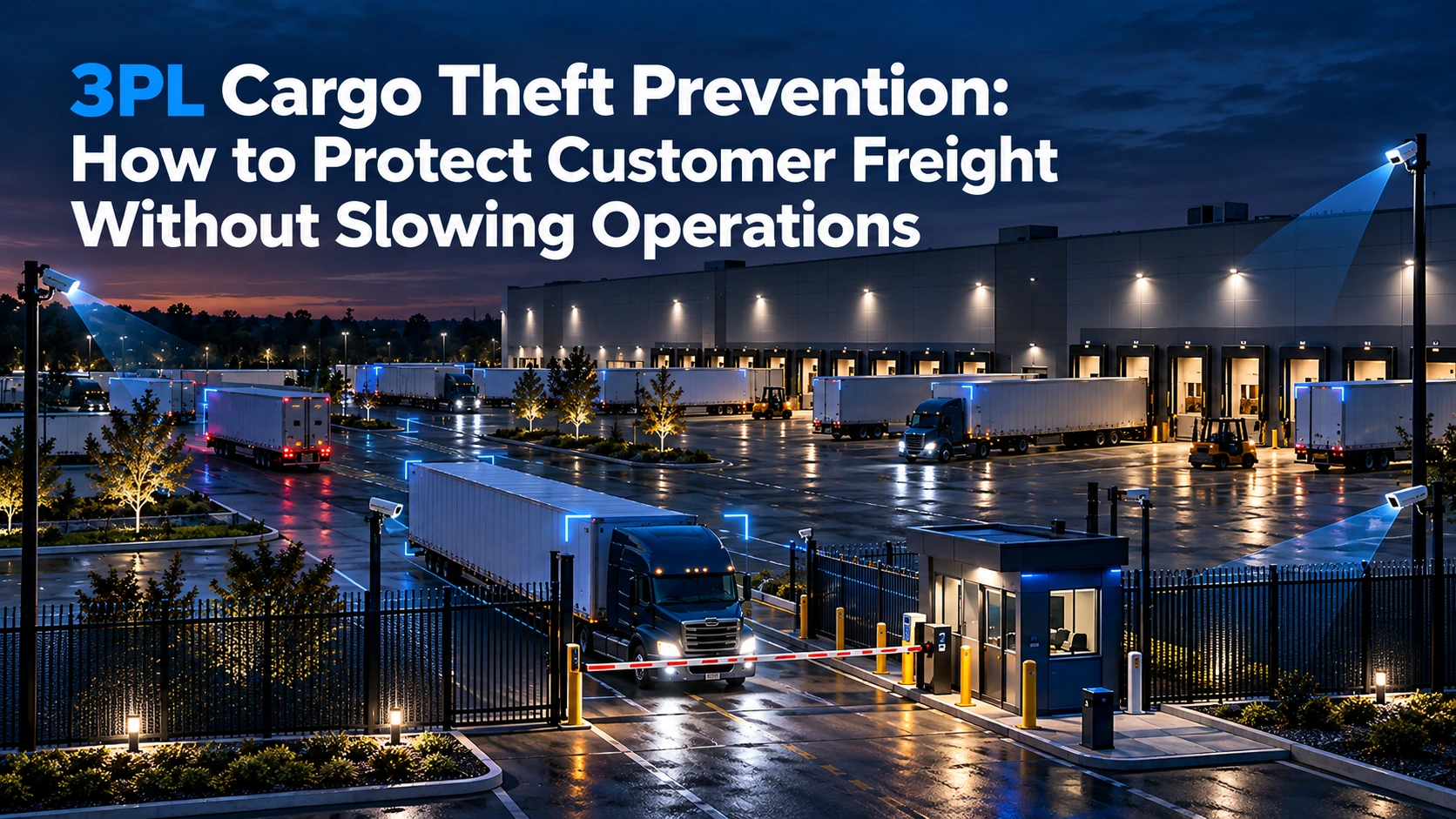
The best 3PL cargo theft prevention strategy combines fast gate verification, yard visibility, perimeter protection, digital transaction records, and human intervention when automation reaches an exception.
Quick Answer: How Can 3PLs Reduce Cargo Theft Risk?
| Security Area | What 3PLs Should Do |
|---|---|
| Gate | Verify drivers, carriers, trucks, trailers, pickup details, BOLs, and seals |
| Yard | Maintain visibility over trailers, restricted zones, staging areas, and unusual movement |
| Perimeter | Detect suspicious activity and verify threats in real time |
| Records | Create searchable digital records for every important gate and security event |
| Exceptions | Escalate unusual transactions to trained personnel instead of forcing automation to guess |
Why Cargo Theft Is a Different Problem for 3PLs
A 3PL facility may handle freight for many different customers, carriers, brokers, drivers, and transportation partners at the same time.
Each customer may have different requirements. One customer may require a seal check. Another may require a pickup number. Another may only authorize specific carriers. Another may require secondary approval before freight can leave the facility.
The more customers and protocols a 3PL manages, the harder it becomes to rely on memory, paper instructions, and manual guard processes.
That creates a security challenge.
The process needs to remain fast, but it also needs to remain consistent.
1. Verify the Driver Before Releasing Freight
One of the most important cargo theft controls is verifying that the person arriving for a shipment is actually authorized to collect it.
The FBI identifies strategic cargo theft methods that can involve fraudulent carriers, fictitious pickups, identity theft, double brokering, and other forms of deception.
Facilities can review the FBI cargo theft guidance for additional information.
For a 3PL, a driver saying the correct customer name is not enough.
The gate transaction should be able to confirm:
- Driver identity
- Carrier
- Truck information
- Trailer information
- Pickup or appointment reference
- Shipment authorization
The goal is to verify the transaction, not simply recognize the story.
2. Connect the Driver to the Correct Truck and Trailer
Driver verification is only one part of the process.
A legitimate driver can still arrive with the wrong trailer.
A carrier may substitute equipment.
A trailer number may be entered incorrectly.
A shipment may be assigned to different equipment than expected.
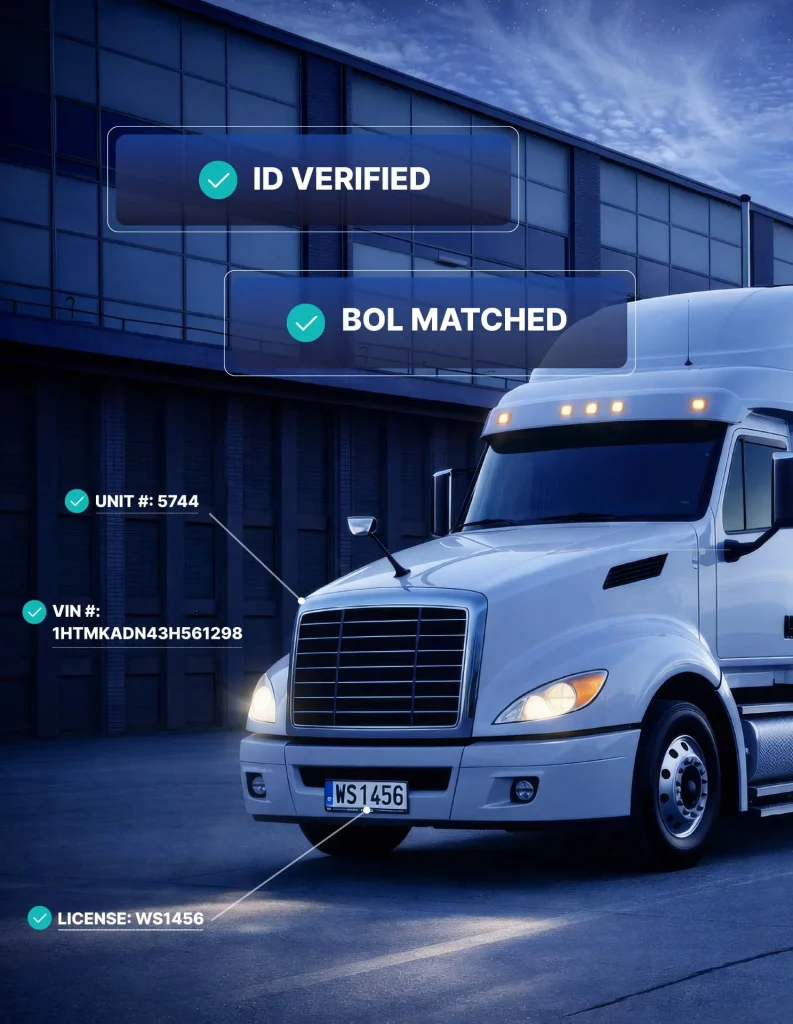
That is why 3PL gate security should connect the driver with the actual truck and trailer involved in the transaction.
This creates a stronger chain between:
Person → Carrier → Truck → Trailer → Shipment.
For more detail, see our guide to driver verification at warehouse gates.
3. Capture BOL and Seal Information
Shipment documentation should not exist separately from the gate transaction.
If a Bill of Lading is reviewed, the facility should have a way to connect that document to the driver, truck, trailer, and access decision.
The same applies to trailer seals.
A strong process may document:
- BOL information
- Seal number
- Seal condition
- Missing seal
- Damaged seal
- Seal mismatch
- Exception reason
Checking something is useful. Documenting what was checked is more useful.
Read more in BOL Capture and Seal Checks: Why Gate Documentation Matters.
4. Do Not Let Security Stop at the Gate
Once a truck enters the facility, the risk does not disappear. Loaded trailers may remain in staging areas. Drivers may move between docks. Yard tractors may reposition trailers. Employees and contractors may operate around customer freight.
For a 3PL handling multiple customer accounts, that makes yard visibility especially important.
The facility should be able to identify unusual activity such as:
- Unexpected trailer movement
- After-hours activity
- People entering restricted areas
- Vehicles remaining where they should not
- Activity around high-value freight
- Unusual behavior near the perimeter
The gate controls who gets in. Yard security helps control what happens after they enter.
5. Protect the Perimeter Before Someone Reaches the Freight
Perimeter security remains one of the first physical layers of cargo theft prevention.
That includes:
- Fencing
- Lighting
- Camera coverage
- Clear sightlines
- Restricted access points
- Detection around vulnerable areas
But detection alone is not enough.
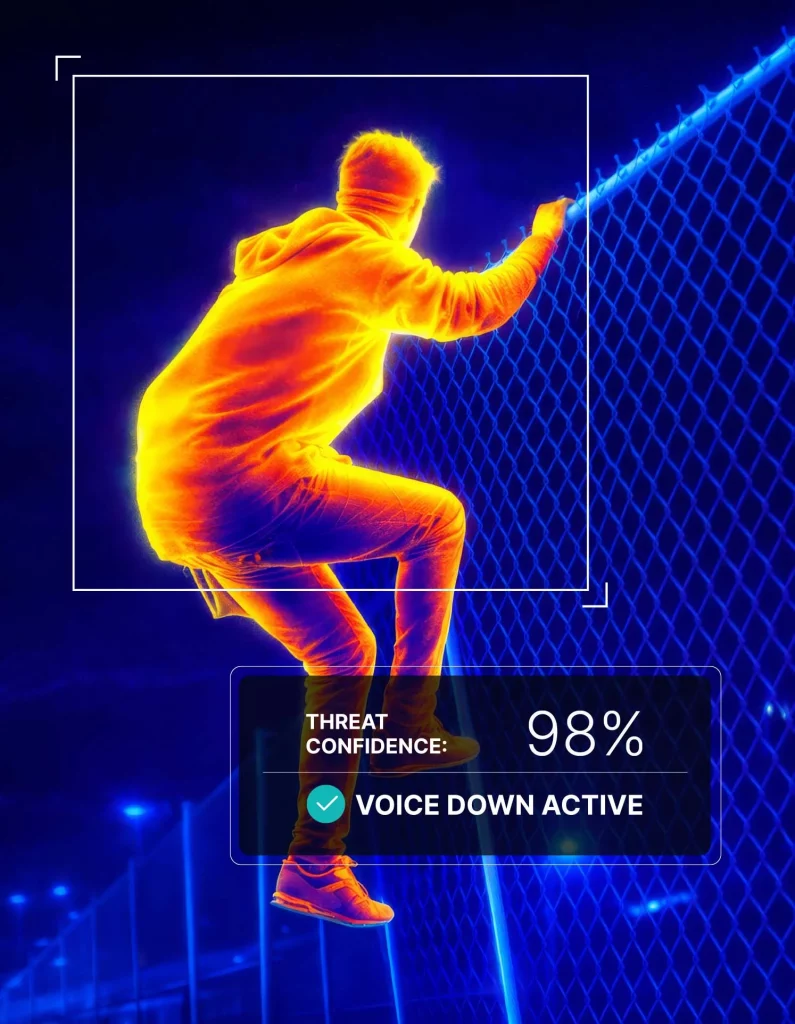
A camera can show that someone is near a trailer.
An AI system can detect that movement is unusual.
The important question is:
What happens next?
A strong security model should be able to verify whether the event is a real threat and intervene when necessary.
That may involve remote communication, Voice-Down™, escalation, or contacting the appropriate facility personnel.
6. Replace Paper Logs With Searchable Gate Transaction Records
3PL operators manage too much freight and too many customer relationships to rely on incomplete handwritten records.
When a customer asks what happened to a shipment, the facility should not have to reconstruct the answer from:
A paper guard log.
An email.
A BOL photograph.
Camera footage.
A spreadsheet.
And someone’s memory.
A digital gate transaction record can connect:
- Driver
- Carrier
- Truck
- Trailer
- License plate
- Shipment documentation
- Seal information
- Entry time
- Exit time
- Access decision
- Exceptions
- Relevant video
For a 3PL, better records are not only a security benefit. They are also a customer service benefit.
See our guide to gate transaction records for a deeper breakdown.
7. Automate Routine Transactions, Not Human Judgment
This is where many automation strategies go wrong.
They assume every transaction will fit the expected workflow.
Real 3PL operations do not work that way.
A driver arrives early.
The trailer number changes.
The BOL is unclear.
The seal does not match.
The carrier substitutes a driver.
A customer requires special approval.
Someone arrives after hours.
Automation should handle the routine. A trained person should handle the exception.
That approach allows the facility to reduce repetitive guard work without forcing software to make decisions when the situation requires judgment.
Why This Matters for 3PL Customer Retention
Security is not only about preventing a theft event.
It is also about protecting customer confidence.
A 3PL customer wants to know:
- Who has access to my freight?
- How are drivers verified?
- How are trailers tracked?
- What happens when there is an exception?
- Can you show me what happened?
- How quickly can you investigate an incident?
The easier it is to answer those questions with evidence, the stronger the 3PL’s security position becomes.
Security Should Not Slow the Gate Down
There is an important balance. A highly secure gate that creates long queues can hurt operations. A fast gate with weak verification creates unnecessary risk. 3PL facilities need both.
Automation can help reduce repetitive processing such as:
- Driver verification
- Truck and trailer identification
- Document collection
- Seal checks
- Access workflows
- Gate transaction records
Then trained personnel can focus on the transactions that actually need attention.
For a broader breakdown, read our Complete Guide to Truck Yard Gate Automation.
How Birdseye Supports 3PL Cargo Security
Birdseye connects security across the facility.
GATECORE helps automate driver, truck, trailer, document, seal, and access verification.
YARDCORE improves visibility across trailer yards and operational areas.
SAFECORE combines AI-powered detection with trained human verification and real-time intervention.
The Portal brings important gate, yard, perimeter, and incident records together.
The result is automation where it works and human judgment where it matters.
3PL Cargo Theft Prevention Checklist
A 3PL facility should be able to answer yes to these questions:
- Can we verify the driver before releasing freight?
- Can we connect the driver to the correct truck and trailer?
- Do we document BOL and seal information?
- Can we identify unusual activity in the yard?
- Are our perimeter cameras and sightlines effective?
- Can someone intervene when a real threat is detected?
- Do gate transactions create searchable digital records?
- Can we quickly reconstruct an event for a customer?
- Can automation escalate unusual situations to a trained person?
- Can we standardize security procedures across multiple customer accounts?
If several of those answers are no, the problem may not be one missing camera or one guard procedure.
It may be that the security process itself is disconnected.
Frequently Asked Questions About 3PL Cargo Theft Prevention
Why are 3PL warehouses attractive targets for cargo theft?
3PL facilities often handle freight for multiple customers, carriers, drivers, and transportation partners. High freight volume and frequent movement can create opportunities when driver verification, yard visibility, or access procedures are inconsistent.
How can a 3PL prevent fraudulent pickups?
3PLs can strengthen driver and carrier verification, confirm truck and trailer details, validate shipment information, document BOLs and seals, and escalate transactions that do not match the expected protocol.
What is the most important security control at a 3PL gate?
No single control is enough. Strong gate security connects driver verification, vehicle and trailer identification, shipment documentation, access authorization, and transaction records.
Can automation reduce security guard costs at a 3PL?
Yes. Routine verification and monitoring tasks can be automated, allowing trained personnel to focus on exceptions, judgment, and response instead of repetitive manual processing.
Why are digital gate records important for 3PLs?
Digital records help 3PLs reconstruct gate activity quickly, investigate customer disputes, document who accessed the facility, and connect drivers, vehicles, trailers, shipment information, and access decisions.