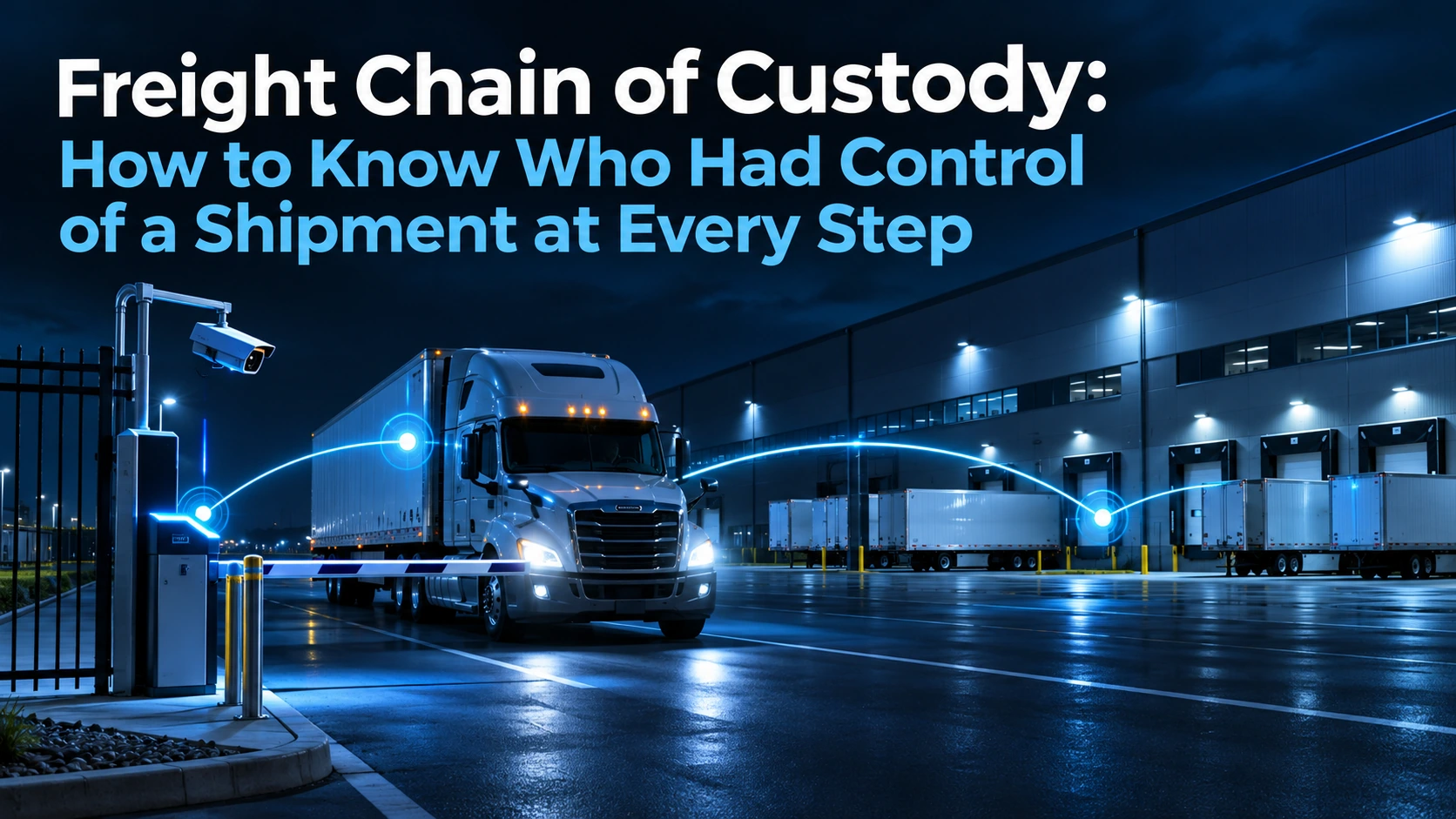
A freight chain of custody is the documented history of who controlled a shipment, where that control changed, what truck and trailer were involved, what documents were presented, and what evidence supports each handoff.
For logistics facilities, this matters because cargo can move through many hands before it reaches the final receiver. A broker tenders the load. A carrier accepts it. A driver arrives. A warehouse releases it. A trailer changes location. A seal is checked. A gate approves exit. A receiver eventually accepts delivery.
If those handoffs are not documented consistently, a company may know where freight was supposed to be without being able to prove who actually controlled it at a specific moment.
That gap matters more as cargo theft becomes increasingly strategic and identity-based. The FBI says current strategic cargo theft methods include fictitious pickups, identity theft, account takeovers, double brokering, and fraudulent carriers. In June 2026, the FBI also advised transportation companies to maintain detailed records of shipments, drivers, vehicles, and delivery documentation. Read the FBI cargo theft warning.
Quick Answer: What Should a Freight Chain of Custody Record?
| Handoff | What Should Be Recorded |
|---|---|
| Carrier assignment | Carrier identity, contact, authority, shipment reference |
| Driver arrival | Driver identity, carrier, tractor, license plate, appointment |
| Trailer verification | Trailer or container number, equipment condition, assigned shipment |
| Document review | BOL, pickup number, customer reference, special instructions |
| Seal verification | Seal number, condition, mismatch or exception status |
| Gate release | Who approved exit, time, lane, exception resolution |
| Yard movement | Relevant trailer movement or staging events |
| Delivery handoff | Receiver, time, location, proof of delivery or reconciliation |
What Does “Chain of Custody” Mean in Freight?
In freight operations, chain of custody means creating a traceable record of possession and control across the shipment lifecycle. It is not just a signature on a Bill of Lading.
A useful chain of custody answers several questions:
- Who was responsible for the load at this point?
- Which carrier and driver were involved?
- Which tractor and trailer were used?
- What documents supported the transaction?
- Was the seal intact?
- When did custody change?
- Who approved the next handoff?
- What happened if information did not match?
The value is not in collecting paperwork for its own sake. The value is being able to reconstruct an event quickly when a customer, insurer, investigator, or operations leader asks what happened.
Why Freight Chain of Custody Matters More in 2026
Cargo theft has moved beyond opportunistic theft from unattended trailers. The FBI describes strategic cargo theft as deception used to convince shippers, brokers, and carriers to hand freight to criminals. It also describes cyber cargo theft, where phishing or compromised systems provide criminals with legitimate shipment information and documents. See the FBI overview of cargo theft methods.
This changes the security question.
The facility cannot only ask, “Is there a truck at the gate?” It needs to ask whether the person, company, equipment, documents, and shipment all belong together.
Industry organizations are tightening identity controls too. NMFTA says identity verification is now required in certain SCAC issuance and renewal processes as part of its effort to strengthen trust and reduce impersonation and misuse of carrier identities. Review NMFTA’s SCAC identity verification requirements.
The direction is clear: identity and transaction verification are becoming a more important part of freight security.
Step 1: Establish the Expected Transaction Before the Driver Arrives
A chain of custody should begin before the gate interaction.
The facility should know what is expected:
- Carrier
- Driver or driver requirements
- Tractor and trailer information when available
- Pickup or delivery reference
- Customer
- Expected freight
- Appointment window
- Special verification requirements
This creates the baseline against which the actual arrival can be compared.
If a driver arrives with a different trailer or a substituted carrier, that does not automatically mean fraud. Real logistics operations change. But the change should create an exception that is verified rather than silently accepted.
Step 2: Verify the Driver, Carrier, Truck, and Trailer as One Transaction
Many weak processes verify these elements separately.
A guard sees a familiar carrier logo. A driver knows the pickup number. A trailer appears to match the load. Each piece looks plausible.
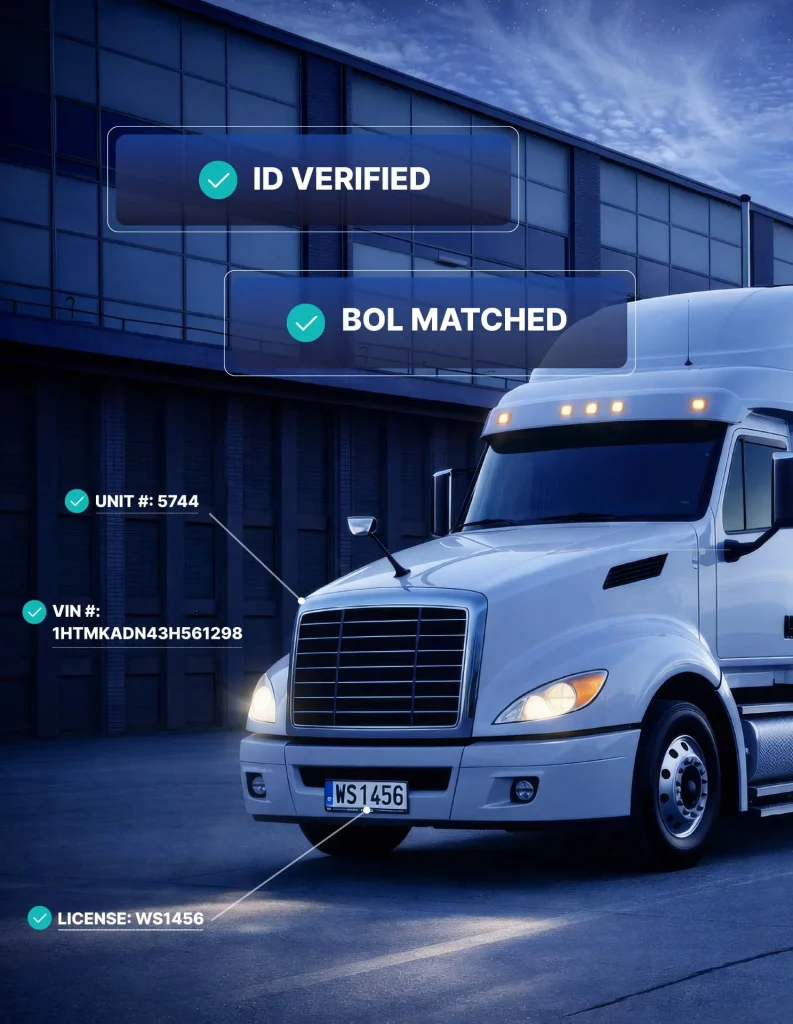
The stronger approach connects all of them.
Driver → carrier → tractor → trailer → shipment.
If one element changes, the transaction can be reviewed before custody changes.
This is especially important for facilities releasing high-value freight or serving multiple customers with different pickup protocols.
For a deeper look at this process, see our guide to driver verification at warehouse gates.
Step 3: Capture the Documents That Support the Handoff
Documentation creates context.
The chain of custody may include a BOL, pickup number, delivery order, appointment record, customer authorization, seal information, or other shipment reference.
The goal is to connect those records to the gate transaction rather than storing them in unrelated systems.
If a BOL is photographed but cannot later be connected to a specific driver, trailer, and timestamp, its investigative value is limited.
The same is true for seal checks.
A note that says “seal okay” is weaker than a record showing the seal number, condition, trailer, time, and access decision.
Read BOL Capture and Seal Checks: Why Gate Documentation Matters for more detail.
Step 4: Treat Gate Approval as a Custody Event
The gate is often the final control point before freight physically leaves the property.
That makes the exit decision part of the chain of custody.
A strong outbound record can show:
- Which driver left
- Which tractor and trailer left
- What shipment was associated with that equipment
- Which documents were presented
- Whether the seal matched
- Who or what approved the release
- Whether an exception occurred
- The exact exit time
“The gate opened” is not the same as “the shipment was properly released.”
Step 5: Connect Yard Activity to the Shipment Timeline
Chain of custody can become unclear between the dock and the gate.
A trailer may be dropped, staged, moved by a yard tractor, placed at another door, or left overnight before departure.
This does not mean every yard movement needs to create a complex compliance record. But important movement should be visible when investigating a discrepancy.
If a trailer left a dock at 8:10 p.m., moved to staging at 8:22 p.m., and exited at 11:44 p.m., that timeline can matter.
Yard visibility also helps answer whether unexpected equipment movement occurred before an incident.
Step 6: Document Exceptions, Not Just Successful Transactions
The most valuable chain-of-custody records are often the exceptions.
Examples include:
- Driver mismatch
- Carrier substitution
- Trailer mismatch
- Missing BOL
- Changed delivery instructions
- Damaged seal
- Seal number mismatch
- After-hours arrival
- Unscheduled pickup
- Manual override
A record should show what happened and how it was resolved.
That may include a callback to a verified contact, secondary approval, an updated shipment record, denial of access, or escalation to a manager.
Exceptions are where human judgment becomes part of the custody record.
Step 7: Maintain Custody Visibility Until Delivery Is Reconciled
CargoNet has warned that identity-based cargo theft can occur after a legitimate carrier has already taken possession, including through changed delivery instructions or compromised communication channels. Its 2026 holiday guidance recommends maintaining shipment visibility until freight is delivered, received, and reconciled. See CargoNet’s 2026 guidance.
This means the custody record should not necessarily stop at the facility gate.
Shippers and logistics providers should have procedures for validating meaningful delivery changes through known contacts and reconciling final delivery when risk warrants it.
For the recordkeeping layer behind this process, see our guide to gate transaction records and why paper logs are not enough.
What Makes a Chain of Custody Weak?
Common weaknesses include:
- Paper logs with incomplete vehicle information
- BOL images stored separately from gate transactions
- No record of who approved an exception
- Outbound transactions receiving less scrutiny than inbound traffic
- Trailer numbers entered manually and inconsistently
- Driver identity not connected to the vehicle and load
- No searchable history across sites
- Camera footage that must be manually reconstructed after an incident
A chain of custody is only useful if the information can be found when it matters.
What Should Logistics Leaders Measure?
Useful metrics can include:
- Percentage of transactions with complete driver and equipment records
- Trailer mismatch rate
- Document exception rate
- Seal exception rate
- Manual override rate
- After-hours release volume
- Average exception resolution time
- Percentage of outbound transactions with complete documentation
- Time required to reconstruct a disputed shipment
These metrics help identify whether custody control is a documented process or merely an expectation.
How Birdseye Supports Freight Chain of Custody
GATECORE helps connect driver, carrier, truck, trailer, document, seal, access, and gate transaction information.
YARDCORE adds visibility into relevant movement after equipment enters the property.
SAFECORE supports perimeter and facility monitoring when suspicious activity occurs around freight.
The Portal centralizes important events and records so teams can review the timeline more quickly.
The objective is not to create more paperwork. It is to create a clearer operational record.
Freight Chain of Custody Checklist
- Do we know which carrier is expected?
- Do we verify the actual driver?
- Do we connect the driver with the tractor and trailer?
- Are shipment references connected to the transaction?
- Are seals documented where required?
- Are exceptions categorized and resolved visibly?
- Do outbound transactions receive the same level of control as inbound traffic?
- Can we search the transaction later by driver, trailer, date, customer, or shipment?
- Can we connect gate records with relevant video?
- Can we reconstruct who controlled the shipment at each critical handoff?
How to Make Chain-of-Custody Data Useful Across Departments
Security teams are not the only users of custody data.
Operations may use it to resolve trailer-location questions. Claims teams may use it during customer disputes. Customer service may need it when a consignee questions a delivery. Finance may need supporting records when a loss becomes a claim. Legal teams may need a clear timeline after a serious incident.
That means the record should be understandable without requiring the original guard, dispatcher, or yard employee to explain what happened.
Useful records are structured around common identifiers such as trailer number, driver, carrier, shipment reference, date, time, and customer. Free-text notes still have value, but they should support structured data rather than replace it.
The best chain-of-custody record is one that another department can understand weeks later without reconstructing the event from memory.
One final principle: custody records should be captured as close to the event as possible. Information entered hours later is more vulnerable to memory gaps, transcription errors, and missing context. Real-time or near-real-time transaction records make the custody timeline more reliable and more useful during investigations.
Frequently Asked Questions About Freight Chain of Custody
What is a freight chain of custody?
A freight chain of custody is the documented timeline of possession and control across a shipment’s lifecycle, including the people, carriers, vehicles, trailers, documents, timestamps, and approvals associated with important handoffs.
Why is chain of custody important for cargo theft prevention?
It makes it easier to verify whether a shipment was released to the correct party and to reconstruct where control changed when a theft, dispute, or delivery problem occurs.
Is a Bill of Lading enough to prove chain of custody?
No. A BOL is an important shipment document, but a stronger chain of custody connects it with driver identity, carrier, truck, trailer, seals, timestamps, access decisions, and delivery records.
Should outbound gate records be part of chain of custody?
Yes. The outbound gate may be the final facility-controlled handoff before freight leaves the property, making the release decision and equipment verification important custody events.
Can chain of custody be automated?
Many routine data-capture and verification steps can be automated. Complex exceptions still benefit from trained human review when information does not match the expected transaction.
Know Who Controlled the Freight — Not Just Where It Was Supposed to Go
Modern cargo theft often exploits gaps between systems, identities, and handoffs.
A strong chain of custody closes those gaps by connecting the shipment to the people, equipment, documents, approvals, and events that moved it through the operation.