Any logistics yard, distribution center, or factory manager is no stranger to the unsettling thought that pops up when examining a traditional security interface and pondering the state of affairs at the perimeter. For as long as anyone can remember, safeguarding the perimeter of an industrial site has always meant choosing between two equally static options:
- either hiring armed on-site guards to keep a watchful eye on the premises or
- deploying surveillance cameras around the fence.
However, the traditional methods of perimeter protection and monitoring have already become obsolete. In the times when cargo theft networks operate using advanced techniques, margins are narrow, and there is always a lack of skilled staff, the old-fashioned way of guarding the fence line is insufficient. An effective solution can only be provided in a fast, accurate manner and seamlessly integrated into the process of operation of a business entity.
The problem with most companies trying to implement perimeter monitoring on a bigger scale lies in the approach used. Namely, they install portable trailers in parking lots with the aim to monitor and protect perimeters using cameras. From one perspective, the solution seems efficient and effective. However, in practice, such units tend to become nothing more than very expensive recording devices capable of documenting the crime scenes in HD quality but not able to do anything else.
The Problems with Traditional Perimeter Monitoring
As we look toward the future, we must take a look at what is failing in the traditional systems. One of the most significant weaknesses in traditional perimeter monitoring is their reactivity. The standard security setup tends to be reactive rather than proactive in its design. As an example, a camera detects an indistinguishable individual scaling a fence in the middle of the night, and an alarm is triggered. Hours worth of video footage is recorded and stored to a server, while the perpetrators have disappeared, leaving logistics workers with only an insurance claim and missed deliveries.
This process creates a huge amount of inefficiency. When using basic cameras with motion detection, the problem of false alarms cannot be avoided. Debris blown around by the wind, wandering animals, and even shadows will set off an alarm of equal importance to an attempted crime against the property. In a case where the surveillance system records hundreds of false alarms each week, human operators are bound to experience alert fatigue.
Moreover, a lot of outdated platforms function like islands. The cameras watching the back fence perimeter cannot interact digitally with the processes taking place at the front entrance or the loading docks. When the security data gets segregated from everything else in the system, executives fail to get the full picture. The presence of an unusual car driving around the edges of the property should instantly put the access control team on edge. However, in a siloed world, each hand remains ignorant of the other’s actions until something goes wrong.
The Hidden Cost of the Hybrid Guard Illusion
However, when the outdated video-based perimeter monitoring system proves inadequate for preventing crimes, the company may decide to combine it with human security guards on location to create a more effective solution. At first glance, the solution looks promising; a suspicious activity picked up by the video stream triggers a command to the guard who then goes to verify it on-site. While this combination of technology and human resources might appear ideal, it usually results in introducing serious lags and unreasonably high costs.
The overreliance on human resources to solve what is primarily a technological issue leads to introducing a weak link – human. The guard can physically be only in one place at a time. Therefore, while he monitors the eastern docks of a fifty-acre complex, nothing stops intruders from approaching the fence located in the western part. The human factor gives criminals a chance to take advantage of the minutes required for the guard to get there.
The financial sustainability of such an approach is no less impossible to achieve. Keeping 24/7 physical security personnel is among the most expensive line items in a company’s operating budget. In addition to increasing costs due to higher pay, hiring difficulties, and management associated with outsourcing security guard contracts, there is added expense due to the inherently sluggish nature of the current security approach. For true efficiency to be achieved, it is imperative that companies move past traditional labor-intensive approaches and into technology-assisted remote security architectures.
Transforming Perimeter Monitoring into Real-Time Intelligence
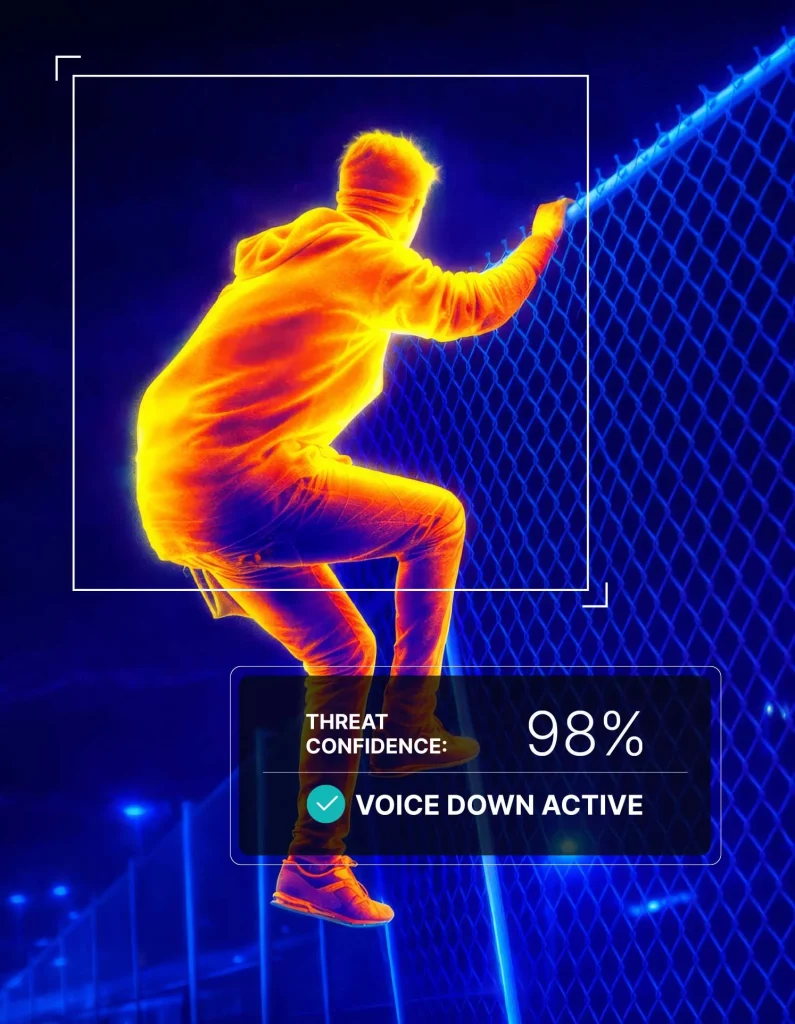
Modern perimeter monitoring technology reverses everything about the conventional method by relying entirely on automated prevention. Instead of relying on the ability to intercept any intrusion, an intelligent security mechanism applies computer vision along with artificial intelligence to assess suspicious activity outside the fence in advance. Once virtual boundaries (also referred to as geofences) have been set, it takes just several moments for the system to detect, recognize, and neutralize any possible threat.
The secret to success lies in using advanced machine learning in addition with constant human monitoring. The algorithm is exceptionally effective at processing data instantly and disregarding the irrelevant noise, such as rustling bushes and passing animals that would trigger a lot of false alarms otherwise. However, the company should not leave the decision up to the technology.
Once the system spots unusual behavior, it presents the operator with live video footage that can be checked within just a few seconds. This human intervention results in 99% accuracy rates, no false alarms, and almost immediate reactions to actual threats.
This level of intelligence eliminates all reliance on the slow process of guard deployment. Since the system has continuous visual coverage of every inch of the premises perimeter at all times, there are no gaps left open. This allows for seamless visibility that works perfectly in zero light by means of thermal and optical imagery. The operations manager can rest assured that the security is foolproof around the clock.
Proactive Deterrence Over Passive Perimeter Monitoring
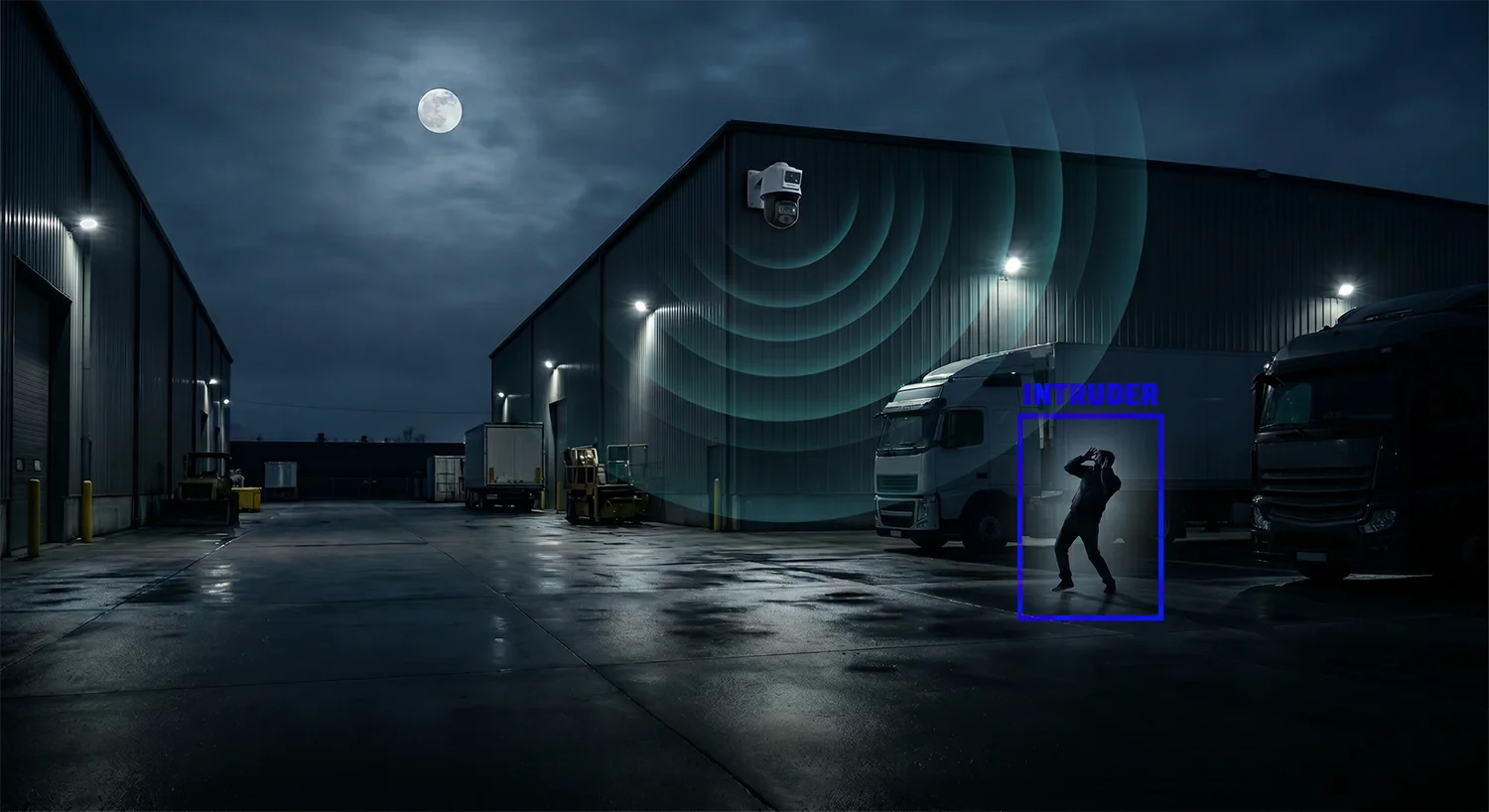
With a credible threat having been detected at the perimeter of your facility, speed becomes crucial. Depending on the response times of the local authorities, or on the time required for an on-site security guard to activate their pre-programmed responses, is simply not an effective strategy. The most efficient way to ensure the protection of an industrial site is to intervene and intercept the threat from the outset. Contemporary perimeter monitoring offers the following revolutionary solution – audio intervention, or Voice-Down™ deterrence.
Consider the case of a trespasser moving toward an unlit row of trailers at a logistics depot at 2 AM. The situation would typically be documented either by video surveillance without further action, or accompanied by a siren being set off automatically.
With modern audio intervention technology, a professionally trained security officer will address the trespasser directly, utilizing a powerful directional speaker: “The individual dressed in a grey hooded jacket in front of trailer number 42, you are now trespassing on private property. Police have been notified. Please leave the area.”
This psychological effect is massive. Criminals depend on anonymity and the knowledge that they are not being watched at all. Once they learn that there’s a person following their every move and communicating with them in real time, everything shifts for them right away. Most of the time, the intruder leaves the area at once. This approach makes perimeter monitoring an active method of prevention, stopping the criminal before any harm is done to your property.
Bridging the Gap Between Security and Industrial Operations
It’s not until you move away from considering perimeter monitoring as just another job and start seeing it as the base component of your business operations’ infrastructure that real industrial security evolves. In heavily trafficked industries such as logistics, manufacturing, and supply chain distribution, any security lapses go hand-in-hand with low operational efficiencies. The breakdown in gate procedures results in a buildup of trucks; a build-up leads to trucks being left parked outside the secured perimeter; trucks sitting on open roads become a goldmine for theft of goods.
By adopting a modular platform-based approach, innovative companies today integrate perimeter security systems seamlessly within their gate and yard management processes. By having the perimeter monitors, gate operations, and yard control systems work together on the same platform, both security and efficiency levels are elevated.
For example, upon arrival, the perimeter monitor system recognizes the approaching truck using its license plates and trailer seals for authentication, reducing gate processing time up to 75%.
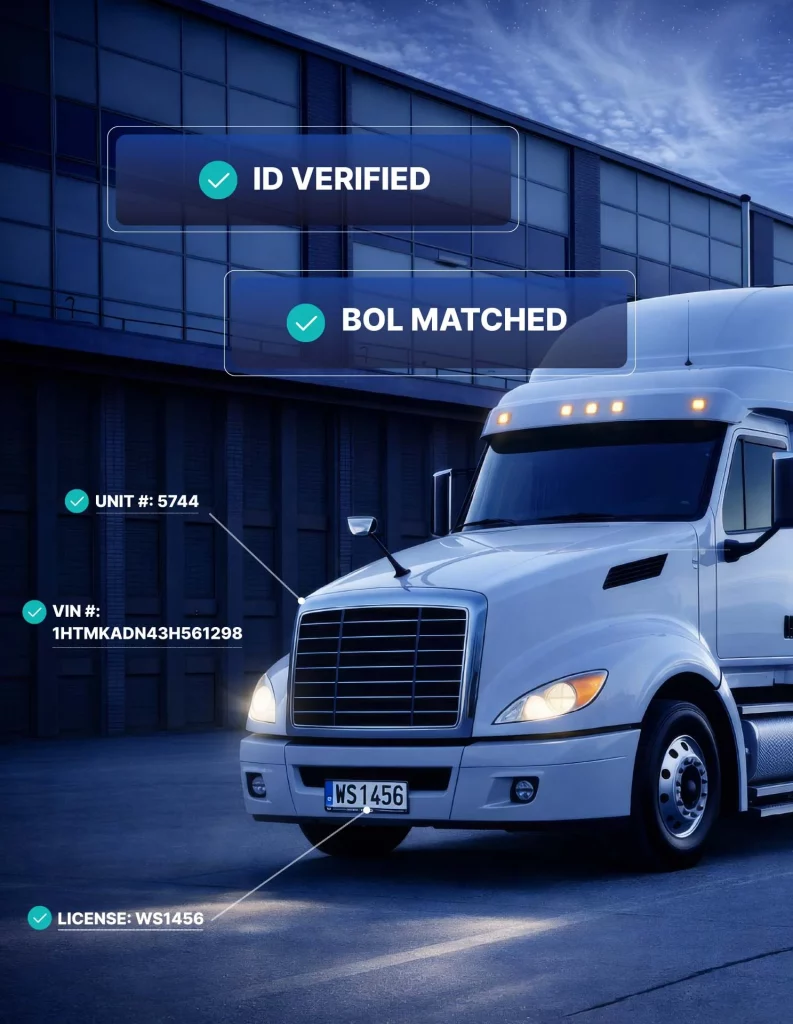
The integrated approach eliminates the classic dividing lines between loss prevention and logistics. Rather than managing the hardware in a piecemeal fashion, using different companies for the gate, for camera trailers, and for the on-site guarding service, yards can manage all aspects of their operation through one cohesive system – the BIRDSEYE PORTAL. Not only does this approach make the facility much more secure against outside threats but also reduces driver dwell time, ensures compliance, and keeps the flow moving predictably throughout the entire supply chain process.
The Financial Impact of a Remote-First Security Model
In addition to the clear benefits of improved threat detection and increased visibility, adopting a cutting-edge, remote first perimeter monitoring system is one of the most ROI-efficient moves a business can make. Once a business moves away from the outdated and costly combination of guard patrol and monitoring, its financials improve almost instantly. Large volume facilities regularly see their security costs cut down from 15% to 25% of their budgets.
The reasons behind those savings are purely logistical. In moving to a remote-first approach, businesses replace expensive man-hours with uninterrupted AI Powered perimeter monitoring that never goes off duty, never makes mistakes, and doesn’t sleep. Rather than investing money in physical security that can only operate within geographical constraints, businesses adopt an intelligent and infinitely scalable security solution that grows as their needs do.
But that’s not all. Being able to keep detailed timestamped logs, record high-quality video footage, and document every single operator response step ensures that the audit process is easier, more transparent, and safer for businesses than ever before. In case of any incidents, having access to irrefutable proof is invaluable when it comes to insurance claims and cargo disputes.
Designing a Smarter, Safer Future for Your Facility
The protection of your industrial site in the modern era requires something far more progressive than what was used to work in the past. There will soon come a point where even the flash of cameras mounted on trailers and high-priced security guards who patrol your site cannot satisfy the demands placed on modern business operations. In order to succeed in the present-day supply chain climate, you need something which provides full visibility, instant deterrence, and full integration into your operations.
That is precisely why a comprehensive system that links up your gate automation, your yard surveillance, and your perimeter surveillance through one intelligent, unified real-time interface is required. What you really need is not simply more pairs of eyes watching your fence line – it is a smarter system that will help you do business with confidence and ensure security while reducing costs.