Freight facilities in 2026 are managing more volume, higher cargo values, and more sophisticated fraud schemes than at any point in the past decade.
Security expectations have shifted accordingly. Executive teams and insurers now require measurable, enforceable control across gate, yard, and perimeter.
A guard-only model was built for observation and response. Modern freight risk requires continuous verification, pattern detection, and perimeter intelligence at machine speed.
Human presence remains valuable. Human-only enforcement does not scale.
The data from 2025 confirms the shift.
Cargo Theft Is Increasing in Financial Impact and Sophistication
In 2025, estimated cargo theft losses in the United States reached nearly $725 million, representing a 60 percent increase over the previous year. The average loss per theft rose to approximately $274,000 per incident, signaling a clear focus on high-value freight.
Industry projections indicate cargo theft incidents could increase another 22 percent in 2025, expanding beyond coastal hubs and into inland logistics corridors.
Strategic theft, methods involving fraudulent, fictitious pickups and identity theft, surged by 1,475% from 2021 through 2024, now representing around 40% of all cargo theft.
Reports also show that roughly 33 percent of U.S. cargo theft incidents in Q2 2025 involved insider involvement, indicating that credential misuse and internal compromise are meaningful risk factors.
The risk environment is no longer limited to perimeter breaches. Fraud entry, identity manipulation, and coordinated pickup schemes now represent material exposure.
Guard-Only Gate Models Struggle Under Throughput Pressure
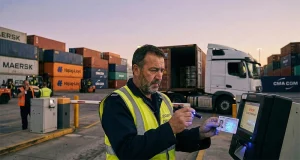
High-volume facilities process hundreds of vehicles daily. Each transaction may require:
- CDL verification
- Dispatch confirmation
- Bill of Lading Review
- Seal validation
- Trailer status confirmation
- License plate logging
Under peak windows, queues form quickly. Review time compresses. Fatigue accumulates. Enforcement becomes dependent on human discretion.
Organized theft groups design their tactics around procedural gaps. Fraudulent carriers exploit documentation checks that are rushed or inconsistently applied. Insider collaboration increases complexity beyond visual inspection.
A human guard can review paperwork. A coordinated fraud scheme can simulate legitimacy.
The system must validate data faster than it can be manipulated.
AI Enables Vehicle-Level Enforcement at Scale
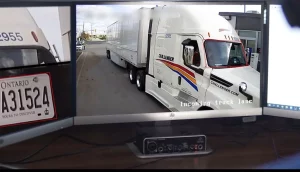
AI-enabled gate systems apply automated logic to every vehicle entering or exiting a facility.
License plate recognition linked to dispatch data enables:
- Real-time cross-validation of vehicle identity
- Detection of mismatched truck-trailer pairings
- Identification of repeat vehicles across sites
- Automated denial of access when risk thresholds are exceeded
- Structured audit trails for every gate event
As transaction volume increases, the system improves. Historical vehicle behavior informs risk models. Pattern detection strengthens across time and geography.
Fraud schemes that rely on procedural inconsistency face consistent enforcement.
This is enforcement at system speed.
Perimeter Risk Extends Beyond Human Field of View
Cargo theft does not rely solely on entry manipulation. Large freight yards face exposure during after-hours operations, low-visibility conditions, and shift transitions.
AI-enabled perimeter systems expand detection capability through:
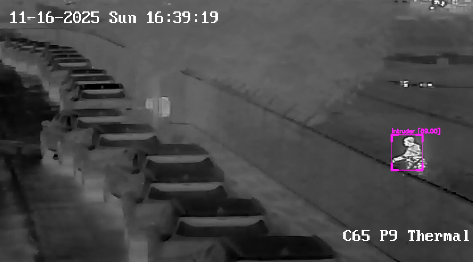
- Thermal detection for heat signature monitoring in darkness or fog
- Real-time intrusion analytics that distinguish human movement from environmental noise
- Behavioral pattern recognition for loitering or staged vehicles
- Automated escalation workflows
Thermal imaging identifies intrusions where visible-light cameras degrade. AI analytics operate continuously without fatigue. Monitoring coverage becomes persistent rather than shift-dependent.
This capability is particularly critical when theft groups test facilities overnight or exploit blind zones.
Insider Risk Requires Structured Accountability
The 33% insider-involvement statistic highlights a material reality: some cargo theft events involve internal collaboration, credential compromise, or policy circumvention.
Human-only models struggle to detect subtle procedural deviations. AI-backed systems generate structured logs tied to:
- Driver identity
- CDL verification
- License plate data
- Trailer seal integrity
- Bill of lading capture
- Entry and exit timestamps
Structured transaction data enables anomaly detection across time. Repeated irregular patterns surface faster. Risk scoring becomes data-driven rather than observational.
Accountability strengthens when every transaction is logged, verified, and retained.
The Enforcement Standard Has Changed
In 2026, freight security requires layered intelligence.
Losses per incident are rising. Organized theft groups coordinate across jurisdictions. Identity-based fraud represents a measurable share of incidents. Insider exposure remains significant.
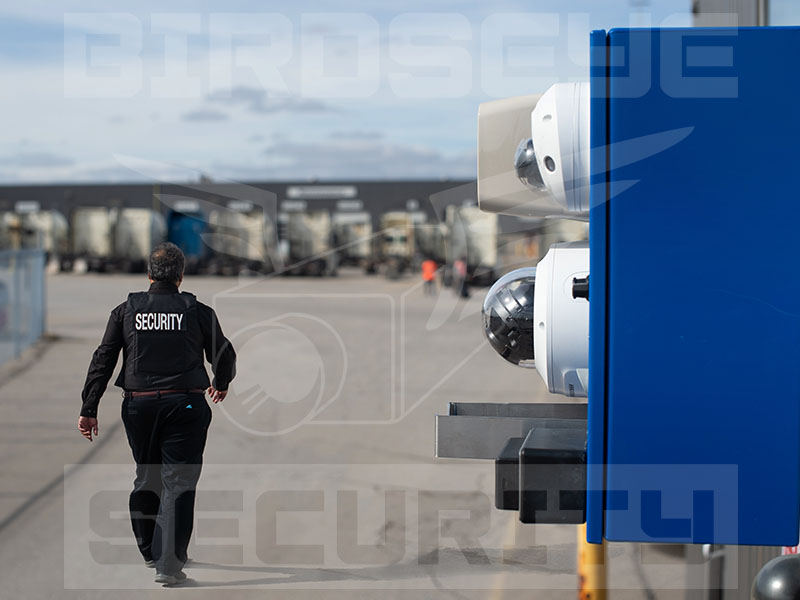
Human guards remain valuable for oversight, response, and escalation. However, relying exclusively on manual verification and visual perimeter patrols under high throughput and organized fraud pressure introduces measurable exposure.
AI-driven gate automation, license plate intelligence, thermal perimeter detection, and structured transaction logging provide scalable enforcement aligned with the modern threat environment.
Birdseye Security Solutions integrates these capabilities across GateCore, YardCore, and SafeCore to deliver vehicle-level control, real-time AI enforcement, and 24/7 monitored oversight for high-volume freight facilities.