A fraudulent cargo pickup does not always look suspicious.
The driver may know the shipment number. The carrier name may be familiar. The truck may arrive during the correct pickup window. The paperwork may appear legitimate.
That is exactly why carrier impersonation is dangerous.
Carrier impersonation happens when a criminal actor presents themselves as a legitimate carrier, driver, broker, or authorized pickup party in order to gain control of freight.
In a modern logistics environment, the deception may begin online, but the loss can become physical at the gate.
The FBI identifies fictitious pickups, identity theft, account takeovers, double brokering, and fraudulent carriers as strategic cargo theft methods. NMFTA has also highlighted carrier impersonation, FMCSA account hijacking, and social engineering as growing freight-security concerns.
That makes the facility gate one of the last opportunities to independently verify that the person, truck, trailer, and shipment in front of you actually belong together.
Quick Answer: How Do You Stop Carrier Impersonation at the Gate?
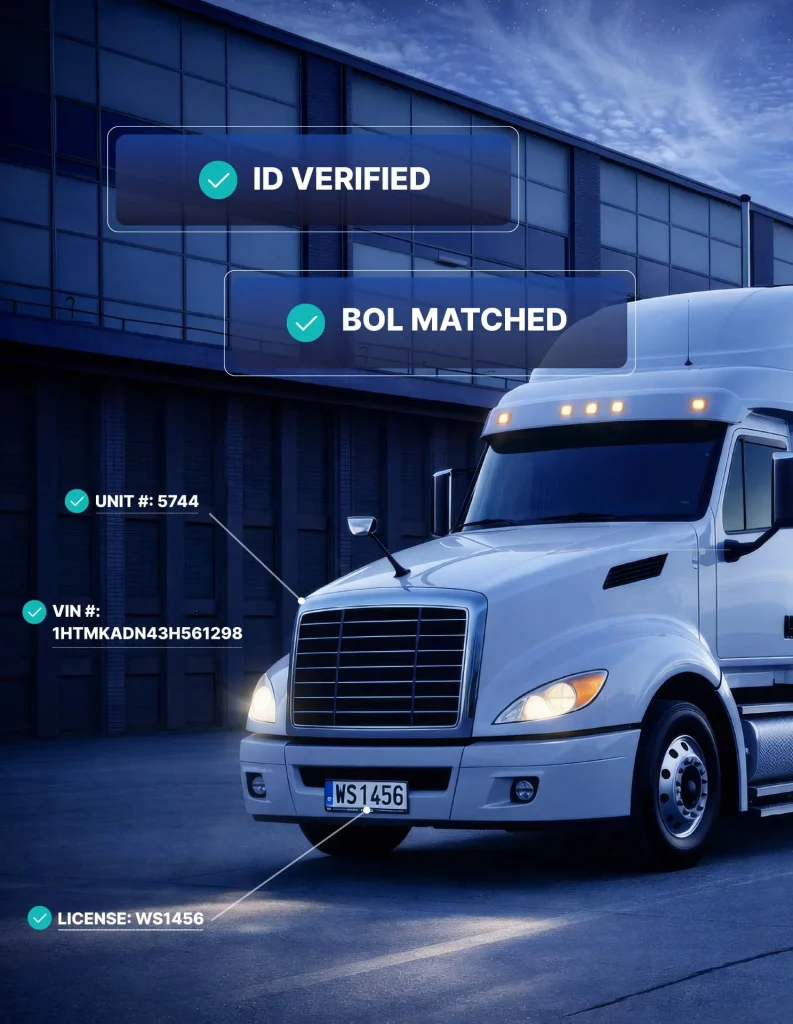
Do not approve a pickup based on one identifier. Build a layered verification process that connects the driver, carrier, truck, trailer, shipment documentation, pickup authorization, and access decision.
| Verification Layer | What to Confirm |
|---|---|
| Driver | Identity, authorization, expected pickup |
| Carrier | Carrier identity and relationship to the shipment |
| Truck | Truck number, plate, company markings |
| Trailer | Trailer number and expected equipment |
| Shipment | BOL, pickup number, appointment, customer reference |
| Seal | Seal number and condition when required |
| Exception | Escalate mismatches to a trained person instead of guessing |
What Is Carrier Impersonation?
Carrier impersonation is a form of freight fraud in which a criminal actor uses the identity, reputation, credentials, or communication channels of a legitimate transportation company to obtain freight.
The scheme may involve:
- Stolen carrier credentials
- Compromised email accounts
- Hijacked phone systems
- Fraudulent load-board activity
- Fake or altered documents
- Compromised compliance-platform accounts
- Driver impersonation
- Unauthorized carrier substitutions
The FBI describes this broader category as strategic cargo theft because the freight is obtained through deception rather than by simply breaking into a trailer.
Read the FBI cargo theft guidance.
Why Earlier Carrier Approval Is Not Enough
A broker or shipper may have correctly approved a carrier when the load was awarded.
That does not automatically prove that the person arriving at the facility later is legitimate.
Between tender and pickup, several things can change.
A carrier account can be compromised. A phone system can be hijacked. Contact information can be altered. A driver substitution can be made. Shipment instructions can be redirected.
CargoNet warned in 2026 that criminals were increasingly trying to operate from inside trusted phone systems and compliance workflows rather than relying only on obvious spoofing.
The gate should therefore act as an independent verification layer, not simply as the physical end of an earlier digital approval.
Warning Sign 1: The Driver Is Correctly Informed but Unexpected
A sophisticated fraudulent pickup may involve someone who knows real shipment details.
That means “they knew the pickup number” is not enough.
If the driver identity does not match what is expected, the transaction should become an exception.
The facility should verify:
- Driver name
- Driver ID or approved credential
- Carrier relationship
- Expected appointment
- Pickup reference
- Any customer-specific authorization requirement
A knowledgeable driver is not automatically an authorized driver.
Warning Sign 2: Truck or Trailer Information Does Not Match
Freight fraud prevention becomes stronger when the driver is connected to the actual equipment arriving at the facility.
Verify:
- Truck number
- License plate
- Trailer number
- Carrier markings
- Equipment type
A mismatch does not always mean fraud.
Carriers legitimately substitute equipment every day.
But a substitution should be handled as a documented exception instead of silently accepted.
This is where trained human review matters.
For more, read Driver Verification at Warehouse Gates.
Warning Sign 3: The Pickup Story Changes at the Gate
Fraudulent actors often rely on urgency.
Examples include:
- “Dispatch changed the trailer.”
- “The customer said it was okay.”
- “My appointment is not in the system, but they told me to come.”
- “The original driver called out.”
- “The BOL will be sent later.”
- “The pickup number was changed.”
Any one of these can be legitimate.
The security problem appears when the gate has no independent way to resolve the change.
Exception handling should be designed into the gate process before the exception occurs.
Warning Sign 4: The BOL or Pickup Documentation Is Incomplete
Documents should support the transaction, not replace verification. A Bill of Lading can contain useful information, but documents can also be altered, copied, or presented outside the expected workflow.
A stronger process connects BOL information with the actual driver, carrier, truck, trailer, and access decision.
For outbound transactions, facilities may also document seal information when required.
See BOL Capture and Seal Checks: Why Gate Documentation Matters.
Why a Single Pickup Number Is Not Enough
A pickup number can be useful, but it should not become the only security control.
If that number is exposed through a compromised email, phone call, screenshot, or account, an unauthorized person may be able to present the correct value.
The FBI recommends confirming positive identities at pickup, including driver, truck, and trailer information, and using secure pickup numbers as part of the security process.
The key phrase is “as part of.” Strong verification is layered.
How the Gate Should Handle a Mismatch
Automated systems are good at comparing expected and observed information.
But when something does not match, the system should not be forced to guess.
A good exception workflow may look like this:
- Transaction is paused.
- Mismatch is identified.
- Relevant driver, carrier, truck, trailer, and shipment details are displayed.
- A trained agent reviews the exception.
- The driver can be contacted through the gate interface if needed.
- The customer or site team is contacted when the protocol requires it.
- The transaction is approved, denied, held, or escalated.
- The final decision is recorded.
Automation should make exceptions visible. Human judgment should resolve the exceptions that require context.
Digital Gate Records Make Fraud Investigations Faster
If a pickup later becomes disputed, the facility should be able to reconstruct what happened.
A complete transaction record may include:
- Driver
- Carrier
- Truck
- Trailer
- Plate
- Pickup reference
- BOL
- Seal status
- Entry and exit time
- Access decision
- Exception notes
- Relevant video
That is much stronger than relying on a handwritten note saying “ABC Trucking — 3:14 PM.”
Read our guide to gate transaction records.
Carrier Identity Security Is Becoming an Industry Priority
Freight identity controls are receiving more attention across the transportation ecosystem.
NMFTA has expanded identity verification requirements around SCAC processes as part of efforts to strengthen trust and reduce impersonation and misuse of carrier identities.
See NMFTA’s SCAC identity verification guidance.
This reinforces a larger principle:
Identity should be verified at multiple points in the freight lifecycle, including the moment freight physically changes hands.
Gate Security Must Connect Digital and Physical Trust
The carrier may have been approved digitally.
The driver arrives physically.
The gate is where those two forms of trust meet.
That means the facility should not treat cybersecurity and physical security as unrelated programs.
A compromised account can create a fraudulent physical pickup. A weak gate can complete a cyber-enabled theft.
The strongest control is an independent physical verification process that does not depend on one compromised data source.
Build a Verification Policy Before the Driver Arrives
Facilities are in a much stronger position when verification rules are defined before a truck reaches the gate.
Customer-specific requirements should be documented. High-value shipments should have clear escalation rules. Transportation teams should define who can approve a driver or carrier substitution. Security teams should know which source of information is considered authoritative when two systems disagree.
This matters because the worst time to invent a fraud-prevention process is while a line of trucks is waiting and a driver is insisting that dispatch already approved the change.
A practical verification policy should answer:
- Which identifiers must match before release?
- Which changes require secondary approval?
- Who can approve the change?
- How will that approval be independently confirmed?
- What information must be stored with the transaction?
- What should happen if the approver cannot be reached?
Clear rules reduce both security risk and gate delay because the operator does not have to invent a decision under pressure.
What Logistics Leaders Should Ask Their Current Gate Team
Carrier impersonation risk is often easier to understand by testing the current process.
Ask the gate team what would happen if the expected driver changed, if the carrier called from a different phone number, if the trailer did not match, or if the BOL looked correct but the appointment was missing.
If the answer is “we usually call someone” or “it depends who is working,” the facility may have a process consistency problem.
Good verification should be repeatable across shifts, locations, and employees. The workflow should also create a record of why a transaction was approved or denied. That is especially important for multi-site operators because inconsistency between facilities can become an exploitable gap.
Make Exception Data Useful Over Time
Every mismatch should do more than create a one-time delay. If a facility categorizes exceptions, patterns can become visible across weeks or months.
Track common causes such as driver substitution, trailer mismatch, missing appointment, changed pickup number, BOL issue, or unrecognized carrier contact. If one carrier repeatedly creates the same exception, transportation and security teams can address the root cause instead of solving the same problem at the gate every week.
Exception data turns gate security into a source of operational intelligence, not just a pass-or-fail checkpoint.
How Birdseye Helps Strengthen Pickup Verification
Birdseye uses GATECORE to support driver, truck, trailer, document, seal, and access verification at industrial gates.
Routine transactions can move through structured automation.
When something does not match, trained Birdseye agents can step in, review the exception, communicate, and follow the facility’s protocol.
Automation handles the routine. People handle what should not be guessed.
Carrier Impersonation Prevention Checklist
- Verify the driver independently at pickup
- Confirm carrier identity
- Match truck and trailer information
- Verify shipment and appointment references
- Connect BOL documentation to the transaction
- Document seal information when required
- Require review for last-minute substitutions
- Do not rely on a single pickup number
- Record the final access decision
- Maintain video and transaction evidence
- Escalate unresolved mismatches to trained personnel
Frequently Asked Questions
What is carrier impersonation?
Carrier impersonation occurs when a fraudulent actor uses the identity or credentials of a legitimate carrier, driver, broker, or transportation company to gain control of freight.
What is a fictitious pickup?
A fictitious pickup is a strategic cargo theft method in which criminals use deception or false identity information to collect freight that should have gone to a legitimate carrier.
How can warehouses prevent fraudulent pickups?
Warehouses can use layered verification that checks the driver, carrier, truck, trailer, shipment documentation, pickup authorization, and access decision rather than relying on a single identifier.
What should happen when driver information does not match?
The transaction should be paused and treated as an exception. A trained person should verify the change according to the facility’s approved protocol.
Can AI stop carrier impersonation?
AI can help compare data and identify mismatches, but complex substitutions and unusual transactions often require human judgment. A combined automation and human-verification model is stronger than either alone.
Stop the Fraud Before the Freight Leaves
Carrier impersonation is difficult because the criminal may appear legitimate.
That is why the gate has to verify the transaction rather than simply recognize the information presented.
The best time to discover a fraudulent pickup is before the gate opens—not after the trailer disappears.