Cargo theft no longer begins only with a cut fence, a broken trailer lock, or an unattended load.
It can begin with a phishing email, a compromised carrier account, a spoofed website, a hijacked business phone system, or a fraudulent change to delivery instructions.
The result is a security problem that crosses the boundary between cybersecurity and physical security.
Cyber-enabled cargo theft happens when criminals use digital compromise or deception to make a fraudulent freight movement look legitimate enough to pass normal operational checks.
That means a warehouse or logistics facility can have strong cybersecurity and still lose freight if the gate does not verify the physical transaction. It can also have cameras, fences, and guards and still release freight to the wrong driver if staff trust compromised digital instructions without independent confirmation.
Quick Answer: What Is Cyber-Enabled Cargo Theft?
Cyber-enabled cargo theft is cargo crime supported by compromised accounts, phishing, spoofed communications, fraudulent load postings, stolen credentials, manipulated phone systems, shipment misdirection, or other digital tactics.
The FBI has warned that criminal groups are increasingly using cyber-enabled methods to impersonate legitimate brokers and carriers, redirect shipments, and steal high-value freight. The FBI also identifies phishing, account takeovers, fictitious pickups, fraudulent carriers, and double brokering as current strategic cargo theft methods.
Read the FBI’s current guidance on cargo theft and strategic cargo theft and its 2026 warning to the transportation and logistics industry.
| Digital Threat | Physical Consequence | Facility Control |
|---|---|---|
| Compromised carrier account | Fraudulent pickup appears legitimate | Verify driver, truck, trailer, and pickup authorization |
| Phishing or account takeover | Shipment details are stolen or changed | Confirm sensitive changes through known channels |
| Spoofed phone or email | Staff receive false instructions | Do not rely on the incoming message alone |
| Fraudulent delivery change | Freight is routed to the wrong destination | Require secondary verification for changes |
| Compromised compliance platform | Bad actor appears to be an approved carrier | Re-verify the physical transaction at pickup |
Why Cybersecurity Alone Cannot Stop a Fraudulent Pickup
Transportation companies have invested heavily in identity management, multi-factor authentication, email filtering, endpoint protection, and secure cloud systems.
Those controls are necessary.
But once a criminal has enough legitimate-looking information, the final theft may happen in a physical place.
A truck arrives at a warehouse.
The driver knows the correct load number.
The carrier name appears valid.
The appointment exists.
The pickup details match information that only an authorized party should know.
From the facility’s perspective, everything may appear normal.
The problem is that the digital identity can be compromised while the physical person and vehicle at the gate are still wrong.
This is why the last line of defense cannot be another email, another spreadsheet, or another portal lookup. The physical transaction needs to be independently verified.
The Gate Is Where Digital Instructions Become Physical Movement
A gate is not just a barrier arm. It is the point where information becomes action. A carrier record becomes an arriving driver. A dispatch instruction becomes a truck entering the property. A pickup number becomes a trailer leaving with freight. A changed delivery instruction becomes an outbound route.
That makes the gate one of the most important control points in a cyber-enabled theft scenario.
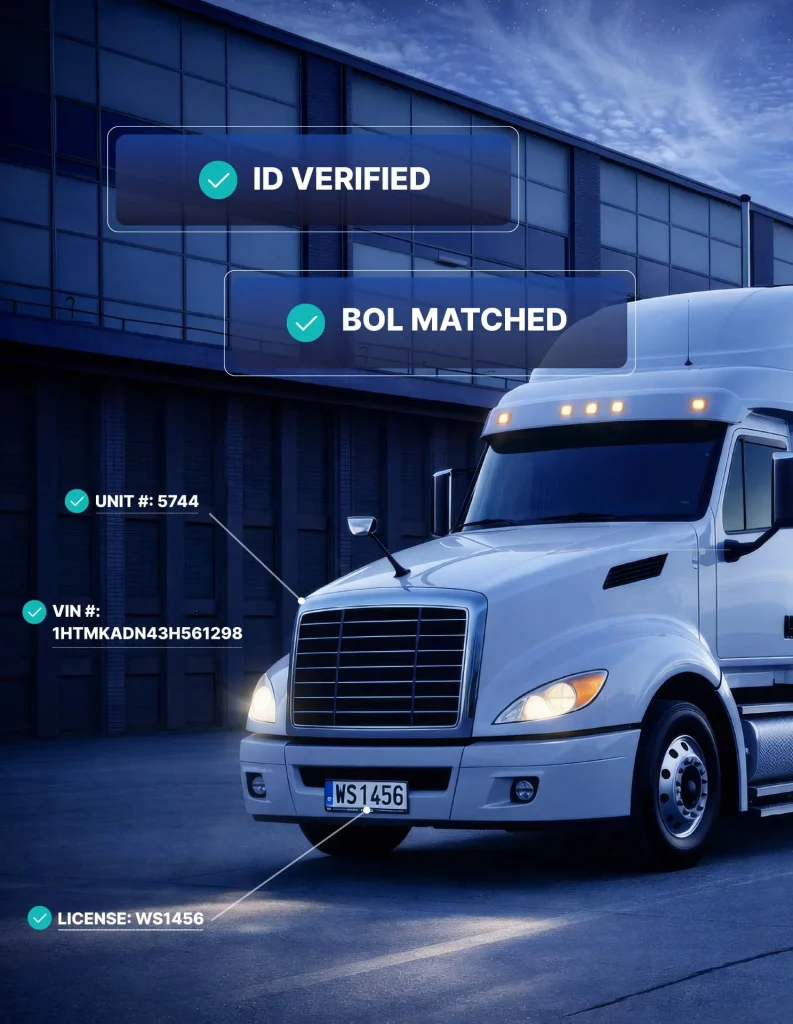
A strong process should connect the digital record to the physical reality:
- Is this the expected driver?
- Is the carrier still authorized?
- Does the truck match?
- Does the trailer match?
- Is the license plate consistent?
- Does the BOL correspond to the correct shipment?
- Is the seal number correct?
- Has the pickup or delivery instruction changed recently?
- If it changed, who verified the change?
For a broader explanation of this physical workflow, see our driver verification at warehouse gates and BOL capture and seal checks guides.
Why “Approved Carrier” Is Not the End of Verification
Many freight security programs focus heavily on carrier selection.
That is understandable. The shipper or broker verifies the motor carrier, checks authority, reviews insurance, validates contact information, and confirms that the company appears legitimate.
But modern fraud can occur after that approval.
NMFTA’s 2026 transportation cybersecurity research highlights identity fraud, account compromise, load-board impersonation, and the weaponization of legitimate systems as growing transportation risks. CargoNet has also warned that criminals increasingly try to gain access to trusted phone systems, carrier accounts, and compliance platforms.
Read NMFTA’s 2026 Transportation Cybersecurity Trends overview.
The operational lesson is simple: trusted digital status should not eliminate physical verification at the moment freight changes hands.
Five Cyber-Enabled Cargo Theft Scenarios Facilities Should Prepare For
1. The Compromised Carrier Account
A criminal gains access to a legitimate carrier account or communication channel.
They may know real load information and use authentic-looking messages.
To facility staff, the transaction appears to come from a trusted carrier.
The defense is not to reject every legitimate carrier. It is to confirm that the physical driver, tractor, trailer, and shipment details match the expected transaction.
2. The Last-Minute Delivery Change
A message arrives instructing the team to redirect a load or release freight to a different destination.
The email may look authentic.
The phone number may even appear to belong to a known company.
Facilities should treat unexpected changes to destination, driver, carrier, or pickup instructions as high-risk exceptions that require secondary verification through a known contact path.
3. The Fraudulent Pickup
A driver arrives with enough correct information to convince staff that the pickup is legitimate.
The strongest control is a layered transaction check: driver identity, carrier, truck, trailer, appointment, secure pickup number, BOL, seal, and release approval.
4. The Compromised Business Phone System
CargoNet has warned about the misuse of software-based business phone systems. If criminals can make calls from recognized company numbers, a callback to the same compromised system may not be enough.
High-risk changes should be confirmed using a separate, pre-established contact method rather than the contact details supplied in the suspicious communication.
5. The Legitimate Carrier Followed by Shipment Misdirection
Not every theft happens at pickup.
A legitimate carrier can take possession and then receive fraudulent delivery changes.
This means freight security should continue after the gate transaction, especially for high-value loads and unusual route changes.
Physical Security Needs a “Do Not Trust the Message Alone” Rule
In cybersecurity, zero-trust principles are built around continuous verification rather than assuming that a user or system should remain trusted forever because it passed an earlier check.
Logistics facilities can apply a similar operational principle.
Do not trust a shipment change simply because the message looks legitimate.
Instead:
- Verify the person requesting the change.
- Use a known contact channel.
- Confirm the driver and vehicle physically present.
- Require additional approval for unusual transactions.
- Create a record of who authorized the exception.
- Preserve supporting documents and video when appropriate.
Gate Exceptions Are Where Cyber Risk Becomes Visible
Most routine transactions do not require a security investigation.
The risk becomes visible when something does not match.
A substitute driver.
A different trailer.
A BOL discrepancy.
A changed pickup number.
An unexpected destination.
A carrier contact requesting a release outside the normal workflow.
Those exceptions should not be treated as administrative annoyances. They are security signals.
A good gate process should categorize exceptions, escalate them to a trained person, document the decision, and preserve the transaction record.
For more detail, see Why Human Verification Matters in AI Security.
Why Searchable Transaction Records Matter
If a shipment is later reported stolen, the investigation should not begin with five people searching different systems.
The facility should be able to answer:
- Who arrived?
- When did they arrive?
- Which carrier were they representing?
- Which truck and trailer were involved?
- What documents were presented?
- What changed from the original transaction?
- Who approved the release?
- When did the vehicle exit?
- What relevant video exists?
A structured digital record makes that reconstruction much faster.
Read our guide to gate transaction records.
Cyber-Physical Security Metrics Worth Tracking
Facilities should measure more than the number of thefts that occurred.
Useful indicators include:
- Driver verification exception rate
- Trailer mismatch rate
- BOL discrepancy rate
- Seal exception rate
- Last-minute pickup changes
- Last-minute delivery changes
- Transactions requiring secondary approval
- After-hours changes
- Denied or held transactions
- Average exception resolution time
These metrics help security and operations teams identify weak points before they become losses.
How Birdseye Supports Cyber-Physical Verification
Birdseye helps connect digital instructions with physical facility activity.
GATECORE supports driver, truck, trailer, document, seal, and access verification at the gate.
YARDCORE adds visibility after vehicles enter the property.
SAFECORE helps detect and verify perimeter activity.
The Portal centralizes important events and records.
When a transaction falls outside the expected workflow, trained Birdseye agents can step in, review the context, follow the facility protocol, and escalate when necessary.
Cyber-Enabled Cargo Theft Prevention Checklist
- Verify drivers independently at pickup.
- Confirm truck and trailer identifiers.
- Use secure pickup numbers where appropriate.
- Require secondary approval for unusual changes.
- Confirm destination changes through known channels.
- Do not rely solely on caller ID or incoming email.
- Document BOL and seal information.
- Record gate exceptions and approval decisions.
- Maintain searchable transaction records.
- Train teams to recognize cyber-enabled freight fraud.
- Coordinate physical security and cybersecurity teams.
- Maintain visibility until high-value freight is delivered and reconciled.
How to Test Whether Your Facility Could Catch a Cyber-Enabled Theft Attempt
A written policy is useful, but the real question is whether the process works during a busy shift.
Facilities should periodically test realistic scenarios such as a substitute driver arriving with correct load information, a trailer number changing shortly before pickup, a delivery destination being altered through email, or an after-hours caller requesting immediate release.
The exercise should measure whether staff follow the expected verification path without improvising. It should also reveal whether the team knows which contact method is trusted, who has authority to approve an exception, and how the final decision is recorded.
A good test should answer five questions:
- Did the team recognize the exception?
- Did they stop the transaction before freight moved?
- Did they verify the change through an independent channel?
- Did they involve the correct decision-maker?
- Did the system create a complete record of the event?
The objective is not to make every transaction slower. It is to make unusual transactions harder to exploit.
What Logistics Executives Should Ask
Cyber-enabled cargo theft is not only an IT problem or a guard problem. It is an enterprise risk that connects security, operations, transportation, customer service, and finance.
Leadership should ask whether the company can prove who authorized a high-risk shipment change, how quickly a suspicious pickup can be paused, whether staff know how to verify a changed instruction, and whether the organization can reconstruct the event afterward without relying on memory.
Another important question is whether cybersecurity alerts and physical security exceptions ever meet in the same process. If a carrier account is suspected of compromise, the gate team should not continue treating that identity as routine. Likewise, a suspicious physical transaction can be an early warning that a digital account or communication channel has been compromised.
The most resilient organizations treat cyber and physical verification as two parts of the same chain of custody.
Frequently Asked Questions
What is cyber-enabled cargo theft?
Cyber-enabled cargo theft uses digital compromise, phishing, account takeovers, spoofed communications, fraudulent platforms, or other cyber tactics to support the physical theft or misdirection of commercial freight.
Can cybersecurity software alone stop cargo theft?
No. Cybersecurity can reduce account compromise and digital fraud, but the physical handoff of freight still needs verification. A legitimate-looking digital instruction can be fraudulent if an account or communication channel has been compromised.
Why should facilities re-verify an approved carrier at pickup?
Because a carrier’s digital identity or communications may be compromised after initial approval. Physical verification helps confirm that the actual driver, truck, trailer, and shipment match the expected transaction.
What shipment changes should trigger extra verification?
Unexpected driver substitutions, carrier changes, trailer changes, destination changes, pickup number changes, unusual after-hours instructions, BOL discrepancies, and seal mismatches should receive additional review.
How do digital gate records help after a theft?
They can connect the driver, carrier, vehicle, trailer, documents, timestamps, exceptions, access decisions, and relevant video into one event history, reducing the time required to reconstruct what happened.
Final Takeaway
Modern cargo theft can start in a digital system and finish at a physical gate.
That changes the role of facility security.
Security teams cannot assume that a message is legitimate because it contains correct shipment data, comes from a familiar phone number, or appears inside a trusted platform.
The physical transaction has to verify the digital instruction.
Facilities that connect cybersecurity awareness with driver verification, shipment documentation, gate exception handling, and searchable records are better positioned to stop fraud before a legitimate-looking transaction becomes a physical loss.