A changed delivery address can look like a normal logistics update.
So can a new contact number, a substitute driver, a different trailer, a revised pickup reference, or an urgent request to release freight outside the normal process.
That is exactly why shipment misdirection fraud is dangerous.
Shipment misdirection fraud occurs when criminals manipulate trusted communications, accounts, or operational instructions so legitimate freight is sent to the wrong person or destination.
The theft may happen without a fence being cut, a lock being broken, or a trailer being physically hijacked. The facility can perform the movement itself because the fraudulent instruction looks legitimate.
Quick Answer: How Do You Prevent Shipment Misdirection Fraud?
Facilities can reduce shipment misdirection risk by treating last-minute changes as exceptions, verifying them through known contact channels, re-checking the driver, truck, trailer, and shipment before release, and creating a searchable record of who approved the change.
| High-Risk Change | Why It Matters | Recommended Control |
|---|---|---|
| Delivery address change | Freight may be redirected after legitimate tender | Confirm through a known, independent contact |
| New driver | Fraudster may impersonate an approved carrier | Re-verify driver identity and authorization |
| Trailer change | Equipment can be substituted during theft | Match trailer to shipment and release record |
| Phone/email change | Compromised communication channel may be used | Do not rely on new contact details alone |
| Urgent after-hours request | Reduced staffing increases decision pressure | Require escalation and secondary approval |
Why Misdirection Fraud Is Different From Traditional Cargo Theft
Traditional cargo theft often involves physically taking freight from a trailer, yard, warehouse, parking area, or transportation asset.
Strategic cargo theft uses deception.
The FBI identifies fictitious pickups, identity theft, account takeovers, double brokering, fraudulent carriers, and cyber-enabled schemes as major cargo theft methods. In 2026, the FBI warned that sophisticated actors were using compromised business accounts, phishing, spoofed websites, and fraudulent load postings to reroute high-value shipments.
Review the FBI’s cargo theft guidance and its 2026 transportation-sector warning.
The key difference is that the criminal may not need to defeat the physical security system. They may persuade the operation to release or redirect the freight for them.
Why Last-Minute Changes Deserve More Scrutiny
Logistics operations change constantly.
Drivers are reassigned. Tractors break down. Trailers change. Appointments move. Destinations are updated. Customers call with urgent requests.
Security cannot treat every operational change as fraud.
But a last-minute change creates one of the best opportunities for a criminal because teams are under time pressure and may prioritize keeping freight moving.
CargoNet’s 2026 advisories have highlighted identity-based fraud, compromised carrier accounts, business phone systems, and shipment misdirection as continuing risks. CargoNet has also warned that theft can occur after a legitimate carrier has already taken possession of a load.
Read CargoNet’s 2026 Labor Day cargo theft advisory.
The Most Dangerous Phrase May Be “We Just Need One Small Change”
Fraud often works because each individual request sounds reasonable.
Change the delivery address.
Use a different driver.
Call this new number.
Release the trailer to this tractor.
The customer approved it.
The broker already knows.
The shipment is late, so please hurry.
Security should evaluate the combination of changes, not only each change in isolation.
One legitimate update may be routine. Three changes involving identity, equipment, and destination within an hour should create a different level of scrutiny.
1. Verify the Source of the Change
The first question is not whether the new instruction looks authentic.
It is whether the facility can independently confirm who requested it.
Do not verify a suspicious change using the new email address, phone number, or contact details included in the same request.
Instead, use:
- a known customer contact already on file;
- a pre-established carrier contact;
- an approved internal system;
- a previously verified phone number;
- or another trusted channel that did not originate with the change request.
This reduces the risk of a criminal controlling both the fraudulent request and the verification path.
2. Re-Verify the Physical Driver and Equipment
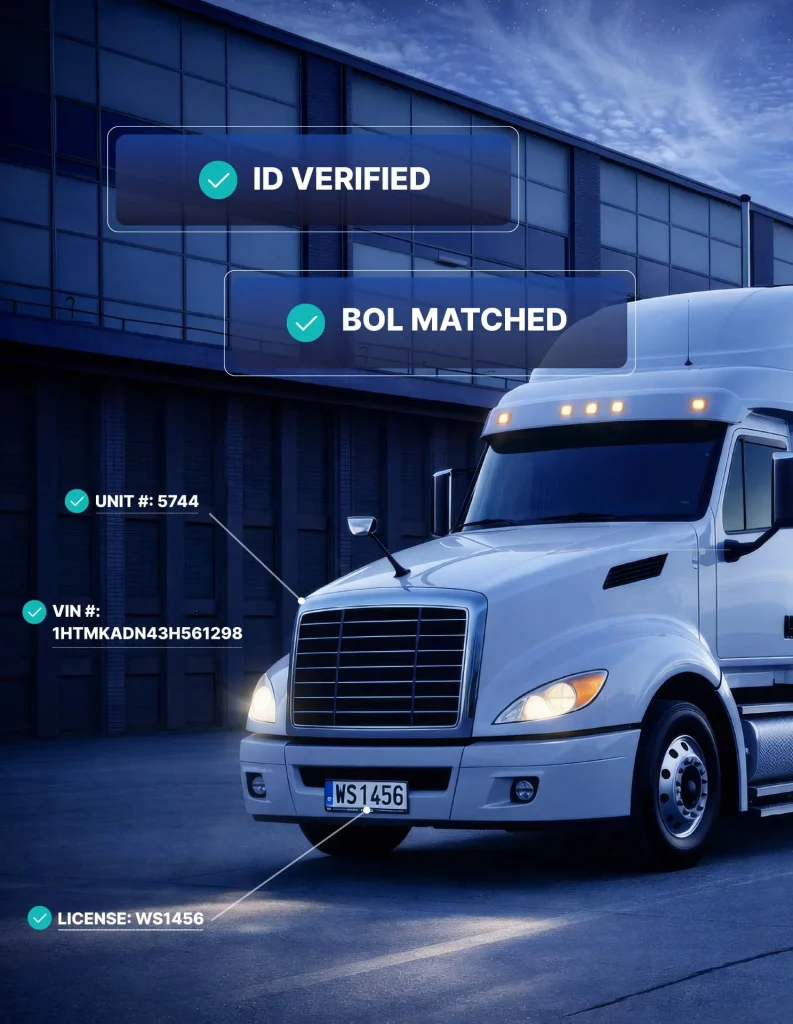
If a shipment instruction changes, the physical transaction should be checked again.
That may include:
- driver identity;
- carrier;
- tractor number;
- license plate;
- trailer number;
- pickup reference;
- BOL;
- seal number and condition;
- and final release authorization.
The FBI specifically recommends positive driver identification at pickup, including driver, truck, and trailer information.
See our guide to driver verification at warehouse gates.
3. Treat Destination Changes as High-Risk Exceptions
A destination change can be legitimate, but it can also bypass every security control that happened earlier.
The carrier may have been properly selected.
The driver may be legitimate.
The freight may have left the warehouse under correct authorization.
Then a criminal compromises an account or trusted communication channel and redirects the delivery.
For high-value freight, changing the destination after tender should trigger independent confirmation and a documented approval path.
4. Watch for Changes That Happen After Business Hours
Night shifts, weekends, holidays, and shift changes create operational pressure.
Fewer managers may be available.
Teams may be working from abbreviated staffing plans.
A criminal requesting an urgent release at 11:45 p.m. may be counting on the fact that the normal approver is unavailable.
Facilities should define in advance:
- who can authorize an after-hours change;
- what types of changes require management approval;
- which contact methods are trusted;
- and what happens when authorization cannot be confirmed.
5. Do Not Let Caller ID Become Proof of Identity
Modern communications systems make phone numbers less reliable as identity proof.
CargoNet has warned about compromised software-based business phone systems that may allow bad actors to make calls from recognized company numbers.
That means “the correct number called us” is not always enough.
For high-risk changes, verify the request through a separate trusted channel and record the confirmation.
6. Build a Change-Control Workflow for Freight
Most companies use formal change control for technology, finance, and safety systems.
Freight instructions deserve a similar approach when the change affects possession, destination, identity, or release authority.
A simple workflow can include:
- Identify the requested change.
- Classify the risk level.
- Confirm the requester independently.
- Re-verify the physical transaction.
- Require the correct approval.
- Document the decision.
- Store the related event record.
The goal is not bureaucracy. The goal is to make a fraudulent change harder to push through during a busy shift.
Shipment Misdirection at the Gate
The gate is often the last place a facility can stop a fraudulent pickup before freight leaves the property.
If the driver, trailer, or shipment details changed, the gate needs access to that context.
A gate process that only asks “is there an appointment?” may miss a more important question:
Does the physical transaction still match the approved shipment?
Read our outbound gate security guide for a deeper look at release controls.
Why BOL and Seal Documentation Matters
When freight is redirected or disputed, documentation can help establish what happened at the facility.
A strong event record can connect:
- the BOL presented;
- seal number and condition;
- driver and carrier information;
- truck and trailer identifiers;
- entry and exit timestamps;
- the original instruction;
- the changed instruction;
- and the person who approved the change.
See BOL Capture and Seal Checks: Why Gate Documentation Matters.
What Should Trigger an Automatic Hold?
Some events should be serious enough that the default action is to pause the transaction until a trained person reviews it.
Examples include:
- driver does not match expected identity;
- carrier changed after appointment creation;
- trailer differs from release information;
- destination changed within hours of pickup;
- pickup number was replaced;
- seal mismatch;
- unexpected after-hours request;
- instructions arrive from a new contact method;
- multiple shipment fields change at once;
- or the person requesting release pressures staff to bypass normal verification.
A hold is not an accusation of fraud. It is a controlled pause until the transaction can be verified.
How to Measure Misdirection Risk
Facilities can track:
- number of delivery changes;
- percentage of changes made within 24 hours of pickup;
- driver substitution rate;
- carrier substitution rate;
- trailer mismatch rate;
- after-hours change requests;
- transactions placed on hold;
- exceptions resolved without escalation;
- exceptions requiring customer confirmation;
- and average resolution time.
These metrics reveal whether shipment changes are rare exceptions or a normal part of the operation that needs a stronger process.
How Birdseye Supports Shipment Verification
GATECORE helps connect driver, truck, trailer, document, seal, and access information at the gate.
When a transaction does not match the expected workflow, trained Birdseye agents can review the exception and follow the customer’s protocol rather than forcing the system to guess.
The Portal helps centralize event records for later review.
Shipment Misdirection Prevention Checklist
- Maintain trusted contact information outside incoming change requests.
- Require independent confirmation for destination changes.
- Re-verify driver and equipment after material changes.
- Escalate after-hours changes.
- Do not rely only on caller ID.
- Document the original and revised instruction.
- Record who approved the change.
- Hold transactions when key shipment fields do not match.
- Preserve relevant gate and video records.
- Train operations and security teams on cyber-enabled freight fraud.
Questions Executives Should Ask
Leadership should know whether a last-minute delivery change can be approved by a single employee, whether high-value loads have a stronger approval path, and whether the organization can prove how a changed instruction was verified.
Another key question is whether customer service, transportation, security, and gate teams follow the same process. Fraud thrives when one department assumes another department already confirmed the change.
A secure process makes ownership explicit: who verifies, who approves, who releases, and who records.
How to Run a Shipment Change Drill
One of the best ways to test a misdirection-control process is to run a controlled exercise during normal operations.
For example, create a scenario in which a known shipment receives a last-minute destination change from a new email address, or a substitute driver arrives with correct load information but a different tractor. The purpose is not to trick employees for punishment. It is to see whether the process itself guides them toward the right response.
During the drill, measure whether the team pauses the transaction, uses the approved verification channel, involves the correct decision-maker, documents the reason for the change, and records the final release decision.
If employees have to search for an old spreadsheet, call several people to discover who can approve the change, or rely on personal memory, the weakness is procedural rather than individual.
A good shipment-change process should make the secure action easier than improvisation.
Why Customers Benefit From Stronger Change Verification
Stronger verification does not only protect the facility. It can protect the customer relationship.
When a shipper asks what happened to a high-value load, a 3PL, warehouse, or terminal should be able to show when the instruction changed, how the change was confirmed, which driver and trailer were involved, and who approved the release.
That level of evidence can reduce ambiguity during claims, disputes, and investigations. It can also demonstrate that the facility follows a repeatable control process rather than relying on informal calls and handwritten notes.
For customers moving high-value or theft-sensitive freight, that operational discipline can become part of the value proposition.
Frequently Asked Questions
What is shipment misdirection fraud?
Shipment misdirection fraud is the manipulation of delivery, pickup, carrier, or routing instructions so legitimate freight is sent to an unauthorized person or destination.
What shipment changes are most suspicious?
Unexpected destination changes, driver substitutions, new carrier information, changed trailer numbers, new contact details, after-hours release requests, and multiple simultaneous changes deserve additional verification.
How can a warehouse verify a last-minute delivery change?
Confirm the change through a known contact channel that is independent of the incoming request, then re-check the physical driver, truck, trailer, documents, and final release authorization.
Can a legitimate carrier still be involved in a misdirection theft?
Yes. Criminals may redirect a shipment after a legitimate carrier has already taken possession by compromising communication channels or sending fraudulent instructions.
Why are digital records important?
They help reconstruct who requested the change, who approved it, which driver and equipment were involved, and when the freight entered or left the facility.
Final Takeaway
Shipment misdirection fraud succeeds when operational urgency outruns verification.
Last-minute changes are part of logistics, but they should not bypass the controls that protect high-value freight.
Verify the source, re-check the physical transaction, document the approval, and never let a changed instruction become proof of its own legitimacy.