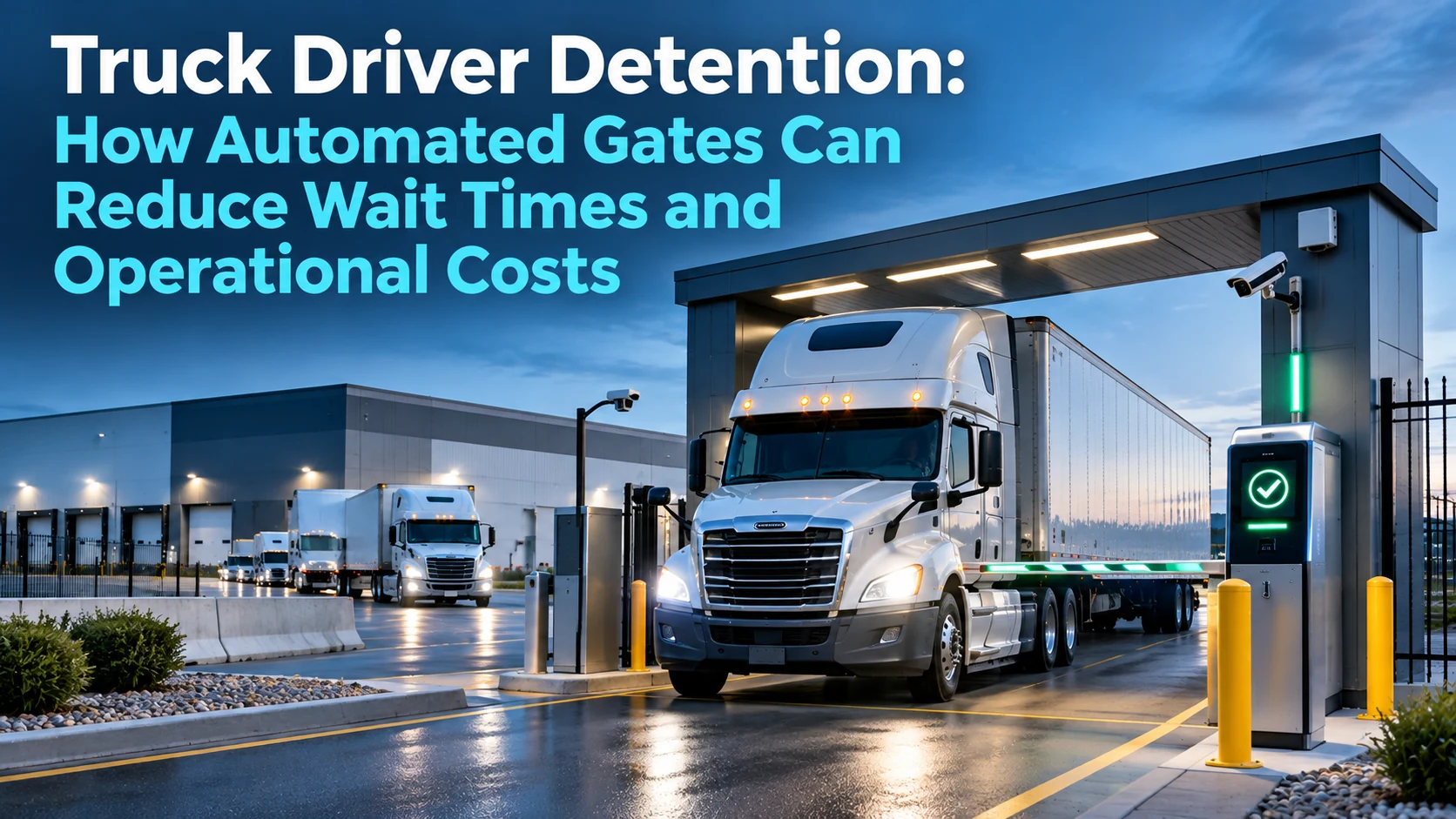
Truck driver detention is not simply a transportation problem. It is a facility performance problem with consequences that extend from the gate to the loading dock, the dispatch office, and the next customer waiting for freight. A driver can arrive on time and still lose a significant part of the working day before completing a pickup or delivery.
Automated truck gates can help reduce truck driver detention by shortening routine check-in and checkout, improving arrival visibility, and routing exceptions to trained personnel. They cannot eliminate delays caused by unavailable docks, labor shortages, or freight that is not ready. The greatest value comes from measuring the entire visit and removing avoidable delay at each stage.
What Is Truck Driver Detention?
Truck driver detention is the time a driver spends waiting at a shipper or receiver beyond an agreed allowance for loading, unloading, or related facility activities. Many transportation agreements use two hours as a starting point, but the applicable free-time allowance, rate, documentation requirements, and exclusions depend on the contract.
Detention should not be confused with every minute a truck spends at a facility. A driver may spend time checking in, staging, receiving instructions, getting loaded, completing paperwork, and exiting. Some of that time is necessary. The operational goal is to identify avoidable waiting without cutting legitimate security or safety checks.
| Term | Meaning | What the facility can measure |
|---|---|---|
| Gate queue time | Waiting before processing begins | Arrival to check-in start |
| Gate processing time | Completing access verification | Check-in start to admission |
| Trailer dwell time | Time equipment remains at the site | Entry to exit or pickup |
| Driver detention | Waiting beyond contractual free time | Eligible visit duration against contract |
| Turnaround time | Total duration of a defined truck visit | Arrival to departure |
A facility can improve gate performance while detention remains unchanged if the dock is still the bottleneck. That distinction is essential when evaluating technology.
How Much Does Truck Driver Detention Cost?
The American Transportation Research Institute’s 2024 detention research estimated that detention in 2023 cost the trucking industry $3.6 billion in direct expenses and $11.5 billion in lost productivity. Drivers in the study reported detention at 39.3% of stops. Those figures describe a particular study period, not a forecast of any individual warehouse’s losses in 2026.
The implications for shippers and receivers are broader than an invoice. Carrier capacity that is occupied by waiting cannot be used on another trip. A delayed vehicle can miss its next appointment, create overtime, or require dispatchers to revise a route. Some carriers build recurring inefficiencies into their prices or become less willing to accept freight from a difficult location.
A CFO may see detention fees in accounts payable but miss the secondary costs hidden in freight rates, staffing, customer service, and operational disruptions. An operations director may see a truck queue but not know how much productive time it represents. A connected measurement process gives both teams a common picture.
Why the Gate Is an Important Starting Point
Every truck visit has a beginning and an end. At many facilities, both happen at a controlled gate. That makes the gate a useful place to capture consistent timestamps and establish who arrived, which equipment is present, and why the driver is there.
Manual entry often requires repeated conversations, handwritten records, visual checks, and calls to internal staff. Even a short routine transaction can become unpredictable if the person processing it must switch between multiple screens or search for a missing appointment. When several trucks arrive together, small delays compound.
The gate should be a verification point, not a waiting room. A structured automated workflow can collect the necessary information, compare it with expected records, and provide clear instructions. The facility still retains its required security checks.
For the underlying workflow, see Birdseye’s complete guide to truck yard gate automation and automated truck gate check-in.
Map the Entire Truck Visit Before Buying Technology
Start by observing how a representative group of vehicles moves through the property. Separate inbound delivery, outbound pickup, drop-and-hook, and live loading where appropriate. These visits have different service patterns and should not be treated as interchangeable.
Record when a truck reaches the queue, begins verification, enters the property, reaches its assigned dock or staging area, starts service, finishes service, receives release instructions, and departs. Where a timestamp is unavailable, mark it as unknown rather than substituting an estimate. Identify who owns each stage and which system supplies the record.
The resulting timeline may show that the gate accounts for only a modest share of the overall visit. That is valuable information. If a dock consistently has insufficient capacity, changing the gate alone may simply move the queue inside the facility. The solution should match the actual constraint.
1. Reduce Repetitive Check-In Tasks
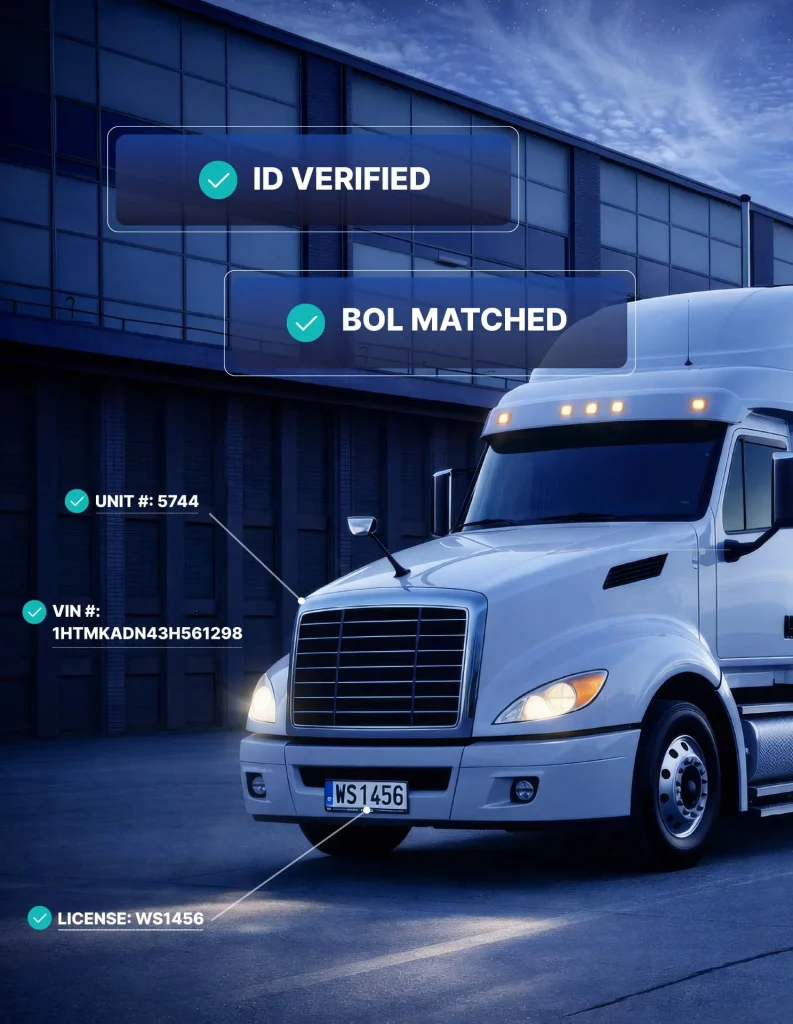
A routine truck visit can involve a series of repeated questions: driver identity, carrier, appointment, truck, trailer, load reference, and required documents. Collecting the same information manually from every driver takes time even when there is nothing unusual about the visit.
An automated check-in can capture and compare relevant data in a consistent sequence, according to the site’s rules. Drivers receive instructions appropriate to their transaction rather than waiting for a person to reconstruct what is already known. Digital records can also reduce duplicate entry into disconnected systems.
The key is to simplify the driver experience as well as the operator experience. Test the actual kiosk or communication process with first-time visitors, different languages where relevant, and drivers who need assistance. A workflow that is efficient for experienced users but confusing for everyone else will create a new source of delay.
2. Identify Exceptions Without Stopping Every Truck
Some arrivals require additional attention. An appointment may have changed, equipment may have been substituted, or shipment information may not match. The correct response is not to relax access controls just because the queue is growing.
A human-backed workflow can help distinguish routine transactions from cases that require review. Trained remote agents can handle appropriate discrepancies under the facility’s rules, while unresolved authorization issues remain on hold or are referred to the designated decision-maker.
Measure exception time separately from routine processing time. Otherwise a small number of complex cases can distort the average and make it difficult to determine whether the automated workflow is working well. See why human-backed gate automation matters for more on the balance between throughput and judgment.
3. Connect Arrival Data With Dock Planning
Knowing that a driver is scheduled is different from knowing that the driver has actually arrived. When receiving staff have no reliable arrival information, the facility may discover that a truck is waiting only after a phone call or a walk to the gate.
A verified arrival event can give downstream systems better context for dock allocation, staffing, and appointment adjustments. This requires an agreed integration and clear responsibilities. The gate should not independently assign a dock unless that is part of the approved workflow and the relevant system has confirmed availability.
Start with a small set of high-value events, such as verified arrival and completed departure. Once those records are reliable, evaluate whether additional statuses will improve decisions. More data is not automatically better; the best information is the information someone can act on.
4. Give Drivers Clear, Consistent Instructions
A driver who enters the correct facility but cannot find the correct staging location can create avoidable movement and calls to the receiving office. Conflicting instructions from different shifts can also increase congestion and safety risk.
Use clear site instructions, appropriate signage, and defined communication channels. Ensure routing reflects the current operational plan and that a driver can request help if instructions are unclear. Avoid encouraging drivers to interact with devices while moving.
Consistent communication is particularly important for facilities with multiple customers, seasonal peaks, or changing traffic patterns. A driver should not need to understand the facility’s internal organization to complete a normal visit safely.
5. Make Checkout as Predictable as Check-In
Many facilities focus on arrival while overlooking departure. A driver who has finished loading can still wait for documents, seal confirmation, release authorization, or access processing at the outbound gate.
Separate the completion of warehouse work from authorization to depart. Record when both happen, and identify which team owns any unresolved issue. A well-defined outbound workflow can reduce repeat conversations and make it easier to determine whether the remaining delay is operational or related to verification.
The goal is not to accelerate the release of freight without authorization. It is to remove unnecessary repetition after all requirements have been satisfied.
Why Detention Also Matters for Safety and Driver Hours
Waiting at customer facilities can disrupt the driver’s schedule. In the United States, the FMCSA hours-of-service summary describes the general 14-hour driving window and applicable limits for property-carrying commercial drivers, subject to exceptions and specific rules. Facility delays can consume time within a driver’s available working window, even when the truck is stationary.
ATRI’s research also identified an association between detention and higher driving speeds. That does not mean every delayed driver will behave unsafely, but it reinforces the importance of predictable appointments and realistic schedules.
Facilities should avoid measuring gate speed in a way that rewards unsafe driving or incomplete checks. A safe, documented transaction is more valuable than an artificially fast one. Any time savings should come from reducing repetitive work and unnecessary waiting, not pressuring drivers or staff to rush.
For a procurement perspective, see our gate automation vendor buyer’s guide for questions that help establish a credible performance baseline.
How to Calculate the Financial Opportunity
Consider an illustrative distribution center that handles 180 truck visits per day, operates 250 days per year, and reduces average combined gate processing time by four minutes per visit.
| Input | Illustrative value |
|---|---|
| Daily visits | 180 |
| Annual operating days | 250 |
| Time saved per visit | 4 minutes |
| Annual visits | 45,000 |
| Aggregate truck time saved | 3,000 hours |
| Assumed value per truck hour | $75 |
| Gross time-value opportunity | $225,000 |
This is a planning scenario, not a Birdseye customer result or guaranteed cash saving. The 3,000 hours represent aggregate vehicle time. They do not automatically become 3,000 fewer paid staff hours, and the assumed $75 rate may not reflect the facility’s contracts. Only eligible detention avoided, staffing changes actually achieved, and documented operational benefits should be counted as realized savings.
Finance teams should compare that opportunity against implementation, ongoing service, integrations, maintenance, and any residual local staffing requirements. Avoid counting the same minutes twice as both labor savings and carrier savings unless the two benefits are separately evidenced.
KPIs That Show Whether Detention Is Improving
Use a consistent measurement period before and after deployment. Compare like-for-like shifts, volume, transaction categories, and seasonal conditions. An average can hide a serious queue during a narrow peak period.
| KPI | Why it matters |
|---|---|
| Median gate processing time | Shows the typical transaction experience |
| 90th percentile processing time | Reveals longer delays hidden by the average |
| Queue time by arrival window | Identifies peak-period congestion |
| Exception rate and resolution time | Separates normal work from difficult cases |
| Total visit duration by transaction type | Shows whether the overall visit improves |
| Detention invoice value and frequency | Links operations to verified financial impact |
Review these alongside the security KPIs for logistics facilities so improvements in speed do not conceal deterioration in verification, record quality, or safety.
A Practical 30-Day Detention Improvement Plan
In week one, agree on the definitions of arrival, processing, admission, service completion, release, and departure. Collect an initial sample across different shifts and confirm which timestamps are trustworthy.
In week two, review the most frequent causes of avoidable waiting with gate staff, receiving, dispatch, and warehouse leadership. Separate process defects from capacity constraints. Assign each issue an owner rather than treating every problem as a security responsibility.
In week three, test a revised workflow on a representative group of routine visits. Observe how unusual cases are handled, and compare results with the baseline. Obtain driver feedback to identify confusing instructions or redundant questions.
In week four, review the measured changes in gate time, total visit duration, exception outcomes, and actual costs. Decide whether to expand the approach, revise integration requirements, or address another bottleneck first. A controlled rollout produces better evidence than a company-wide promise of instant savings.
How Birdseye Helps Reduce Gate-Related Waiting
GATECORE combines automated gate verification and digital transaction records with trained remote support for exceptions. The Portal brings facility events into a shared operational view. Together with agreed integrations, these capabilities can reduce repetitive processing and give teams better visibility into truck activity. Results depend on each facility’s workflow and constraints.
Frequently Asked Questions
What is the difference between truck detention and dwell time?
Dwell time measures how long a truck or trailer remains at a defined location. Detention generally refers to waiting beyond a contractual allowance. Not all dwell time is billable detention.
Can automated gates eliminate detention charges?
No. Automated gates can reduce delays attributable to gate processing and improve timestamp evidence. Dock availability, warehouse readiness, carrier agreements, and other constraints still affect detention charges.
How can a warehouse identify its biggest cause of truck waiting?
Capture timestamps throughout the truck visit and group delays by stage and cause. Compare routine visits with exceptions, and review peak arrival periods separately from average traffic.
Is a faster gate less secure?
Not necessarily. A structured process can reduce repetitive manual work while retaining mandatory verification. Exceptions still need controlled review, and safety and security outcomes must be measured alongside speed.
What should a CFO measure before investing in gate automation?
Measure current staffing and service costs, eligible detention invoices, truck volumes, avoidable processing time, implementation expense, and recurring fees. Use actual financial benefits rather than treating all time saved as cash savings.