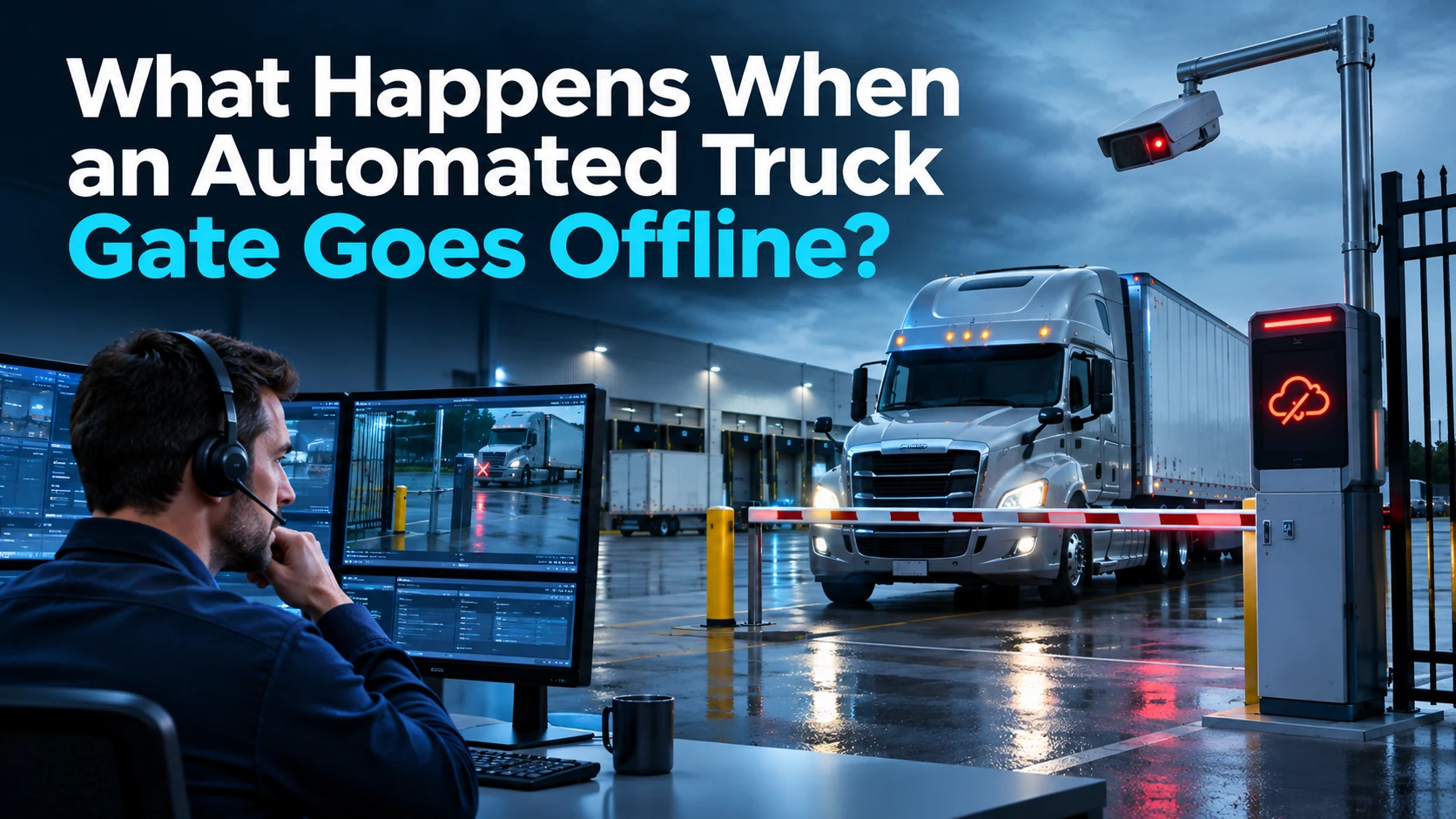
An automated truck gate is part of an operating facility, not simply a software application. It connects physical equipment, communications, identity and shipment records, and the people responsible for making access decisions. When one of those dependencies becomes unavailable, the facility still needs to protect its people, property, and freight.
When an automated truck gate goes offline, it should enter a predefined safe operating state, notify the appropriate support personnel, and use an authorized continuity process until normal service is restored. Whether limited gate operations can continue depends on the available equipment, power, communications, and verified data. A remote agent can help resolve certain interruptions, but cannot substitute for missing physical safety controls or unavailable information.
The question for a buyer is not whether a system can promise uninterrupted operation. It is whether the vendor and facility have designed a reliable response when interruptions occur.
What Does It Mean for an Automated Gate to Go Offline?
The term offline can describe several different conditions. The gate controller may be functioning while an external appointment system is unavailable. A camera may fail while the barrier remains operational. A network connection may be interrupted while power and local safety equipment remain available. A complete outage is different from any of these partial disruptions.
A meaningful continuity plan separates the affected components and defines which capabilities remain available. It also identifies the conditions in which operations must be restricted or suspended. Treating every fault as identical can create unnecessary downtime or unsafe assumptions.
| Interruption | Potential impact | What a continuity plan should address |
|---|---|---|
| Connectivity disruption | Loss of access to remote services or current data | Approved alternate communications and authorization rules |
| External integration outage | Shipment or appointment data cannot be confirmed | Data validity, ownership and authorized review |
| Camera or kiosk fault | Reduced ability to capture or communicate information | Equipment health, service support and permitted alternatives |
| Power interruption | Equipment may stop operating | Approved backup power, safety and recovery procedures |
| Mechanical fault | Barrier movement or lane availability affected | Qualified maintenance and safe traffic management |
| Application service outage | Workflow or record processing interrupted | Incident response, continuity and data reconciliation |
Each scenario requires a site-specific response. A software workaround is not an acceptable substitute for a functioning safety device.
Why Reliability Matters More Than a Perfect Demonstration
A demonstration usually takes place in a controlled environment with clean identifiers, available systems, and predictable vehicles. A working industrial facility has weather, changing traffic patterns, maintenance windows, equipment wear, and third-party software dependencies.
A breakdown can have consequences beyond the gate itself. Trucks may accumulate, a warehouse may lose reliable arrival information, and people may be asked to perform unfamiliar duties. If the facility responds by discarding verification requirements, an operational interruption can become a security incident.
The NIST Guide to Operational Technology Security explains the importance of designing protections around the reliability, performance, and safety needs of systems that interact with physical processes. An automated truck gate illustrates why these concerns must be considered together. Cybersecurity, physical safety, and business continuity are not independent purchasing decisions.
Availability Is Not the Same as Resilience
Availability describes whether a defined service is usable during a specified time. Resilience describes the ability to withstand disruption, adapt safely, and recover. A system can have a high availability figure and still be poorly prepared for a particular dependency failure.
For example, a vendor might report application uptime while a customer’s individual gate has an equipment problem. Both figures can be technically correct, but only the second tells the facility whether the lane can process a transaction. Ask for definitions before comparing statistics.
Availability should distinguish the core platform, the site equipment, the integrations, and the end-to-end gate workflow. It should also identify exclusions, such as planned maintenance or customer-provided network issues. A service agreement must establish which party owns each component and how issues are communicated.
A useful reliability commitment describes the service the customer actually depends on. It does not hide every operational interruption behind a single platform percentage.
Design for a Safe State First
Gate continuity must begin with physical safety and lawful access. There is no universal rule that every barrier should remain open or closed during every outage. Emergency access, egress, fire requirements, equipment design, traffic management, and site security all influence the appropriate response.
The facility should involve its equipment supplier, safety personnel, and relevant authorities where necessary when establishing its approved operating states. Drivers and employees must know how to obtain assistance and where to wait safely if a lane is unavailable.
A decision to suspend a transaction is not necessarily a failure of the security system. Sometimes it is the correct result when the system cannot establish authorization. Restoring movement should never take priority over protecting people or releasing freight only to the correct party.
Connectivity and Power Are Part of the Gate Design
Many gate automation projects focus on cameras and software while treating connectivity and power as background utilities. At an industrial site, those utilities are part of the service. The environment, distance from buildings, local coverage, and installation constraints can affect the options available.
During planning, establish who provides the network, who monitors its health, and who is responsible for restoration. Ask the vendor what happens to essential functions during a communications interruption and whether any alternate connectivity or backup power options are appropriate for that site. Do not assume every deployment includes the same features.
Backup resources also require maintenance and testing. A component that has never been checked under representative conditions should not be treated as a proven continuity capability. Schedule approved tests with the relevant operators and confirm that all required safety controls remain functional.
What Happens When an Integration Is Unavailable?
A functioning barrier and camera do not necessarily mean a truck transaction can be safely completed. If a transportation management system cannot confirm the current appointment or authorization, a local gate application may have incomplete information.
Define which data must be current before an access or release decision can proceed. Determine who owns the authoritative record and who can approve a correction. An unavailable system should be represented as unavailable rather than interpreted as proof that no problem exists.
When approved continuity procedures permit an alternative review, the decision and evidence should be documented. Transactions that cannot be verified should remain restricted until the required authorization is established. Read more about gate exception management for the distinction between a discrepancy and a valid resolution.
Human Backup Is a Resilience Layer, Not a Universal Workaround
A human-backed gate model is useful when the equipment and communications needed for a transaction remain available but the standard automated workflow cannot resolve a question. A trained remote agent can review an exception, communicate with the driver, and apply the agreed facility rules.
That does not mean an agent can operate a physically failed barrier, access an unavailable data source, or ignore a required safety interlock. Human support has technical and authorization limits, just as automation does. A credible continuity plan acknowledges those limits.
A buyer should ask the provider to explain which operational responsibilities it retains when an interruption occurs and which responsibilities belong to local staff, maintenance contractors, or the customer’s system owners. The objective is to avoid discovering those boundaries during a live incident.
Birdseye’s article on human-backed gate automation explains why routine automation and trained human judgment are complementary rather than competing approaches.
Communicate With Drivers and Operations Teams
A stalled lane is both an access issue and a traffic management issue. Drivers need clear information about the status of their visit and the next authorized step. Warehouse and dispatch personnel need to know whether arrivals or departures are affected. Uncertainty can create additional calls, conflicting instructions, and unsafe movement.
Assign responsibility for communicating with each group. Ensure messages are concise, accessible, and consistent with the facility’s traffic plan. Use established channels rather than creating informal instructions that are difficult to verify later.
If traffic needs to be held or redirected, the facility must use its approved safety and emergency procedures. Remote personnel cannot physically manage every situation, so the site’s local response responsibilities should be defined in advance.
Recovery Is More Than Bringing a System Back Online
A restored connection does not necessarily mean all records are synchronized or all equipment is ready to resume normal service. An interruption may leave transactions in incomplete states, delayed notifications, or discrepancies between systems.
Before returning to normal processing, the responsible parties should confirm equipment readiness, validate current authorization information, and reconcile affected transaction records. Distinguish when an event occurred from when its record reached the destination system. Preserve corrections and relevant decision history rather than silently overwriting information.
This is particularly important for outbound transactions, customer claims, and trailer inventories. A facility may be relying on a digital departure record to determine whether freight remains on site. A missing or duplicated event can therefore affect multiple operational teams.
See Birdseye’s guide to digital gate transaction records for why consistent, searchable evidence matters even after an interruption has ended.
A related consideration is how outages propagate across gate automation integrations, particularly when the gate depends on third-party authorization data.
Measure Reliability With Operational KPIs
A useful reliability dashboard combines technical health with operational outcomes. The technology team needs to know which component became unavailable. The operations team needs to know which visits were affected and whether security requirements remained intact.
| Metric | Definition or question |
|---|---|
| End-to-end availability | Share of agreed service time in which the required workflow was usable |
| Detection time | How quickly the responsible team learned of an interruption |
| Recovery time | Elapsed time until defined normal service was restored |
| Affected transactions | Number of visits delayed, restricted or otherwise affected |
| Record reconciliation | Whether affected events were accounted for after recovery |
| Repeat incidents | Whether the same underlying cause keeps returning |
Define the measurement boundary and denominator before using percentages. Compare planned maintenance separately from unplanned disruption where appropriate. An incident that affects a high-volume lane at peak time may have greater business consequences than a longer interruption during a scheduled closure.
Use the security KPIs for logistics facilities alongside reliability reporting to preserve a balanced view of performance.
Model the Cost of Downtime Without Inventing Savings
Suppose a lane interruption delays 30 trucks by an average of 20 minutes. That represents 10 aggregate truck-hours of additional waiting. If a finance team uses an illustrative truck-hour value of $80, the time-value exposure is $800. This is not necessarily a billable cost, and it excludes the potential impact of missed appointments, staff reassignment, or disrupted warehouse operations.
The example helps explain why measuring only the cost of replacing failed equipment understates the business issue. A reliable gate affects the flow of the entire facility. Conversely, a costly redundancy feature may not be justified for every site if the risk and impact are low. Buyers should evaluate their own volumes, service commitments, and operational dependencies.
How to Test a Gate Continuity Plan
Before deployment, agree on a test plan with the vendor, IT team, local operations, and safety leadership. Use controlled simulations rather than deliberately disrupting a live lane. Establish what constitutes a successful test, who is authorized to participate, and how the results will be recorded.
Include representative partial failures, communication issues, and recovery scenarios. Verify that the expected alerts reach the correct people, that permitted workflows remain within their authorization boundaries, and that affected records are correctly reconciled. Review how staff and drivers receive instructions.
Repeat the exercise after meaningful equipment, software, or process changes. A continuity plan is not a one-time installation document. It is an operating capability that needs owners, maintenance, and evidence.
How Birdseye Approaches Gate Reliability
GATECORE combines automated verification with trained remote support for exceptions. Birdseye evaluates deployment requirements, including equipment and connectivity, as part of the site-specific solution. The Portal provides a shared view of facility activity. Specific redundancy options, support commitments, continuity arrangements, and recovery capabilities should be confirmed during project scoping.
Frequently Asked Questions
Can an automated truck gate work without internet access?
It depends on the architecture, available local equipment, current authorization data, and approved continuity rules. Some functions may remain available while others must be restricted. Confirm the actual deployment capabilities with the provider.
Can remote agents resolve a gate outage?
Remote agents can help with certain workflow or verification exceptions if the required information and communication tools are available. Physical equipment faults and unavailable safety controls require appropriate local or technical response.
Should an automated gate open automatically when power fails?
There is no universal answer. The appropriate state must be determined by the equipment design, emergency access requirements, applicable safety rules, and the facility’s approved operating plan.
What is the difference between uptime and recovery time?
Uptime measures availability over an agreed period. Recovery time measures how long it takes to restore a defined service following a disruption. Both need clear definitions and measurement boundaries.
How can a facility evaluate gate automation reliability before purchase?
Request documented service responsibilities, availability definitions, maintenance arrangements, support commitments, approved continuity procedures, and a controlled acceptance test. Evaluate the end-to-end workflow, not only software uptime.